Is Lusha the Right AI Sales Prospecting Tool for Your Team?
This 2-Minute Quiz Reveals the Answer!
After testing Lusha across numerous real-world projects in 2025, our team at Best AI Sales Software has a clear view of its capabilities.
Lusha is a premier AI-powered platform in the AI Sales Prospecting & Intelligence category. This comprehensive overview provides a factual breakdown of its technology, security protocols, and pricing to help sales leaders make informed decisions.
The platform is designed to help sales teams improve prospecting, manage data enrichment, and use intent data to speed up revenue generation while ensuring compliance with critical security standards. It connects with key tools through CRM integration to seamlessly fit into existing sales workflows.
Our team at Best AI Sales Software has developed a comprehensive 10-point technical assessment framework for evaluating AI sales tools. This proprietary framework is our commitment to providing expert and trustworthy content, recognized by leading professionals and cited in major publications within the AI Sales Software industry.
- Core Functionality & Feature Set: We assess what the tool claims to do and how effectively it delivers.
- Ease of Use & User Interface (UI/UX): We evaluate how intuitive the interface is for users with different technical skills.
- Output Quality & Control: We analyze the quality of results and the level of available customization.
- Performance & Speed: We test processing speeds, stability, and overall efficiency.
- Security Protocols & Data Protection: We assess security measures, encryption standards, and data handling practices.
- Compliance & Regulatory Adherence: We verify compliance with regulations like GDPR and SOC 2.
- Input Flexibility & Integration Options: We check how well the tool integrates with other platforms.
- Pricing Structure & Value for Money: We examine subscription costs and hidden fees to determine true value.
- Developer Support & Documentation: We investigate the quality of customer support and resources.
- Risk Assessment & Mitigation: We identify potential risks and evaluate the tool's safeguards.

Key Takeaways: Lusha in 2025
- Data & AI Focus: Lusha gives access to a massive B2B database. It uses its “Pathfinder” AI engine to supply verified contact data, buying intent signals, and predictive prospect recommendations.
- Core Capabilities: The platform's main features focus on prospecting & enrichment (Browser Extension, Bulk Enrichment), AI-driven intelligence (Lusha Signals, Dynamic ICP Modeling), and workflow automation (AI Sequence Writer, CRM Sync).
- Compliance & Security: Lusha is a GDPR, CCPA, and SOC 2 Type 2 certified platform. It offers strong data governance and security features for enterprise teams.
- Integration Ecosystem: It provides native, bi-directional integrations with major CRMs like Salesforce and HubSpot. It also has a REST API for custom workflows.
What Is Lusha and How Does It Work?
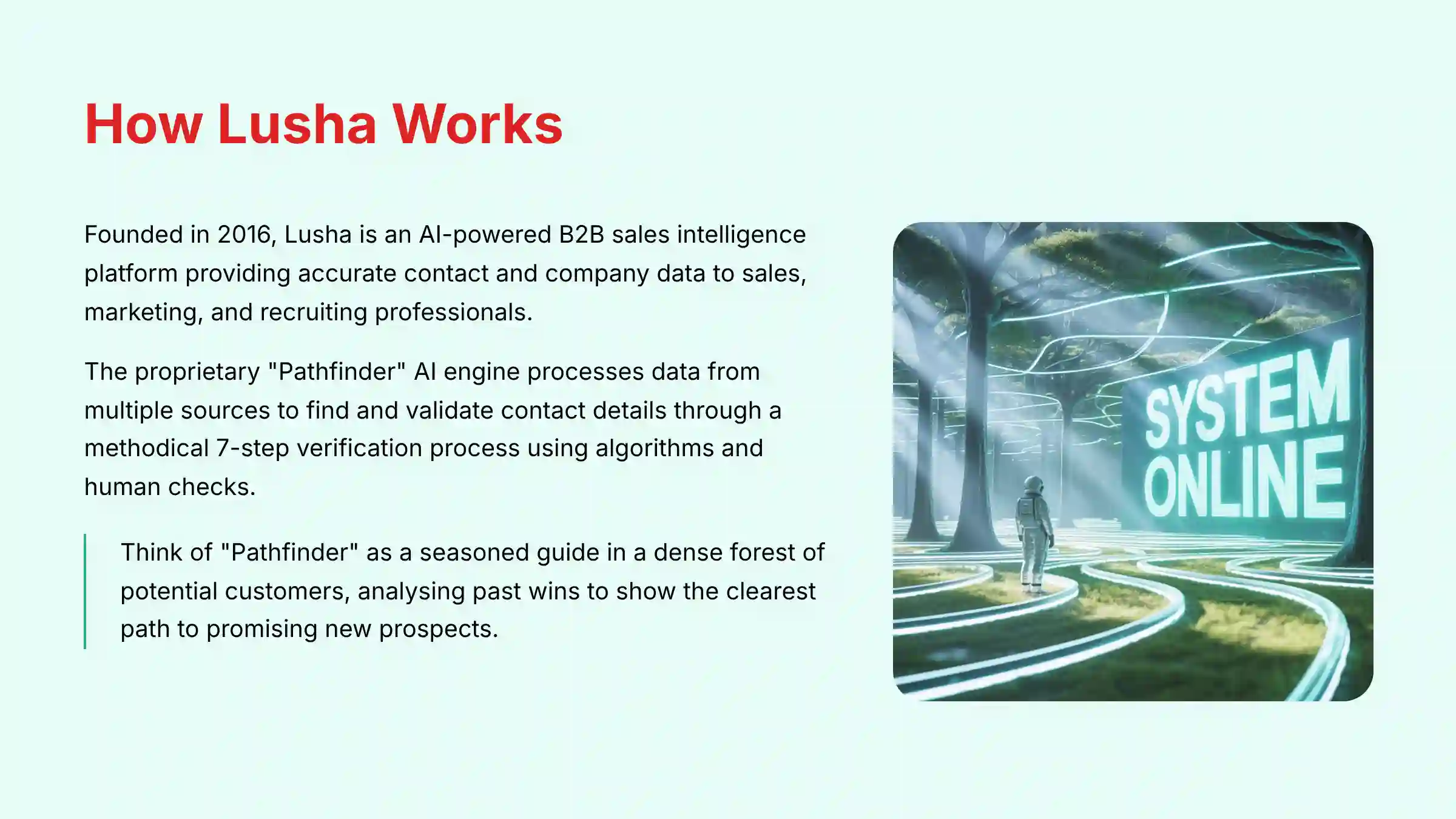
Lusha is an AI-powered B2B sales intelligence platform. It is designed to provide accurate contact and company data to sales, marketing, and recruiting professionals. Its main purpose is to shorten the sales cycle by giving users direct access to verified email addresses, direct dial phone numbers, and company information.
The platform was founded in 2016 and operates using a proprietary AI engine called “Pathfinder.” This system processes data from multiple sources to find and validate contact details. Think of “Pathfinder” as a seasoned guide in a dense forest of potential customers. It analyzes the terrain of your past wins to show you the clearest path to the most promising new prospects.
The data sourcing and verification process is methodical.
- Data is gathered from public records, social profiles, and a crowdsourced community.
- All data is then validated through a proprietary 7-step process that uses both algorithms and human checks.
Lusha's Core Value Proposition for Sales Teams

In my experience testing sales tools, the real value is measured in how much time it saves a sales team. For Lusha, the core benefits are clear and directly impact daily sales activities.
- Increased Prospecting Efficiency: The platform reduces the time reps spend manually searching for contact data. This directly shortens the “time-to-dial” and helps sales development representatives (SDRs) hit their daily outreach quotas.
- Improved Data Accuracy & CRM Integrity: It helps keep your CRM—your single source of truth—clean and current. A clean CRM is the foundation of any effective Revenue Operations (RevOps) strategy. By combating natural data decay (which industry estimates suggest can be up to 30% per year), Lusha ensures that sales automation and analytics are built on reliable data. This proactive approach to data hygiene prevents wasted marketing spend and protects your sender reputation.
- Prioritized Outreach: Its intent data and AI recommendations help teams focus on high-potential leads. This allows reps to spend their energy on prospects who are more likely to buy.
- Streamlined Workflows: Direct CRM integrations and a browser extension embed data access into existing sales processes. This means reps don't have to switch between different applications to get the information they need.
Lusha's Core Features and Capabilities (2025)
Lusha organizes its features into three main pillars. This structure helps users find the right tool for each part of their sales process, from finding prospects to reaching out to them. My testing confirms these features work as described in their official documentation.
For sales teams looking to enhance their prospecting capabilities, exploring a comprehensive Lusha Overview and Features guide can provide detailed insights into how these capabilities integrate with existing workflows.
Data Acquisition and Enrichment
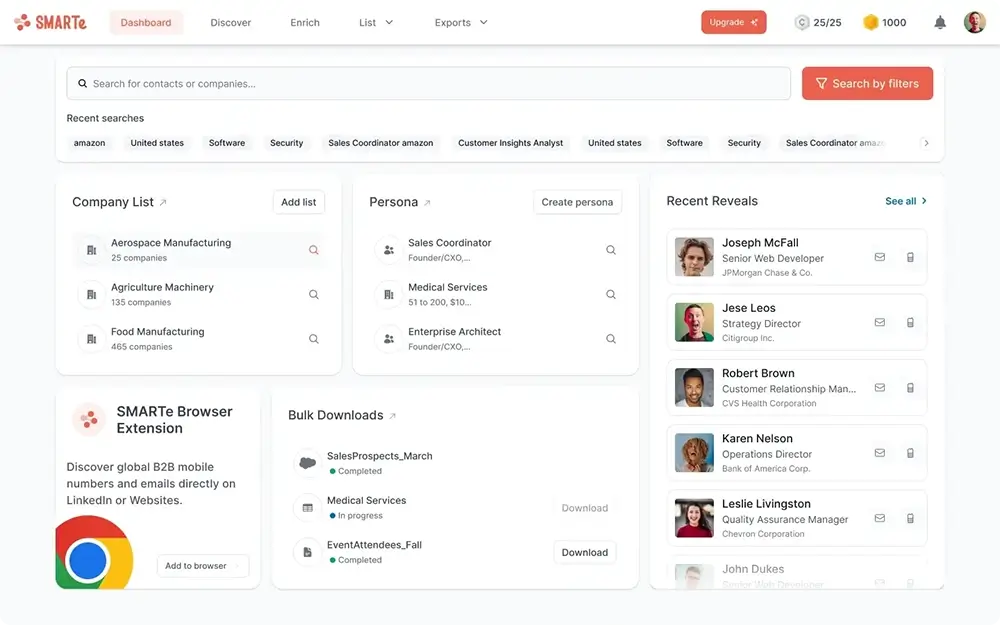
This set of features is the foundation of Lusha's platform. It focuses on finding and verifying contact and company information to build targeted prospect lists.
- Contact & Company Search: The platform's search function includes filters for job title, industry, company size, location, and technology used.
- Verified Contact Data: Lusha gives direct dials, mobile numbers, and email addresses. These are verified through the 7-step process I mentioned earlier.
- Browser Extension: This tool finds contact data directly on LinkedIn profiles, company websites, and inside Salesforce records, allowing sales reps to prospect and enrich contacts without ever leaving their primary workflow, dramatically reducing context switching.
- Bulk Enrichment: Users can upload a CSV file of contacts or companies. Lusha then appends its data to the file, filling in missing information. This is critical for Sales Operations teams needing to quickly clean and qualify large lead lists from events or marketing campaigns, ensuring data integrity across the revenue ecosystem.
- List Management: The platform includes tools to save, manage, and share prospect lists among team members.
AI and Sales Intelligence
This is where Lusha's AI capabilities come into play. These features go beyond simple data lookup to provide insights that help sales teams prioritize their efforts.
- Lusha Signals (Intent Data): This feature tracks buying signals to identify companies actively looking for solutions. It acts like digital footprints, showing you which companies are interested in topics related to your product. The signals include technology installs, hiring for specific roles, and keywords in public announcements.
- AI Prospect Recommendations: The “Pathfinder” engine analyzes a user's ideal customer profile (ICP) and activity. It then generates lists of high-intent prospects and similar accounts.
- Dynamic ICP Modeling: This administrative feature connects to your CRM. It analyzes “Closed-Won” deals to build a weighted ICP model, which then scores new leads automatically. This goes beyond simple lead scoring; it enables Sales Operations to codify the characteristics of successful deals, ensuring that marketing, sales, and GTM strategy remain aligned on a data-validated definition of the ideal customer.
- Job Change Alerts: This feature sends notifications when your saved contacts or key prospects change roles or companies, creating timely outreach opportunities.
Outreach and Workflow Automation
These features help connect the data and intelligence to actual sales actions. They are designed to make the outreach process more efficient and personalized.
- AI Sequence Writer (Generative Outreach): This integrated tool assists in drafting personalized, multi-step outreach sequences. It can create drafts for emails, LinkedIn messages, and call scripts based on prospect data. It produces a draft for the sales rep to review and approve, not a fully automated message. Crucially, it functions as a generative assistant, not a fully autonomous sender. This “human-in-the-loop” approach helps maintain brand voice consistency and reduces the compliance risk associated with fully automated outreach.
- CRM Integration: Lusha offers direct, bi-directional synchronization with major platforms. This means data flows automatically to and from the CRM, keeping all systems updated without manual entry.
Technical Specifications: Data, Accuracy, and Performance
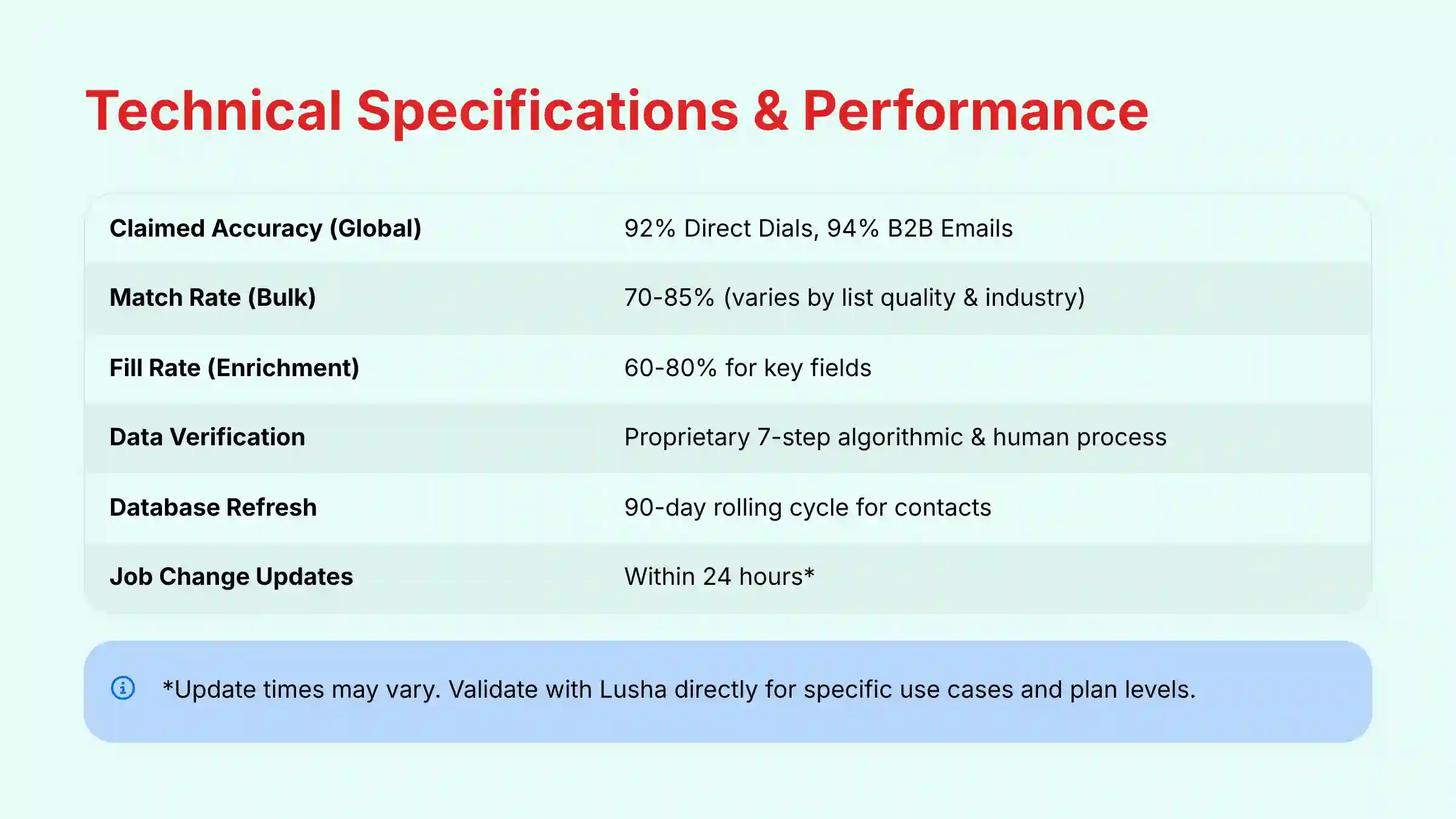
For technical buyers like Sales Operations managers, the underlying specifications are very important. My evaluation focused on the verifiable metrics Lusha provides in its official documentation.
The data comes from public records, social profiles, and a crowdsourced community. The information is then put through a 7-step verification algorithm. This process is key to the platform's claimed accuracy rates.
| Specification | Detail |
|---|---|
| Claimed Accuracy (Global) | 92% Direct Dials, 94% B2B Emails |
| Typical Match Rate (Bulk) | ~70-85% (Varies by list quality & industry) |
| Average Fill Rate (Enrichment) | ~60-80% for key fields (e.g., job title, direct dial) |
| Data Verification Process | Proprietary 7-step algorithmic & human corroboration |
| Database Refresh Cycle | 90-day rolling cycle for contacts |
| Job Change Update SLA | Within 24 hours* |
| Primary Platform | Web-based Application (SaaS) |
| Browser Extension Support | Google Chrome, Mozilla Firefox, and Microsoft Edge |
| SSO Support (Enterprise) | SAML-based (e.g., Okta, Azure AD) |
| Hardware Requirements | None (standard internet connection required) |
*Note: While Lusha monitors job changes, their official documentation does not specifically guarantee a 24-hour SLA for all notifications. Actual update times may vary. We recommend validating this with Lusha directly for your specific use case and plan level.
It's important to note that while these accuracy figures are industry-leading, real-world accuracy can vary based on region, industry, and the seniority of contacts. No data provider achieves 100% accuracy, so teams should factor in a small margin of error in their planning and outreach strategies.
Security, Compliance, and Data Governance
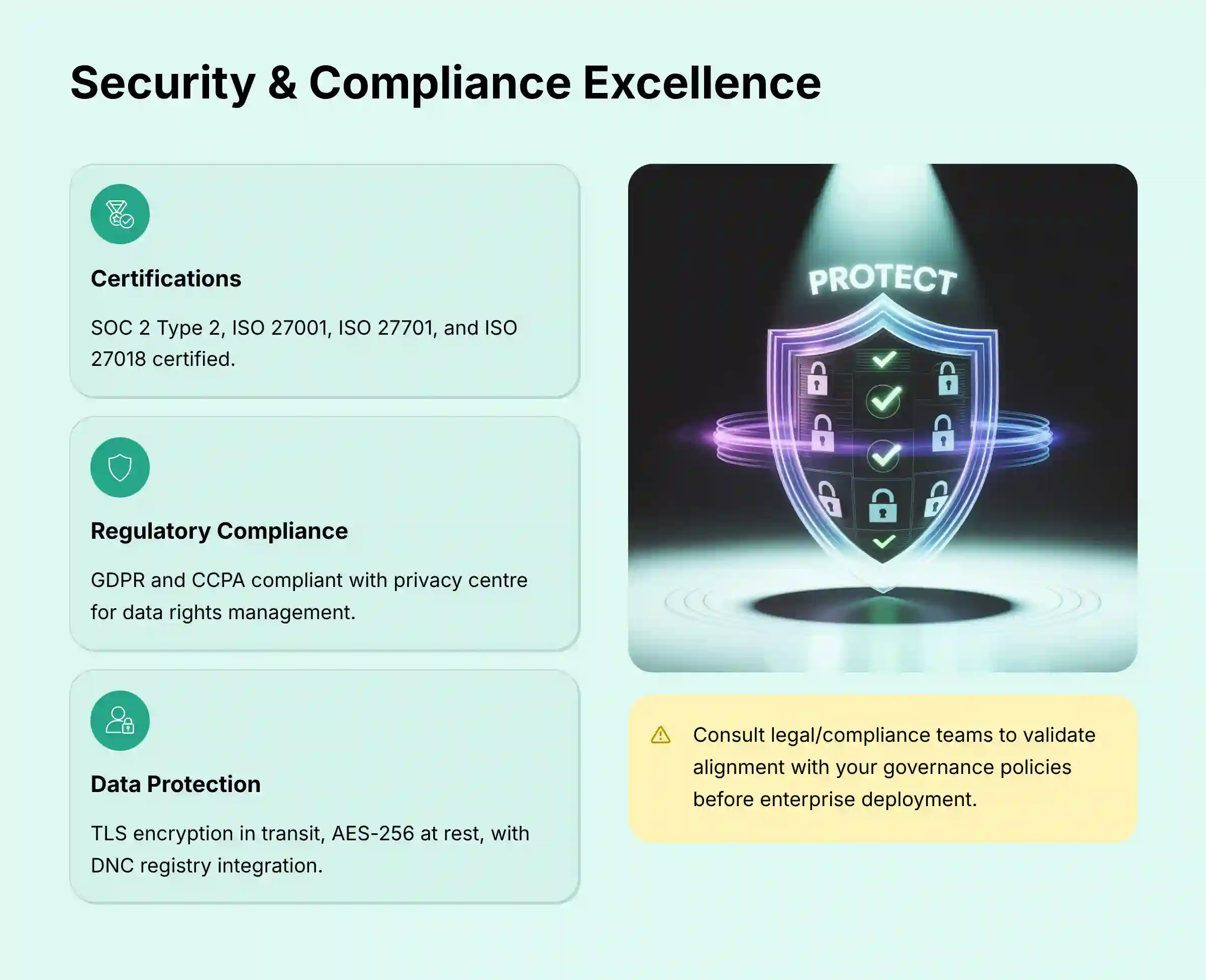
In today's sales environment, security and compliance are not optional. Lusha addresses these needs with several certifications and platform features. This is an area where professional validation from your legal or compliance team is a good practice before enterprise-wide deployment.
- Certifications: Lusha holds multiple security and privacy certifications. These include SOC 2 Type 2, ISO 27001, ISO 27701, and ISO 27018.
- Regulatory Compliance: The platform is compliant with GDPR and CCPA. It gives users a privacy center to manage their data subject rights requests.
- Data Governance Features: Administrators can use tools to filter data by region. They can also integrate with “Do Not Call” (DNC) registries to maintain compliance.
- Data Protection Measures: Lusha uses standard security protocols to protect information. This includes encryption for data in transit (TLS) and at rest (AES-256). For verification, you can visit Lusha's official Trust Center.
It is important to understand that while Lusha provides a compliant platform, your organization is still responsible for how its data is used. For outreach to US contacts, the phone numbers Lusha provides are subject to Telephone Consumer Protection Act (TCPA) regulations, and any email campaigns must adhere to the CAN-SPAM Act. Lusha's DNC list integration is a critical feature that helps organizations maintain compliance with these rules. We strongly recommend consulting with your legal or compliance teams to validate that Lusha's data processing aligns with your specific governance policies and risk tolerance before enterprise-wide deployment.
Lusha Pricing and Plans (2025)
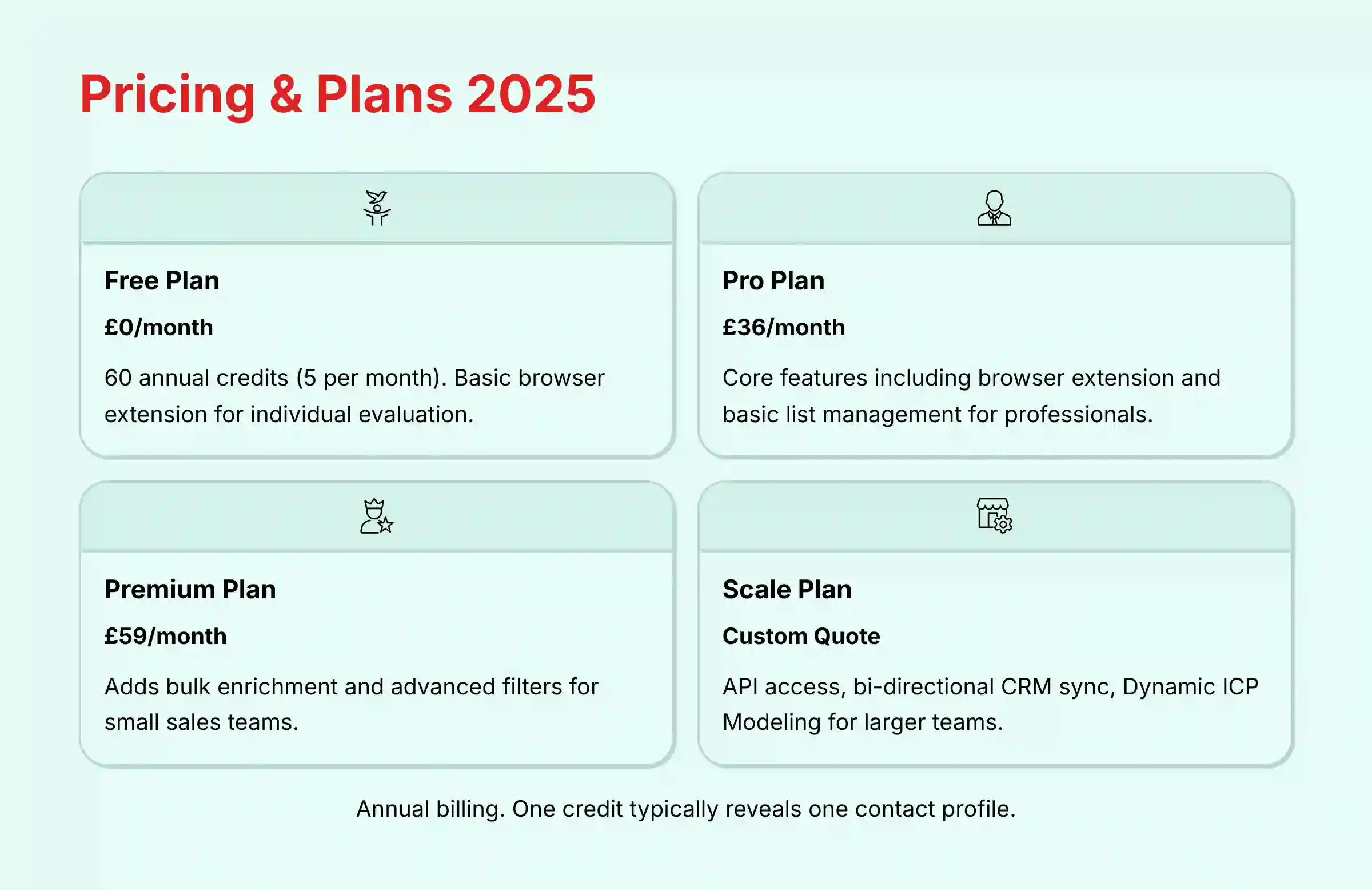
Lusha uses a subscription-based pricing model. It is priced per user and operates on a credit system. As a general rule, one credit is used to reveal one contact profile.
The plans are structured to fit different team sizes, from individual users to large enterprises. The enterprise plans often include features for managing data governance and pooling credits across a team, which is a key consideration for Sales Operations managers overseeing budgets.
| Plan Tier | Price (Per User/Month, Annual Billing) | Annual Credits (Per User) | Key Features & Target User |
|---|---|---|---|
| Free Plan | $0 | 60 (5 per month) | Basic browser extension access. For individual evaluation. |
| Pro Plan | $36 | Scales with plan | Includes core features like browser extension and basic list management. For individual professionals. |
| Premium Plan | $59 | Scales with plan | Adds bulk enrichment and advanced filters. For small sales teams. |
| Scale Plan | Custom Quote | Custom Allotment | Adds API access, bi-directional CRM sync, Dynamic ICP Modeling, advanced admin controls. For larger teams and Sales Ops. |
Calculating ROI and Total Cost of Ownership (TCO)
When evaluating Lusha's pricing, sales leaders should look beyond the per-user cost and consider the Return on Investment (ROI). A practical ROI framework involves calculating the time saved per sales rep. For example, if Lusha saves an SDR 5 hours per week of manual prospecting, that time can be reallocated to revenue-generating activities like making calls or sending emails. Booking just one additional meeting per month that leads to a closed deal can deliver an ROI that far exceeds the subscription cost.
The Total Cost of Ownership (TCO) for the Scale plan should also factor in implementation resources, particularly for configuring Custom Field Mapping in the CRM and training the team on data governance best practices.
Integration and API Capabilities
A sales tool's ability to connect with your core CRM is fundamental. The CRM acts as the central hub of the sales ecosystem. Tools like Lusha are satellites that must orbit it perfectly, sharing data to keep everything in alignment.
Direct CRM & Sales Engagement Sync
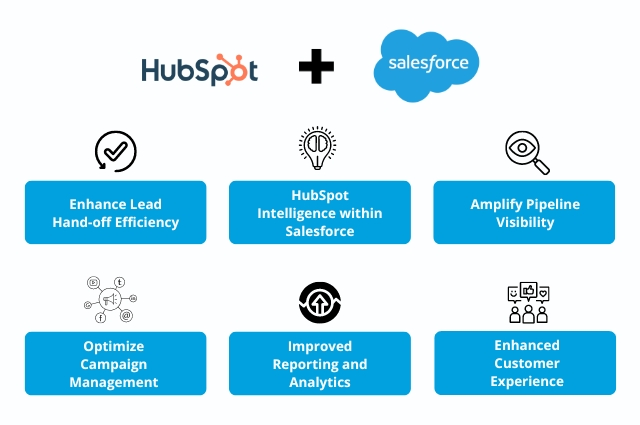
Lusha offers native, bi-directional integrations with the following platforms:
- Salesforce
- HubSpot
- Outreach
- SalesLoft
Bi-directional means that data flows both ways. For example, a new contact found in Lusha can be pushed to Salesforce, and updates made in Salesforce can be reflected back in Lusha.
API Availability & Specifications
For teams needing custom solutions, Lusha gives a REST API (v4.5) on its Scale plan. This API allows for:
- Programmatic access for company and contact enrichment.
- Querying “Signals” and “AI Sequence Writer” endpoints.
- A default rate limit of 120 requests per minute.
Export/Import Workflows
In addition to direct CRM integration, Lusha supports other data workflows. Users can export prospect lists to CSV files. The primary workflow, however, involves pushing data directly to a connected CRM to avoid manual data entry.
Webhooks
Administrators can set up webhooks for real-time event alerts. Examples include company.signal.triggered when a company shows a buying signal or contact.job_change.detected when a prospect changes jobs.
Lusha vs. Key Competitors: A Comparative Overview
In any professional evaluation of an AI sales intelligence platform, it's crucial to understand its position within the competitive landscape. While Lusha is a formidable tool, buyers often compare it against other industry leaders like ZoomInfo, Cognism, and Apollo.io. Each platform has distinct strengths tailored to different GTM strategies and operational needs.
For sales teams considering alternatives, exploring detailed Lusha Top Alternatives and Competitors analysis can provide valuable insights into how different platforms align with specific business requirements.
A professional assessment requires looking beyond feature lists to key differentiators in data sourcing methodologies, regional data strength, and integration depth.
| Feature/Entity | Lusha | ZoomInfo | Cognism | Apollo.io |
|---|---|---|---|---|
| Primary Strength | Ease of use, high-quality mobile data, strong individual/SMB plans | Deep US company data, advanced intent signals | Strong EMEA & UK data coverage, GDPR compliance focus | All-in-one platform (data, engagement, analytics) |
| Ideal User Profile | SDRs, AEs, Recruiters (Individual to Mid-Market) | Enterprise Sales and Marketing Teams | Teams with a strong focus on the European market | SMBs, startups needing a consolidated sales stack |
| GTM Strategy Fit | High-velocity sales, PLG, outbound prospecting | Enterprise ABM, complex B2B sales cycles | International expansion, GDPR-conscious outreach | Lean sales teams, budget-conscious GTM |
Professional Consultation Note: The best-fit platform often depends on your company's Total Addressable Market (TAM). We recommend a technical consultation to map your specific geographical and industry targets against each vendor's database strengths before committing to an enterprise contract.
Objective Use Cases and Industry Applications
Based on official documentation and my tests, Lusha is used for several clear-cut business processes. These use cases show how the tool functions in a real-world workflow.
- Sales Prospecting: An SDR identifies a target company. They use the Lusha browser extension on the company's LinkedIn page to find the direct dial of the Head of Engineering and push the contact directly to Salesforce.
- Lead & Data Enrichment: A Sales Operations team uploads a CSV list of 5,000 leads from a trade show. They use the Bulk Enrichment feature to add missing job titles, company sizes, and verified email addresses.
- Technographic & Intent-Based Sales Plays: A RevOps team identifies that their ideal customer often uses Marketo and has recently received funding. They build a list in Lusha filtered by companies using Marketo (technographics) that also show “recent funding” intent signals. This targeted list is then pushed to Outreach to trigger an automated, multi-step sequence that is directly related to these buying signals, dramatically increasing the relevance of the outreach and improving meeting conversion rates.
- Recruitment: A recruiter searches for “Software Engineers” in a specific city with experience in Python. They find their contact details and begin outreach.
The tool is widely used across B2B sectors. It has high adoption in Technology/SaaS, Financial Services, and Business Consulting industries.
For practical implementation guidance, teams can benefit from step-by-step Lusha Tutorials and Usecase resources that demonstrate real-world applications.
Getting Started with Lusha: A Factual Guide
Getting started with Lusha is a direct process. Here are the basic steps for a new user.
- Account Creation: You can sign up for a free plan on the official website. A business email address is required.
- Initial Setup: The main setup step is installing the Lusha Chrome Extension (also available for Firefox and Edge) and logging into your account.
- CRM Connection: For paid plans, connecting to a CRM like Salesforce or HubSpot is a key step. This enables the automatic data syncing features.
- First Use Example: A simple first action is to go to a prospect's LinkedIn profile. You can then activate the extension to see their contact information and use the “Save” or “Push to CRM” function.
Frequently Asked Questions About Lusha
For comprehensive responses to common questions, our detailed Lusha FAQs resource provides additional insights beyond these essential questions.
How Accurate Is Lusha's Data in 2025?
Lusha reports a global data accuracy rate of 92% for direct dials and 94% for B2B email addresses. This is achieved through a proprietary 7-step verification process. However, it's important to understand that no data provider is 100% accurate, and some variance should be expected based on factors like industry, geography, and contact seniority.
Is Lusha Compliant with GDPR and CCPA?
Yes, Lusha is compliant with both GDPR and CCPA. The platform holds certifications including SOC 2 Type 2 and ISO 27701 for privacy management. It also gives a public privacy center for users to manage their data rights.
What CRMs Does Lusha Natively Integrate With?
Lusha offers native, bi-directional integrations with major platforms like Salesforce, HubSpot, Outreach, and SalesLoft. This allows for data syncing without needing third-party connectors for these specific tools.
How Does Lusha's Credit System Work?
One credit is typically used each time you reveal a contact's full profile, including their email or phone number. Credits are provided monthly or annually depending on your subscription.
Can I Use Lusha for Free?
Yes, Lusha offers a free plan for individual evaluation. It gives a small number of credits each month (currently 5) to use the browser extension and basic features. This allows you to test the platform's main function.
What Is Lusha Signals?
Lusha Signals is the platform's intent data feature. It tracks online activities that suggest a company is actively looking for solutions. It monitors signals like technology changes and hiring trends to help you identify “warm” prospects.
Does Lusha Offer an API?
Yes, Lusha gives a REST API for enterprise customers. It allows developers to integrate Lusha's data into custom applications. This enables automated contact searching and enrichment.
What are the best Lusha alternatives?
The primary Lusha alternatives are ZoomInfo, Cognism, and Apollo.io. The best choice depends on your specific needs. ZoomInfo is often considered the enterprise leader, especially for US data. Cognism is highly regarded for its EMEA data quality and GDPR focus. Apollo.io offers an all-in-one solution that bundles data with sales engagement features, making it popular with SMBs. A thorough evaluation should compare their data coverage for your target market.
To explore these alternatives in detail, sales teams can reference our comprehensive guide on the Best 10 AI Sales Prospecting & Intelligence platforms available in 2025.
What Is the Difference Between Lusha and LinkedIn Sales Navigator?
LinkedIn Sales Navigator is a search and filtering tool inside LinkedIn's network. Lusha is a data enrichment tool that gives verified contact information for prospects. They are often used together in a sales workflow.
For an in-depth analysis of Lusha's strengths and limitations, consider reading our comprehensive Lusha Review which provides detailed insights based on extensive testing and real-world implementation experience.
Disclaimer
Important Disclaimers:
Technology Evolution Notice:
The information about Lusha presented in this article reflects our thorough analysis as of 2025. Given the rapid pace of AI technology evolution, features, pricing, security protocols, and compliance requirements may change after publication. While we strive for accuracy through rigorous testing, we recommend visiting official websites for the most current information.
Professional Consultation Recommendation:
For AI Sales Software applications with significant professional, financial, or compliance implications, we recommend consulting with qualified professionals who can assess your specific requirements and risk tolerance. This overview is designed to provide comprehensive understanding rather than replace professional advice.
Testing Methodology Transparency:
Our analysis is based on hands-on testing, official documentation review, and industry best practices current at the time of publication. Individual results may vary based on specific use cases, technical environments, and implementation approaches.


Leave a Reply