Unsure Which AI Sales Intelligence Tool to Choose?
This 30-Second Quiz Reveals Your Perfect Match!
Welcome to the most comprehensive guide to Lusha's AI sales intelligence platform. Whether you're a sales professional looking to streamline your prospecting process or a business leader evaluating B2B data solutions, this detailed FAQ covers everything you need to know about how Lusha leverages artificial intelligence to transform sales prospecting.
Key Takeaways
- AI-Powered Intelligence: Lusha uses sophisticated algorithms to crawl, validate, and enrich B2B contact data at massive scale, providing direct-dial phone numbers and verified email addresses
- Flexible Credit System: Unlike traditional seat-based licensing, Lusha operates on a credit-based model starting at $29/month with 480 annual credits, making it accessible for SMBs
- GDPR/CCPA Compliant: Lusha maintains full compliance with privacy regulations through legitimate interest legal basis and SOC 2 Type II certification
- Superior Mobile Data: Lusha's primary differentiator is its exceptional quality and quantity of direct-dial mobile numbers, especially strong in North American and European markets
- Seamless Integration: Native CRM integrations with Salesforce, HubSpot, and others plus a powerful LinkedIn browser extension enable efficient workflow automation
What is Lusha and how does it use AI in its platform?

Lusha is an AI-powered sales intelligence and B2B data enrichment platform designed to help sales, marketing, and recruiting professionals find accurate contact and company information. Its primary function is to provide direct-dial phone numbers, verified B2B email addresses, and firmographic data on prospects and companies, reducing the time spent on manual research and enabling sales teams to connect with decision-makers more efficiently.
The “AI” component of Lusha operates in several ways. First, it uses sophisticated algorithms to crawl, aggregate, and validate data from a multitude of sources at a massive scale—a task impossible for humans. These sources include publicly available information, a network of third-party data partners, and Lusha's unique “Community Program.” The AI then cross-references and validates these data points to determine their likely accuracy.
Second, its integration capabilities allow it to fuel other AI-driven sales processes. By automatically enriching lead and contact records in a CRM like Salesforce, Lusha provides clean, accurate data that is essential for effective lead scoring models, AI-powered sales engagement sequences, and reliable sales forecasting. While Lusha itself isn't a generative AI that writes emails, it provides the foundational data intelligence that makes the rest of the AI sales stack work effectively.
For those seeking a comprehensive understanding of Lusha's capabilities, our detailed Lusha Overview and Features guide provides in-depth analysis of how these AI-powered features translate into practical sales results.
Who is the ideal user for Lusha in AI sales software?
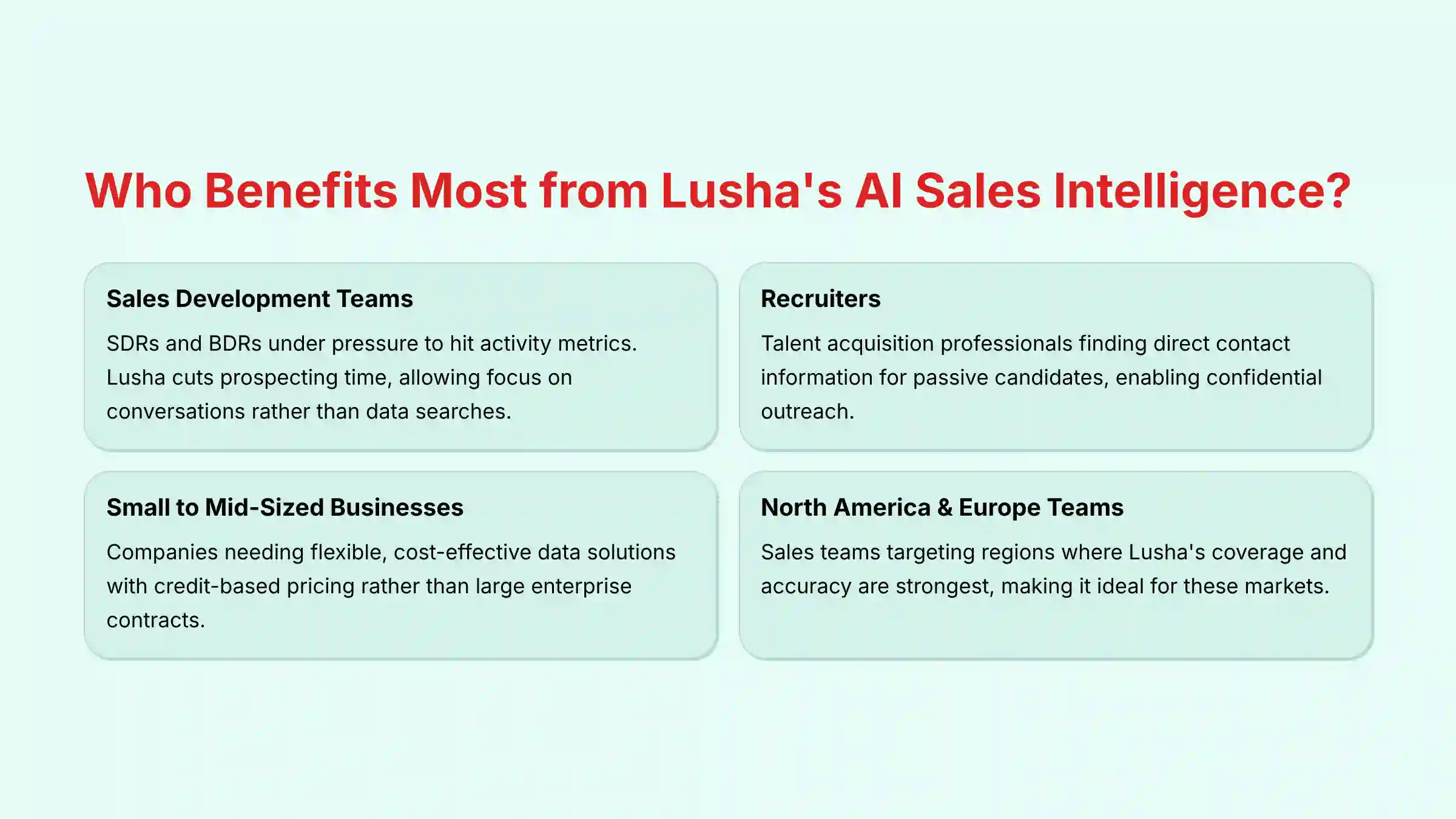
Lusha is ideal for B2B sales development representatives (SDRs), account executives (AEs), sales leaders, and recruiters whose success depends on outbound prospecting and direct outreach. The platform's core value is providing access to high-quality mobile numbers and direct dials, making it particularly powerful for teams that rely on phone calls as a primary channel for booking meetings and engaging prospects.
Specifically, the ideal user profiles include:
- Sales Development Teams: SDRs and BDRs are under pressure to hit high activity metrics and book meetings. Lusha dramatically cuts down prospecting time, allowing them to focus on conversations rather than searching for contact data.
- Recruiters: Talent acquisition professionals use Lusha to find direct contact information for passive candidates who may not be actively searching for jobs, enabling direct and confidential outreach.
- Small to Mid-Sized Businesses (SMBs): Companies that need a flexible, cost-effective data solution often find Lusha's credit-based pricing model more accessible than the large, enterprise-only contracts of some competitors.
- Sales Teams Targeting North America & Europe: While Lusha has global data, its coverage and accuracy are often cited as being strongest in the North American and European markets, making it a prime choice for teams focused on these regions.
Conversely, teams that rely exclusively on email outreach or those requiring deep, intent-based company data might find other platforms to be a better fit. To help you make the right choice, our comprehensive Lusha Review provides detailed analysis of use cases and performance metrics across different team types.
How does Lusha get its data and is it GDPR/CCPA compliant?
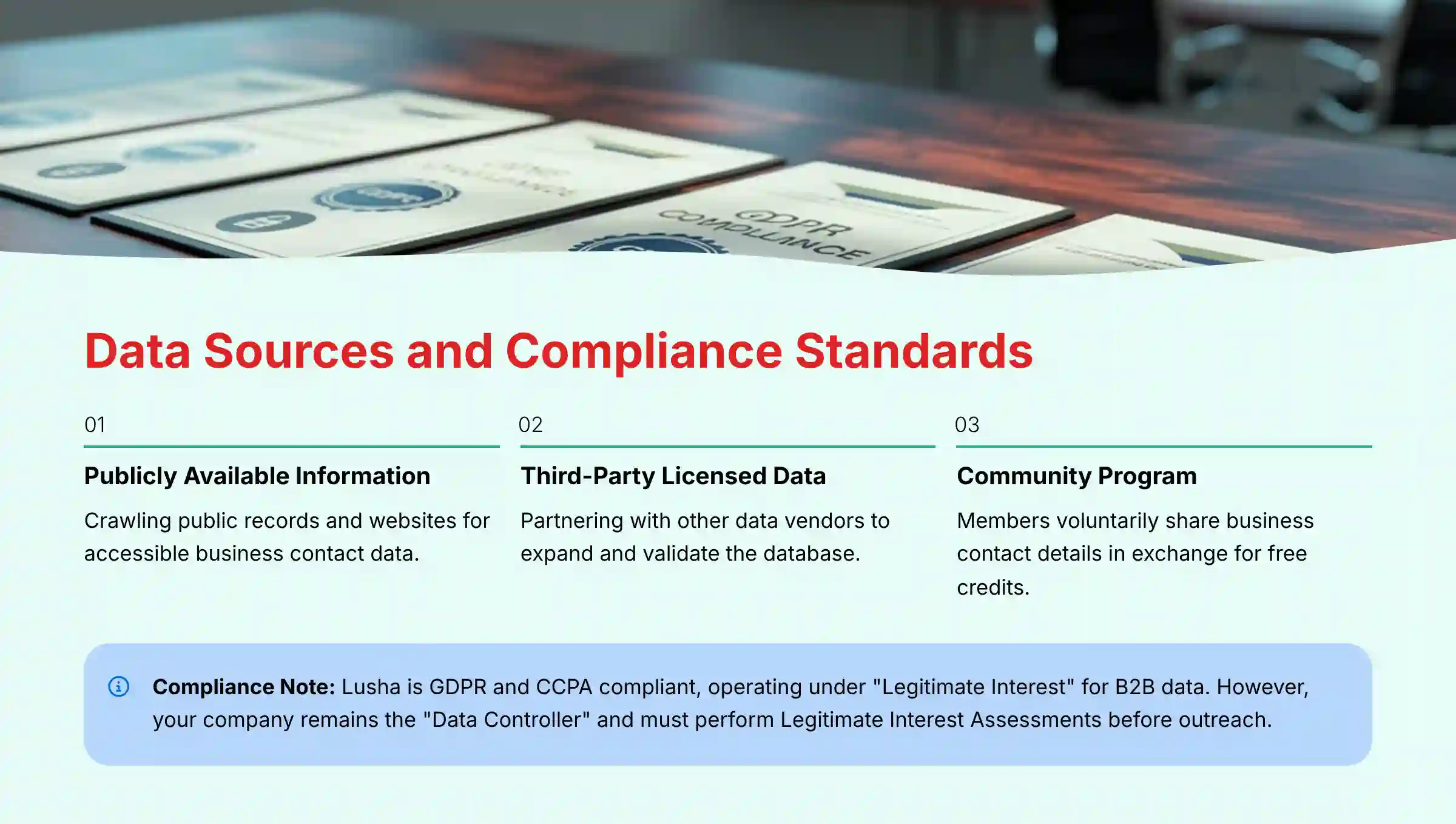
Lusha sources its data through a multi-pronged method, which is crucial to understand for compliance purposes. Their primary sources are:
- Publicly Available Information: They crawl public records and websites
- Third-Party Licensed Data: They partner with other data vendors to expand their database
- The Lusha Community Program: Their most unique and debated source. Members of the Community Program voluntarily agree to share their business contact details in exchange for free credits, which Lusha then uses to validate and expand its database
This crowdsourced model allows them to access data that may not be publicly listed.
Regarding compliance, Lusha states that it is fully compliant with regulations like GDPR (General Data Protection Regulation) and CCPA (California Consumer Privacy Act). They achieve this by focusing on B2B contact information (not private consumer data) and operating under the legal basis of “Legitimate Interest” for processing data. This means they believe the value of their service for B2B commerce outweighs the privacy impact on the individual, provided the individual's rights are protected.
Lusha provides clear mechanisms for individuals to request their data be removed from the platform and honors those requests. The company has also achieved SOC 2 Type II and ISO 27001/27701 certifications, which attest to their security and privacy management systems.
Important Note: A common misconception is that if Lusha is GDPR compliant, then your use of its data is automatically compliant. This is incorrect. Lusha acts as the “Data Processor,” but your company is the “Data Controller.” This means you are still responsible for ensuring you have a “legitimate interest” to contact the person. Before using data from Lusha (or any provider), you should perform a Legitimate Interest Assessment (LIA) to document why you believe the prospect might reasonably expect to hear from you.
How accurate is Lusha's data, and what happens if I get incorrect information?
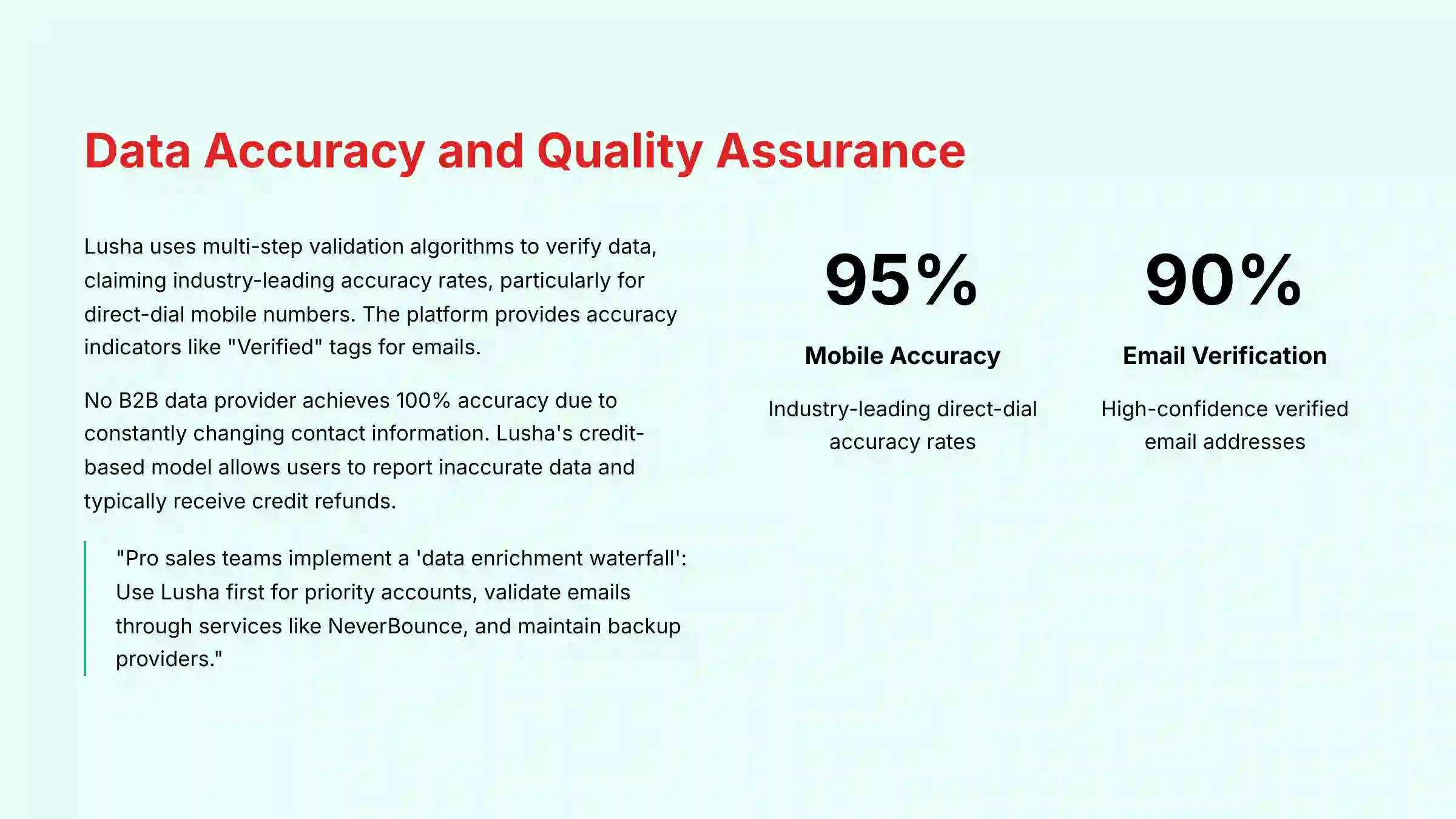
Data accuracy is the cornerstone of any prospecting tool's value, and it's a primary area of focus for Lusha. The platform uses a multi-step validation algorithm to verify its data, and it claims one of the highest accuracy rates in the industry, particularly for direct-dial mobile numbers. However, it's essential to set realistic expectations: no B2B data provider can achieve 100% accuracy. Contact information is constantly changing as people switch jobs, and data can become stale.
Lusha's system typically provides accuracy indicators next to contact details. For emails, you might see a “Verified” tag, indicating a high degree of confidence. In practice, users report that Lusha's mobile phone data is its strongest asset, often providing direct access to decision-makers that other platforms miss. Email accuracy is generally good but, like all providers, can be inconsistent.
To combat the issue of incorrect data, Lusha's pricing model is built around “credits.” If you use a credit to reveal contact information that turns out to be inaccurate, you can typically report it and, in many cases, get the credit refunded to your account. This policy is a key part of their value proposition, as it reduces the financial risk of encountering outdated information. However, the process for getting a credit back may require manual reporting through the platform.
Pro sales teams never trust a single data source blindly. To maximize ROI and protect your domain's reputation, implement a ‘data enrichment waterfall': Use Lusha first for top-priority accounts where direct phone calls are valuable, then run any emails through dedicated validation services like NeverBounce before adding to automated sequences, and maintain a secondary, lower-cost provider as backup.
How does Lusha's pricing work? What is a “credit”?
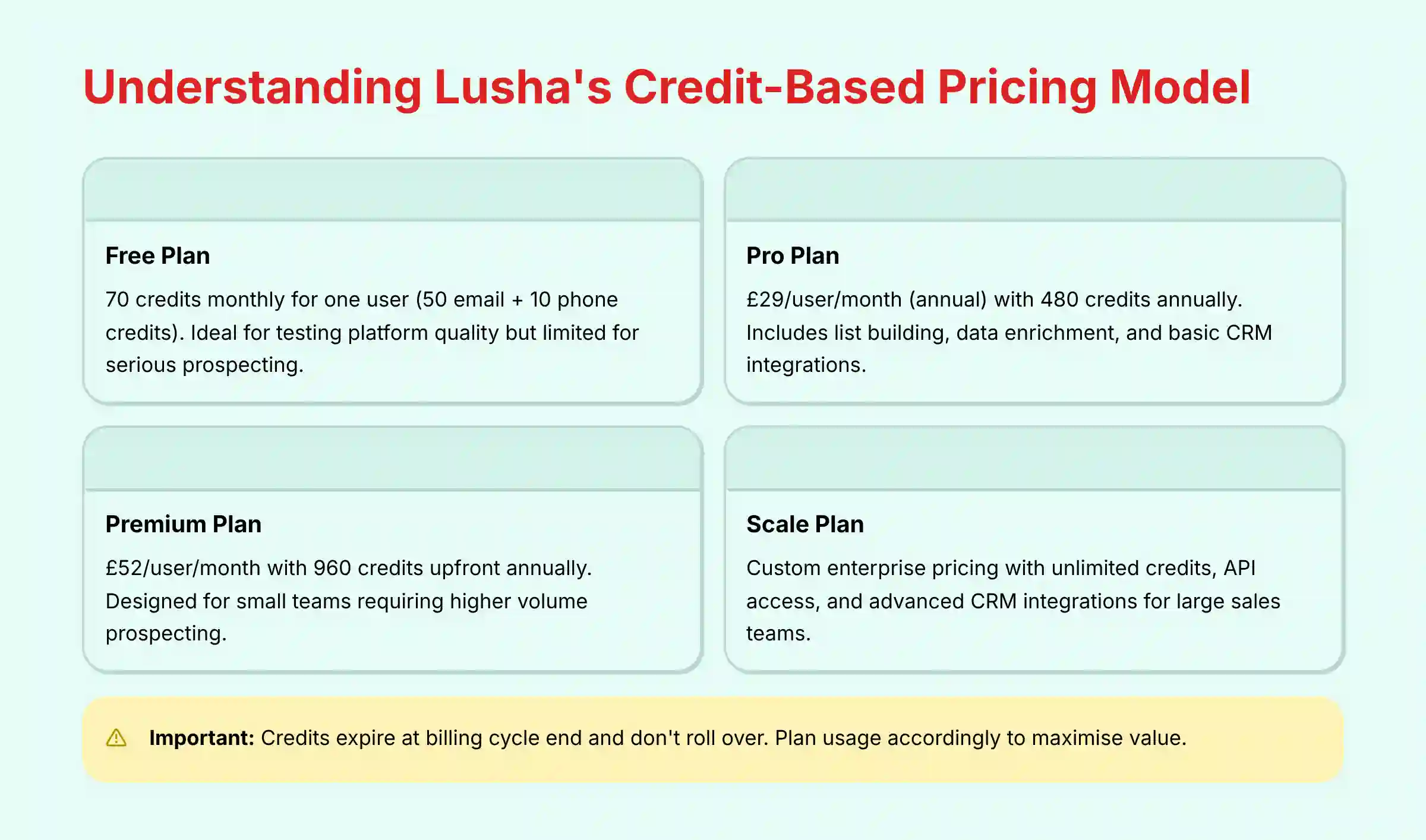
Lusha operates on a freemium, credit-based subscription model, which offers more flexibility than the traditional user-seat licenses of many competitors. A “credit” is the currency of the Lusha platform. One credit is consumed each time you reveal a contact's full information, though different types of data may require different credit amounts – typically 1 credit for email access and separate credits for phone numbers.
The pricing is structured in several tiers:
- Free Plan: The free plan gives access to 70 credits per month for one user, with some sources indicating 50 email credits and 10 phone credits upfront, plus the ability to earn additional credits through the Lusha Community Program. It's designed for individuals or very small teams to test the platform's data quality, but its limitations on features and credit volume make it unsuitable for serious prospecting efforts.
- Pro Plan: Priced at $29 per user per month when billed annually ($39 monthly), the Pro plan includes 480 credits per user annually. This tier unlocks key features like list building, data enrichment, and basic CRM integrations.
- Premium Plan: Designed for small teams, this plan costs $612 per user annually (approximately $52 monthly) and provides 960 credits upfront for the entire year.
- Scale Plan: This is the enterprise-level tier with custom pricing and unlimited credits for large sales teams, offering advanced features like API access and deeper CRM integrations.
A key detail to be aware of is that in most Lusha plans, credits expire at the end of the billing cycle and do not roll over. This encourages consistent usage but means you can't “bank” credits for future campaigns.
For teams evaluating different pricing options and alternatives, our Lusha Top Alternatives and Competitors analysis provides detailed cost comparisons and feature breakdowns to help optimize your budget allocation.
What are the key differences between Lusha, ZoomInfo, and Apollo.io?
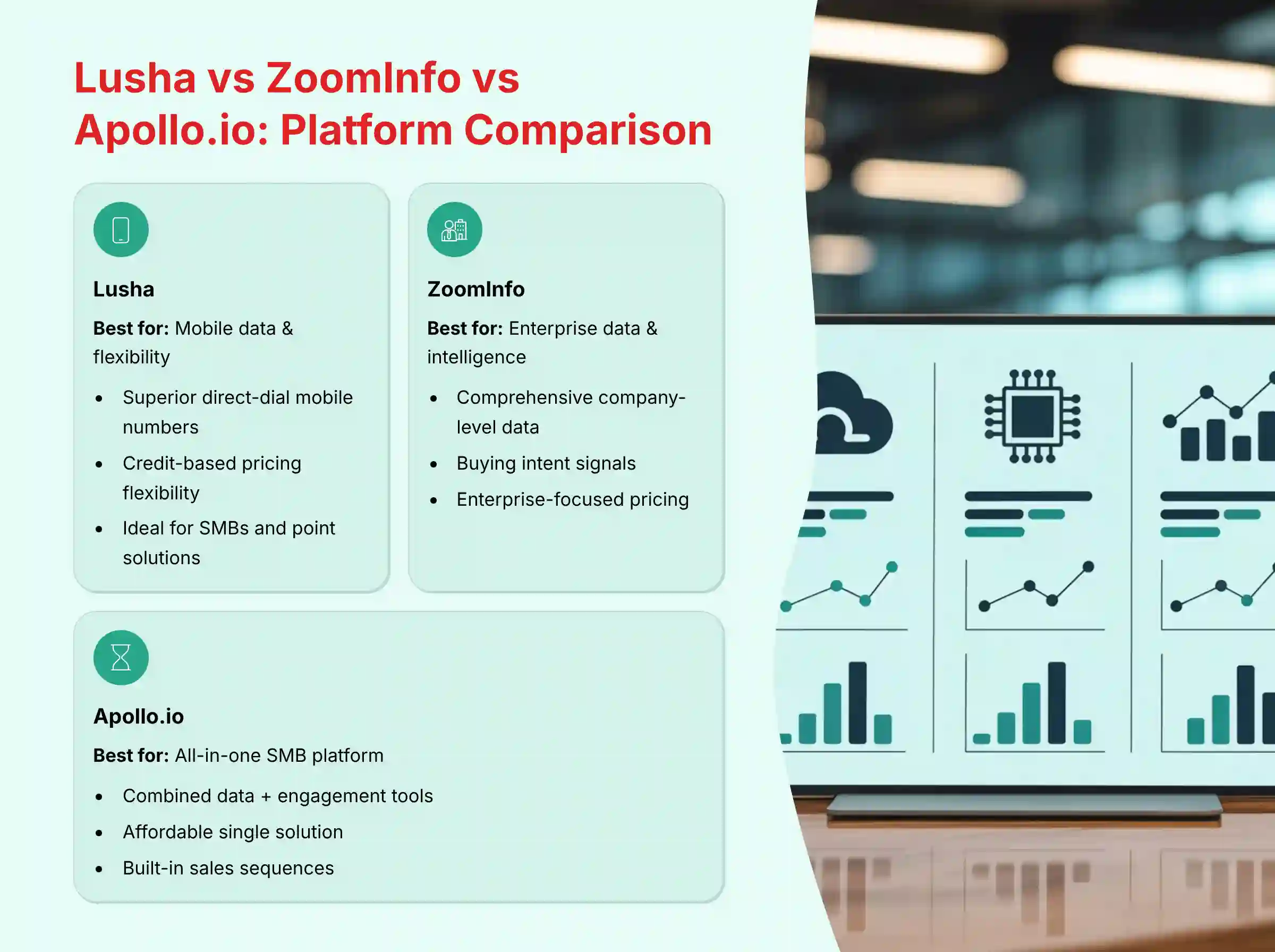
Choosing between Lusha, ZoomInfo, and Apollo.io is a critical decision for AI sales software implementation, as each platform is optimized for different sales motions, team sizes, and budgets. While all three provide B2B data, their core philosophies and strengths vary significantly.
Lusha: Best for Mobile Data & Flexibility. Lusha's primary differentiator is the quality and quantity of its direct-dial mobile numbers. Its credit-based system is highly flexible, making it a favorite among SMBs and teams who want to pay for what they use without being locked into massive, long-term contracts. It excels as a point solution for adding high-quality contact data into an existing AI sales stack.
ZoomInfo: Best for Enterprise Data & Company Intelligence. ZoomInfo is the enterprise heavyweight with broader and deeper capabilities than Lusha's, offering extensive company-level data, buying intent signals, organizational charts, and deep technographic information. Its pricing and contract structure reflect this enterprise focus, being significantly more expensive and rigid, targeting larger organizations that need comprehensive, all-in-one data intelligence platforms.
Apollo.io: Best All-in-One Platform for SMBs. Apollo combines B2B data with a built-in sales engagement platform, allowing users to find prospects, build lists, and execute multi-channel outreach sequences all within one tool. While its data accuracy is generally considered less precise than ZoomInfo or Lusha's mobile data, its value proposition is immense for SMBs wanting a single, affordable solution that eliminates the need for separate engagement tools.
The right choice depends entirely on your team's structure and goals: Choose Lusha if your #1 bottleneck is getting decision-makers on the phone and you already have preferred sales engagement tools; opt for ZoomInfo if you're a large enterprise needing deep company intelligence and buying signals with a significant budget; go with Apollo.io if you're an SMB wanting an affordable, all-in-one solution.
For comprehensive guidance on implementing these tools effectively, our Lusha Tutorials and Usecase resource provides step-by-step implementation strategies and best practices.
How does the Lusha browser extension work with LinkedIn?
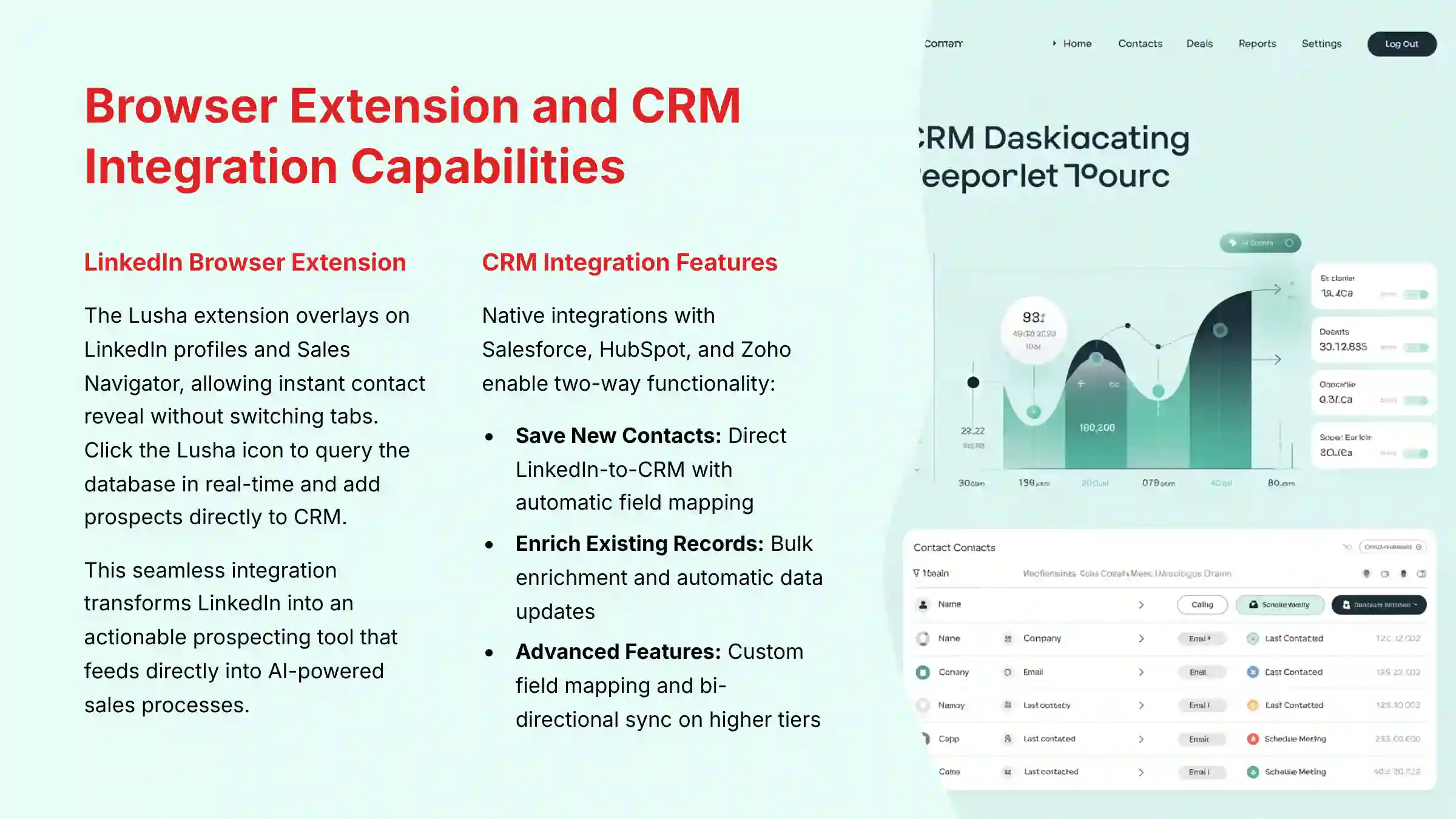
The Lusha browser extension is one of its most popular features and a core component of modern AI sales software workflows. Once installed (on Chrome, Firefox, or Edge), the extension overlays a Lusha icon on LinkedIn profiles, LinkedIn Sales Navigator, and many company websites. When a sales rep is viewing a prospect's LinkedIn profile, they can click the Lusha icon to instantly reveal that person's contact information directly on the page.
This workflow is incredibly efficient because it allows reps to prospect where they already are, without having to switch tabs or manually copy-paste names into a separate application. The extension pulls the prospect's name and company from the LinkedIn page and queries the Lusha database in real-time. If a match is found, it will display the available email addresses and phone numbers. The user can then click to “Show” the contact info, which consumes the appropriate Lusha credits, and directly add that prospect to a list or push them to their integrated CRM.
This seamless integration with a salesperson's natural prospecting environment is a primary driver of Lusha's time-saving value proposition. It transforms LinkedIn from a simple networking site into a powerful, actionable prospecting tool that feeds directly into your AI-powered sales processes. The extension also works on company websites, allowing reps to build comprehensive prospect lists while researching target accounts, making it an essential component of any modern AI sales software stack.
How does Lusha integrate with CRMs like Salesforce and HubSpot?
Lusha's ability to integrate with CRMs is fundamental to its role in an automated AI sales software stack. The integrations are designed to solve a major pain point: messy, incomplete, and outdated CRM data that undermines AI-powered sales processes. Lusha offers native integrations for major platforms like Salesforce, HubSpot, and Zoho, as well as several sales engagement tools.
The integration works in two primary ways:
Saving New Contacts: When you use the Lusha extension to find a new prospect on LinkedIn, you can save them directly to your CRM as a new Lead or Contact with a single click. Lusha automatically maps the data fields (Name, Title, Company, Email, Phone) to the corresponding fields in your CRM, preventing manual data entry errors and ensuring your AI tools have clean data to work with.
Enriching Existing Records: You can also use Lusha to enrich existing records in your CRM. For example, you can set up rules to automatically enrich any new lead that enters your HubSpot or Salesforce instance, or you can enrich lists of contacts in bulk. This ensures that your entire team is working with the most complete and accurate data available, which improves everything from email deliverability to call connection rates and AI-powered lead scoring accuracy.
The depth of integration varies by plan. Higher-tier plans (like Scale) offer more advanced features, such as automatic data enrichment for entire CRM databases and custom field mapping to align with your specific CRM setup. This bi-directional sync keeps the CRM as the single source of truth while ensuring it's populated with high-quality data that powers your AI sales processes effectively.
To explore broader sales intelligence solutions and maximize your prospecting effectiveness, consider reviewing our comprehensive guide to the Best 10 AI Sales Prospecting & Intelligence platforms available in today's market.
Ready to transform your sales prospecting with AI-powered intelligence? This comprehensive FAQ guide covers the essential aspects of Lusha's platform, from its AI-driven data validation algorithms to practical implementation strategies. Whether you're evaluating Lusha against competitors like ZoomInfo and Apollo.io, or looking to understand compliance requirements and pricing models, these insights provide the foundation for making informed decisions about your sales technology stack.
For additional questions not covered in this guide, we recommend exploring our other Lusha FAQs resources or reaching out to Lusha's support team directly through their platform.


Leave a Reply