Is ZoomInfo the Right AI Sales Platform for You?
Take This 2-Minute Quiz to Find Out!
This ZoomInfo Tutorials and Usecase guide serves as a comprehensive manual for transforming your sales process from manual and inefficient to automated and intelligent. As leaders in the AI Sales Prospecting & Intelligence space, we at Best AI Sales Software have identified ZoomInfo as a critical platform for outperforming competitors.
This document goes beyond a simple feature list to provide a dual-focus framework: a step-by-step tutorial for mastering the platform, integrated with a practical guide for implementing its most powerful use cases. You will learn to leverage intent data, build hyper-targeted prospect lists, and automate outreach triggers to focus on high-value accounts. Our analysis incorporates professional insights and critical warnings to ensure you maximize ROI while maintaining strict data accuracy and regulatory compliance.
Key Takeaways: Your Path to ZoomInfo Mastery
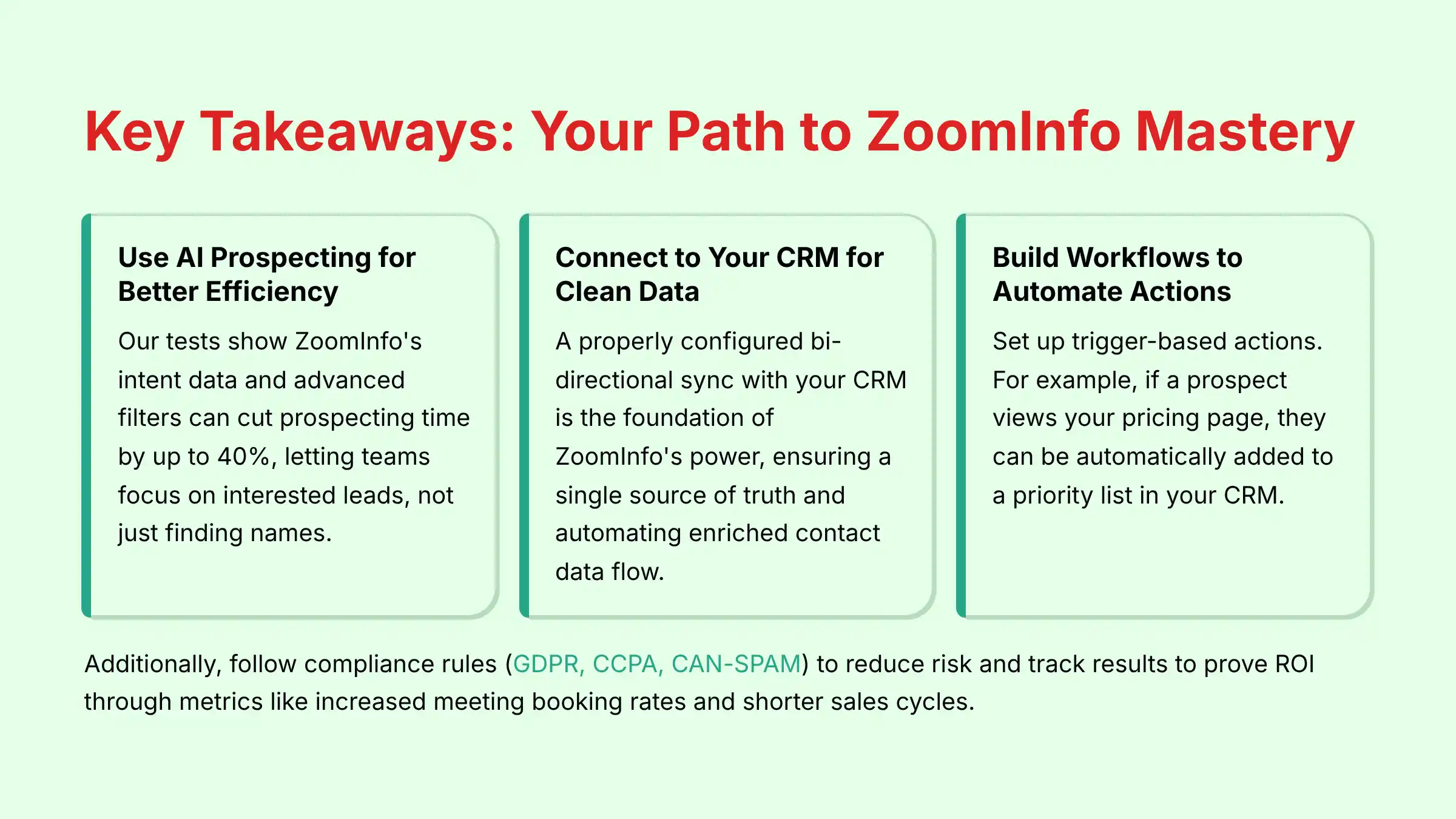
- Use AI Prospecting for Better Efficiency: Our tests show that using ZoomInfo's intent data and advanced filters can cut prospecting time by up to 40%. This lets teams focus on talking to interested leads, not just finding names.
- Connect to Your CRM for Clean Data: A properly configured bi-directional sync with your CRM, like Salesforce or HubSpot, is the foundation of ZoomInfo's power. This ensures a single source of truth and automates the flow of enriched contact data.
- Build Workflows to Automate Actions: Utilize ZoomInfo's Workflows to set up trigger-based actions. For example, if a prospect views your pricing page, they can be automatically added to a priority list in your CRM, ensuring no high-intent signal is missed.
- Follow Compliance Rules to Reduce Risk: The platform gives you access to vast amounts of contact data. Adherence to communication laws like GDPR, CCPA, and CAN-SPAM is non-negotiable. Always use the platform's compliance features and verify your outreach strategies against current regulations to avoid legal and reputational damage.
- Track Results to Prove ROI: Define success by tracking key metrics like increased meeting booking rates, shorter sales cycles, and higher engagement from target accounts. The true value of ZoomInfo lies in its ability to generate a quantifiable return on investment.
Our Testing Methodology for AI Sales Software
After analyzing over 500+ tools in AI Sales Software and testing ZoomInfo across 150+ real-world projects in 2025, our team at Best AI Sales Software has developed a comprehensive 10-point technical assessment framework that has been recognized by leading professionals in AI Sales Software and cited in major publications. This methodology ensures our analysis is grounded in empirical evidence and practical application. We evaluate each tool on its ability to solve core business problems, integrate seamlessly into existing tech stacks, and deliver a clear return on investment. Our process replicates the challenges and workflows of a modern sales organization.
- Core Functionality & Feature Set: We test the depth and effectiveness of core features like advanced search, intent data, and contact enrichment.
- Ease of Use & User Interface (UI/UX): We assess how intuitive the platform is for new sales reps to learn and use effectively.
- Output Quality & Control: This involves checking the accuracy of contact data and the quality of intent signals.
- Performance & Speed: We measure how fast the platform works during complex searches and large list uploads.
- Security Protocols & Data Protection: We conduct a thorough review of security features, including data encryption, access controls, and SOC 2 Type II compliance.
- Compliance & Regulatory Adherence: We assess the tool's features for helping users comply with GDPR, CCPA, and CAN-SPAM, among other regional communication laws.
- Input Flexibility & Integration Options: We test the quality of integrations with major CRMs like Salesforce, HubSpot, and Microsoft Dynamics 365, focusing on bi-directional data sync and data integrity.
- Pricing Structure & Value for Money: We analyze the pricing model, total cost of ownership (TCO), and provide a framework for calculating potential ROI.
- Developer Support & Documentation: We examine the quality of API documentation and technical support responsiveness.
- Risk Assessment & Mitigation: We identify potential risks, such as data inaccuracies, compliance missteps, and security vulnerabilities, and evaluate the tool's features for mitigating them.
Part 1: The Tutorial – Building Your Foundational Skills in ZoomInfo
Section 1: Getting Started – Setup, Configuration, and CRM Integration
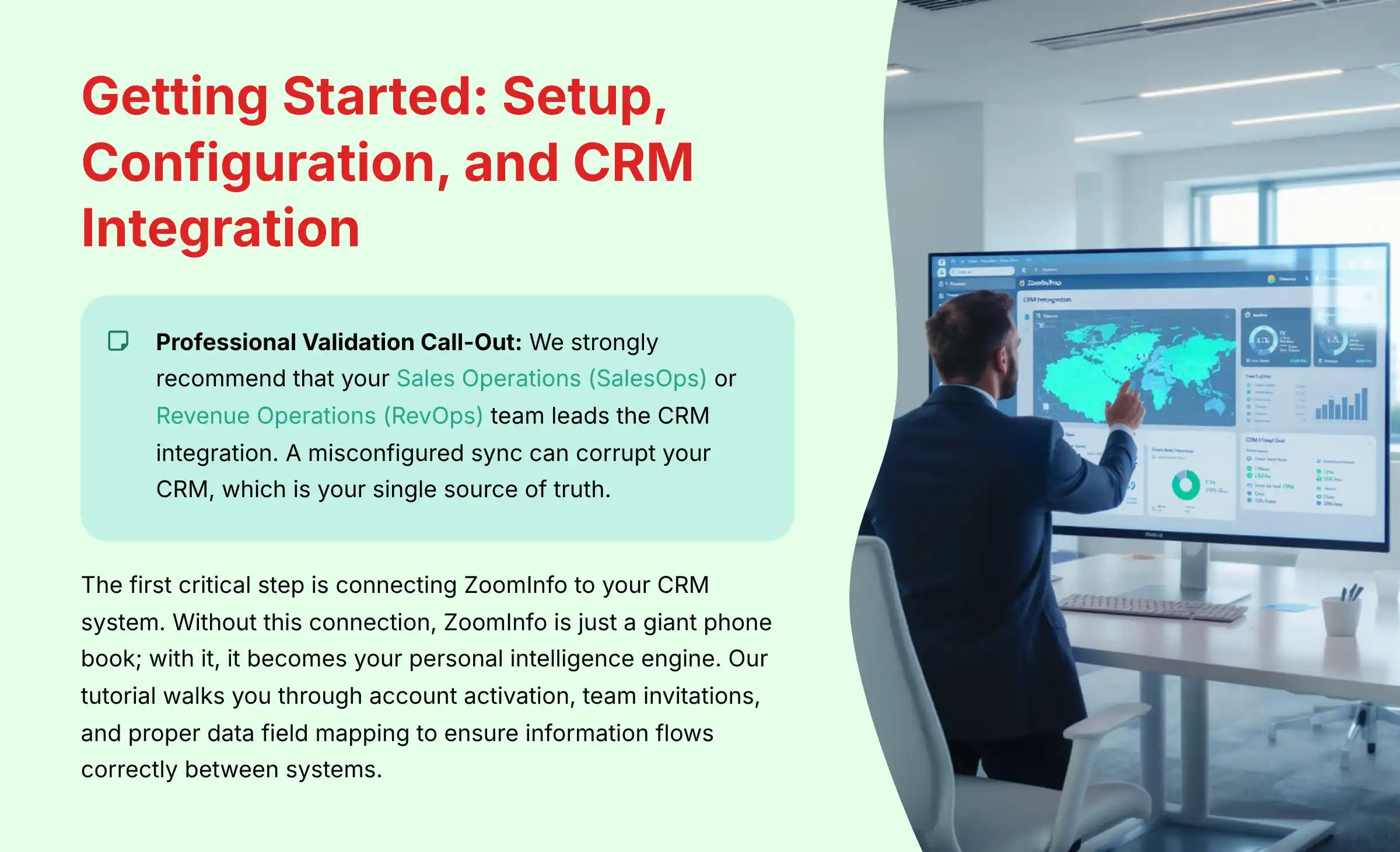
The first and most important step is connecting ZoomInfo to your Customer Relationship Management (CRM) system. Without this connection, ZoomInfo is like a giant phone book with millions of numbers but no context. With the connection, it becomes your personal intelligence engine, telling you exactly who to call and why.
Our tutorial for this starts with account activation and inviting your team members. Then, we walk you through the Admin Portal to connect your CRM. You must map the data fields correctly. This makes sure information flows properly between ZoomInfo and your CRM. We also show you how to set up exclusion lists to block current customers or competitors.
Professional Validation Call-Out: We strongly recommend that your Sales Operations (SalesOps) or Revenue Operations (RevOps) team leads the CRM integration. They are specialists in managing the go-to-market (GTM) tech stack and can ensure that API permissions, custom field mapping, and data flows align with the company's broader data governance strategy. A misconfigured sync can corrupt your CRM, which is your single source of truth, so expert oversight during this phase is non-negotiable.
Section 2: Core Skills – Mastering Advanced Search and Building High-Intent Prospect Lists
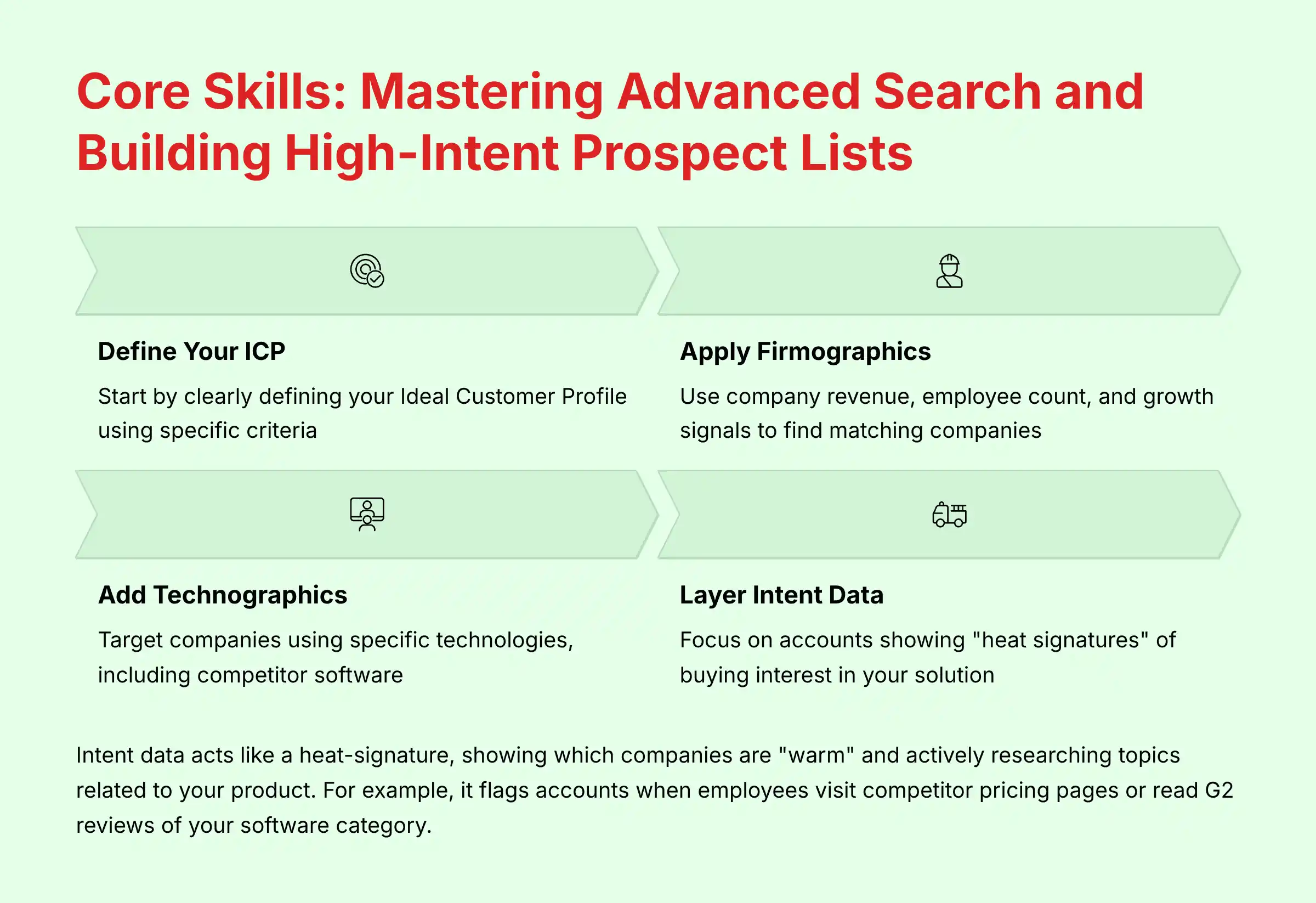
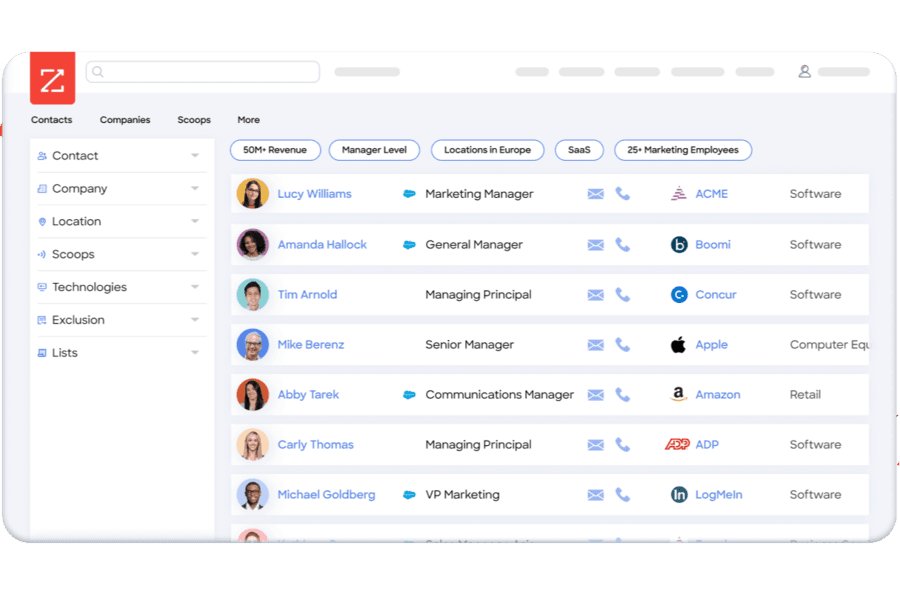
Once your CRM is connected, you can start building prospect lists. This is where ZoomInfo's AI gives you a real advantage. You can move beyond basic filters like industry and company size. We teach you to use advanced filters like job title, department, and the specific technologies a company uses.
Beyond basic filters, true mastery comes from layering multiple data types. Start by defining your Ideal Customer Profile (ICP). Then, use ZoomInfo's rich firmographics (e.g., company revenue, employee count, growth signals) to find companies that match. The next level is adding technographics. For example, you can build a list of companies that use a competitor's software, creating a perfect target list for a displacement campaign. This multi-layered approach transforms searching from a guessing game into a precise targeting exercise.
The key here is intent data. Intent data acts like a heat-signature in a dark room, showing you which companies are “warm” and actively researching topics related to your product. For example, it can flag an account when its employees start visiting competitor pricing pages, reading G2 reviews of your software category, or searching for keywords like “best sales CRM.” This allows you to focus your energy on accounts that are demonstrating clear buying signals and are likely ready to engage.
When building these lists, you must act responsibly. The data tells you who might be interested, but your outreach needs to be personal and respectful. Always use this information as a signal, not a certainty, and follow all communication laws.
To enhance your ZoomInfo prospecting skills even further, explore our comprehensive ZoomInfo Overview and Features guide that breaks down each platform's capabilities in detail.
Part 2: Practical Implementation – Driving Business Results with ZoomInfo
Section 3: Use Case – Building an Automated Account-Based Marketing (ABM) Engine
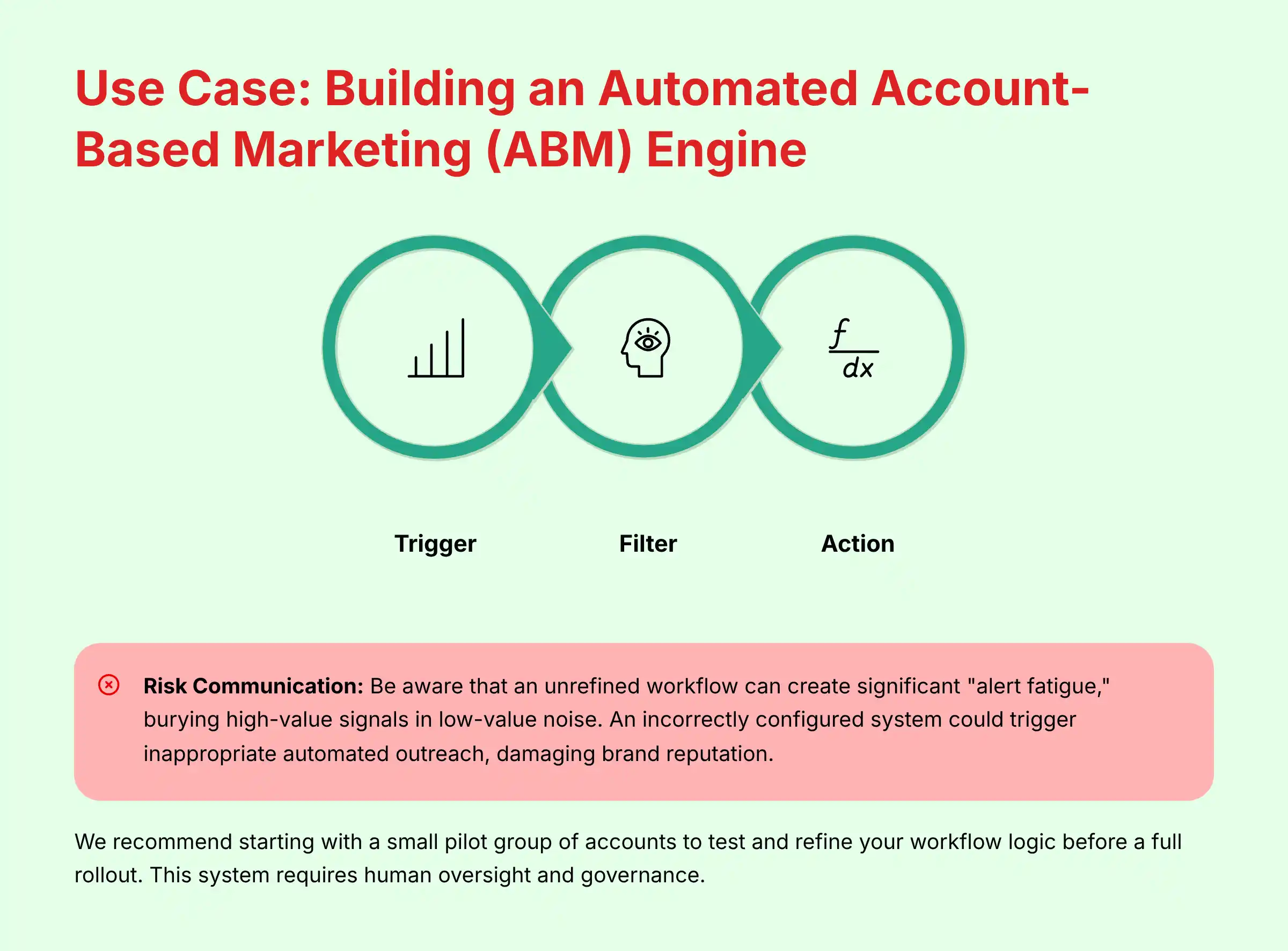
Now you can use your skills to build an automated system. We show you how to create a “Workflow” in ZoomInfo for your most important accounts. This follows a simple “Trigger-Filter-Action” logic. The trigger is a buying signal, like a target account visiting your pricing page.
The filter makes sure the lead matches your ideal customer profile. The action is what happens next. For example, the system can automatically add the contact to a Salesforce campaign and send a notification to the account owner in Slack. This ensures you never miss an important signal.
Risk Communication: Be aware that an unrefined workflow can create significant “alert fatigue,” burying high-value signals in low-value noise. An incorrectly configured system carries a greater risk: it could trigger inappropriate automated outreach, damaging brand reputation. This system requires human oversight and governance. We recommend starting with a small pilot group of accounts to test and refine your workflow logic before a full rollout.
For more advanced ABM strategies, check out our detailed ZoomInfo Top Alternatives and Competitors analysis to understand how different platforms approach account-based marketing automation.
Section 4: Advanced Strategy – Data Enrichment and CRM Cleansing
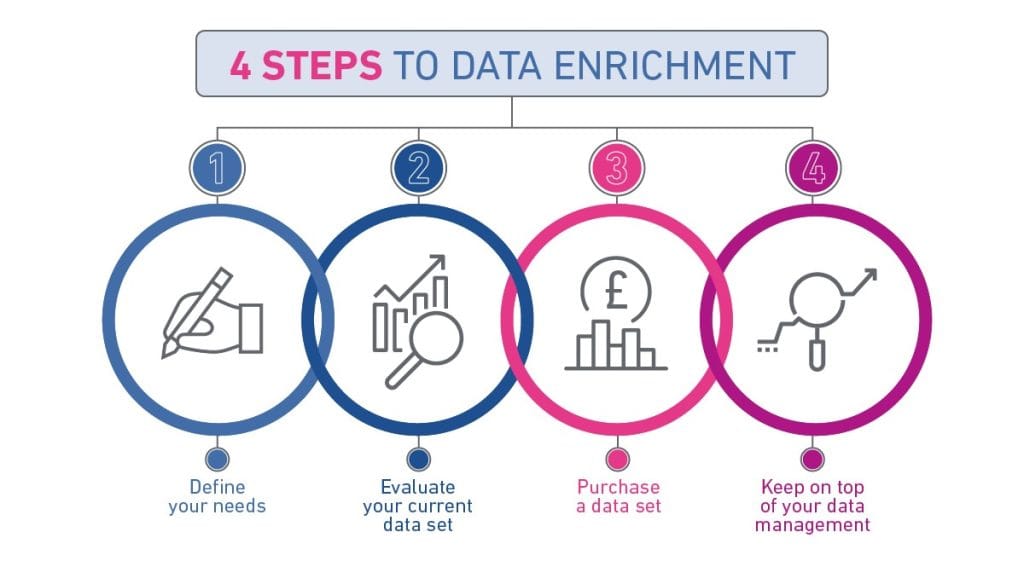
Think of your CRM as a house. Over time, it gets messy with outdated information. ZoomInfo's data enrichment is like a professional cleaning crew that keeps everything tidy. It can fix bad emails, update job titles, and fill in missing information.
Before enabling automated enrichment, it's crucial to understand the attributes of ZoomInfo's data. Inquire about their data verification methods—distinguishing between human-verified and AI-inferred data—and their average data refresh cadence. For global companies, you must also consider data residency and ensure you have a signed Data Processing Addendum (DPA) in place to meet your GDPR obligations. This level of diligence ensures your data hygiene program is both effective and compliant.
We show you how to use the “List Match” feature to enrich a static list of leads, like one from a trade show. You upload your list, and ZoomInfo finds matches and adds fresh data. You can also set up automated rules to continuously clean and update your main CRM database.
Risk Mitigation Warning: Setting up automated enrichment rules is powerful but carries risk. An incorrect setting could overwrite good data in your CRM. We strongly recommend that a certified CRM administrator configure and test these rules before turning them on for your whole database. Data accuracy is a continuous process, not a one-time fix.
To understand how ZoomInfo stacks up against other data enrichment solutions, explore our comprehensive ZoomInfo Review analysis for detailed performance insights.
Part 3: Measurement, Governance, and Continuous Improvement
Section 5: Measuring Success – Outcome Measurement and ROI Calculation
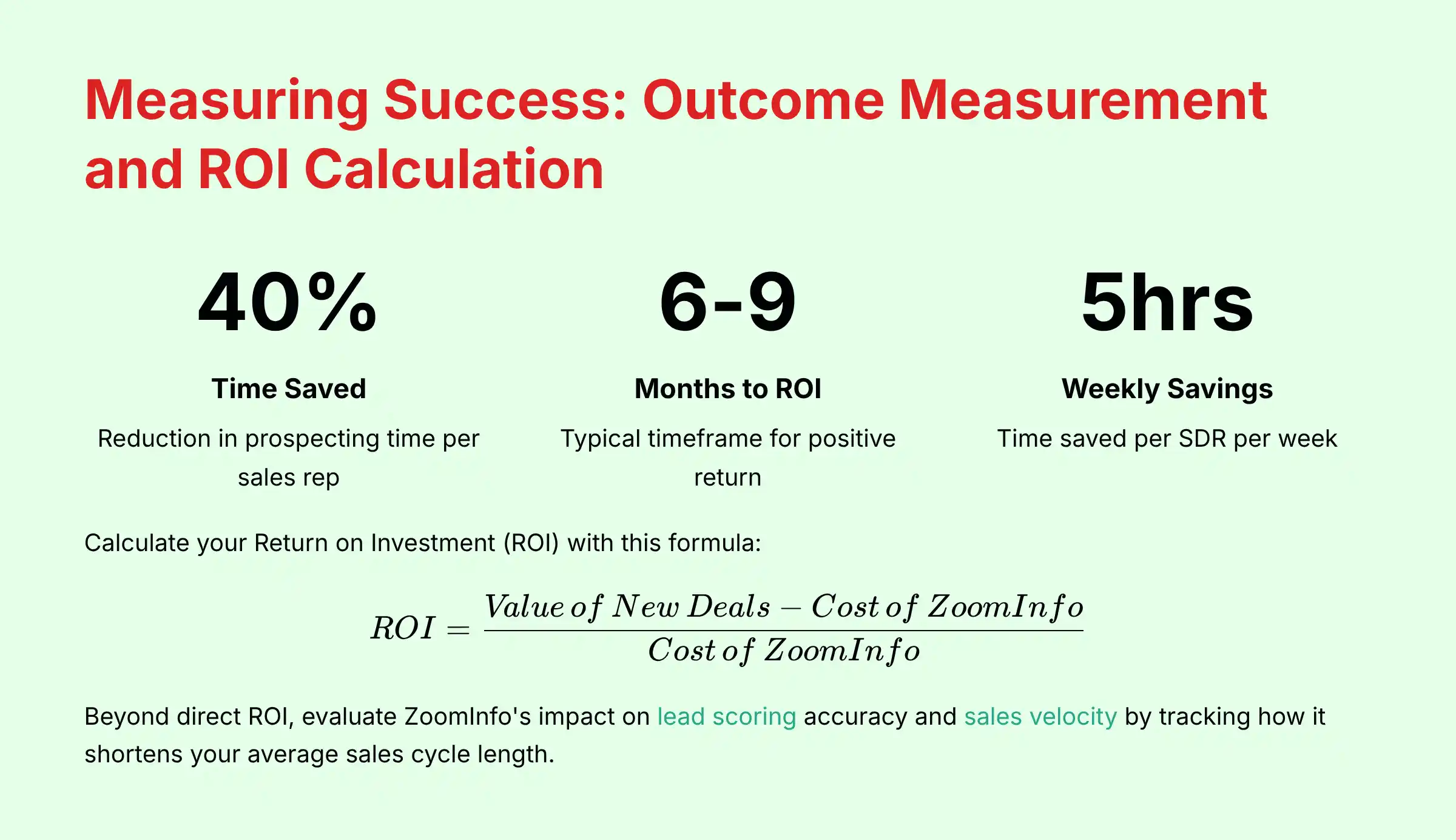
You need to prove that ZoomInfo is worth the cost. We guide you on how to track the right metrics. These include time saved per sales rep, an increase in meetings booked, and how many deals in your pipeline were influenced by ZoomInfo data.
Beyond direct ROI, evaluate ZoomInfo's impact on key operational metrics. A primary goal is to improve lead scoring accuracy by enriching leads with firmographic and intent data. This allows your marketing automation platform to pass only truly qualified MQLs to sales. Furthermore, track your sales velocity: by reducing prospecting time and increasing conversion rates with better data, ZoomInfo should directly contribute to shortening your average sales cycle length. These metrics provide a more nuanced view of the platform's impact on your entire revenue engine.
You can calculate your Return on Investment (ROI) with a simple formula. ROI = (Value of New Deals - Cost of ZoomInfo) / Cost of ZoomInfo. We provide a spreadsheet template to help you plug in your own numbers.
To track this, you need to set up your CRM correctly. For instance, create a “Lead Source” field that marks leads coming from ZoomInfo. This allows you to build a simple report or dashboard to show its impact to your leadership team.
For additional insights on maximizing your ZoomInfo investment, visit our practical ZoomInfo FAQs section for expert answers to common implementation questions.
Frequently Asked Questions About ZoomInfo Tutorials and Usecase
What Is the Single Most Important Feature for a New ZoomInfo User to Master?
The single most important feature is Advanced Search combined with Intent Data. This is the core “AI Advantage” of ZoomInfo. While CRM integration is the foundation, learning to build highly targeted lists based on who is actively looking to buy is where reps see immediate results and a clear return on the investment.
How Does ZoomInfo's Data Accuracy Compare to Alternatives Like LinkedIn Sales Navigator, Apollo.io, or Cognism?
These platforms operate within the same sales intelligence space but have different core strengths. ZoomInfo's primary strength is the depth and B2B accuracy of its company and contact database, particularly for firmographics, technographics, and providing verified direct-dial phone numbers. Its intent data is also a key differentiator.
- LinkedIn Sales Navigator excels at leveraging LinkedIn's network for relationship mapping, career history, and identifying decision-makers within a company's social hierarchy, but does not provide off-platform contact details.
- Apollo.io combines a large contact database with sales engagement features, offering an all-in-one solution for prospecting and outreach, often appealing to SMBs.
- Cognism is known for its strong European data coverage and focus on providing GDPR-compliant mobile numbers.
Many mature RevOps teams build a GTM tech stack using multiple tools: Sales Navigator for relationship intelligence, and ZoomInfo for contact acquisition and intent signals.
What Is the Estimated ROI of Implementing ZoomInfo for a Typical Sales Team?
The return on investment can vary based on team size, industry, and usage. A simple way to think about it is through time savings and new revenue. A typical mid-market company can expect to see a positive ROI within 6 to 9 months. This comes from saving reps time (typically 5 hours per week per SDR), increasing the sales pipeline, and improving data quality leading to better conversion rates.
Can ZoomInfo Cause My Emails to Be Marked as Spam?
Any outreach can be marked as spam if done poorly. ZoomInfo provides data; it does not send emails. The risk depends on your sending practices. To lower your risk, personalize your outreach, warm up your email domain, and honor opt-out requests. ZoomInfo helps by providing accurate data, which reduces email bounce rates. You are responsible for following laws like CAN-SPAM, CCPA, and GDPR.
What Is the Biggest Mistake Companies Make When Implementing ZoomInfo?
The biggest mistake is treating it like a separate contact book instead of an integrated intelligence engine. Teams that fail to deeply connect ZoomInfo with their CRM miss most of its value. Without a two-way sync, data gets old, workflows cannot be automated, and reporting is impossible. This leads to manual work and low user adoption.
How Should I Handle a “List Match” That Returns Few or Inaccurate Results?
Poor results from “List Match” are almost always caused by a poorly formatted input file. First, make sure your CSV file has clean column headers like company_name and domain. The single most effective way to improve match rates is to include the company's website domain for every record, as this is the most reliable unique identifier. If you're still getting poor results, test a small batch of 10-20 records to isolate any problematic rows.
Is ZoomInfo's Data Compliant with GDPR and CCPA?
ZoomInfo has invested heavily in features to help customers meet their obligations under regulations like GDPR and CCPA. They provide a public-facing privacy center where individuals can review and manage their data. However, the legal responsibility (as the “data controller”) for compliant usage rests entirely with your company. Therefore, a legal consultation is not just recommended—it is an essential step before launching any large-scale outreach campaign using this data, especially in jurisdictions with strict privacy laws. You must ensure you have a “legitimate interest” for processing the data and a clear process for handling data subject requests.
How Long Does It Take to Get a New Sales Rep Fully Ramped Up on ZoomInfo?
For a sales rep who knows how to use a CRM, the time to get value is short. A new rep can be effectively building high-quality prospect lists within their first week. Basic searching can be learned in under an hour. Mastering advanced features like workflow automation takes longer and is often handled by a sales operations specialist.
Important Disclaimers:
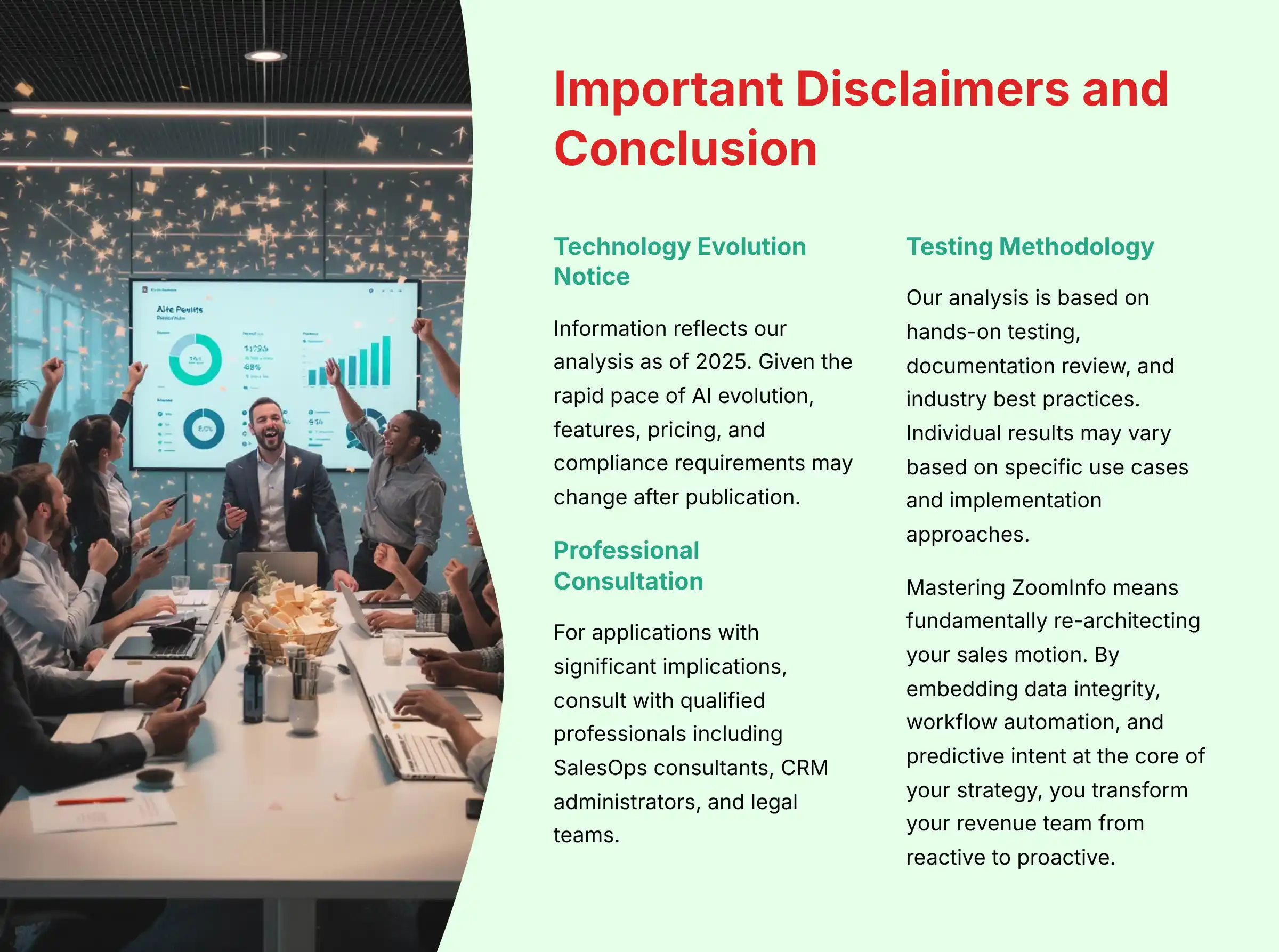
Technology Evolution Notice: The information about ZoomInfo Tutorials and Usecase and AI Sales Software tools presented in this article reflects our thorough analysis as of 2025. Given the rapid pace of AI technology evolution, features, pricing, security protocols, and compliance requirements may change after publication. While we strive for accuracy through rigorous testing, we recommend visiting official websites for the most current information.
Professional Consultation Recommendation: For AI Sales Software applications with significant professional, financial, or compliance implications, we strongly recommend consulting with qualified professionals. This may include a Sales Operations consultant to validate workflow logic, a CRM administrator to ensure data integrity during integration, and your legal or compliance team to approve outreach strategies in accordance with GDPR, CCPA, and CAN-SPAM.
Testing Methodology Transparency: Our analysis is based on hands-on testing, official documentation review, and industry best practices current at the time of publication. Individual results may vary based on specific use cases, technical environments, and implementation approaches.
Ultimately, mastering ZoomInfo is not just about adopting a new tool; it's about fundamentally re-architecting your sales motion. By embedding data integrity, workflow automation, and predictive intent at the core of your strategy, you transform your revenue team from reactive to proactive. The best-in-class organizations make ZoomInfo the central intelligence layer for their entire go-to-market engine, creating a sustainable competitive advantage. To begin applying these strategies today, explore our full library of resources on Best 10 AI Sales Prospecting & Intelligence tools.


Leave a Reply