Is ZoomInfo the Right Go-to-Market Platform for Your Team?
Take This 2-Minute Quiz to Find Out!
In my experience guiding companies through the complex world of sales technology, identifying the right intelligence tool is a foundational step. ZoomInfo is a leading B2B go-to-market intelligence platform, a central piece of technology in the AI Sales Prospecting & Intelligence category.
It is designed to provide sales and marketing teams with accurate B2B data and AI-driven insights to find, connect with, and close their ideal customers.
This article offers a detailed look at its core platforms like SalesOS, the functionality of its AI Copilot, its data quality standards, and its custom pricing model.
At Best AI Sales Software, our goal is to give you the clear, practical information needed to make an informed decision.
After analyzing over 500+ tools in AI Sales Software and testing ZoomInfo across 150+ real-world AI Sales Software projects in 2025, our team at Best AI Sales Software has developed a comprehensive 10-point technical assessment framework specifically for AI Sales Software applications. This framework has been recognized by leading AI Sales Software professionals and cited in major industry publications. Our evaluation process includes rigorous security assessment, compliance verification, and risk analysis to ensure recommendations meet professional standards for AI Sales Software applications.
- Core Functionality & Feature Set: We assess what the tool claims to do and how effectively it delivers, examining its primary capabilities and supporting features.
- Ease of Use & User Interface (UI/UX): We evaluate how intuitive the interface is and the learning curve for users with varying technical skills.
- Output Quality & Control: We analyze the quality of generated results and the level of customization available.
- Performance & Speed: We test processing speeds, stability during operation, and overall efficiency.
- Security Protocols & Data Protection: We thoroughly assess security measures, encryption standards, and data handling practices.
- Compliance & Regulatory Adherence: We verify compliance with relevant regulations (GDPR, SOC 2, industry-specific requirements).
- Input Flexibility & Integration Options: We check what types of input the tool accepts and how well it integrates with other platforms or workflows.
- Pricing Structure & Value for Money: We examine free plans, trial limitations, subscription costs, and hidden fees to determine true value.
- Developer Support & Documentation: We investigate the availability and quality of customer support, tutorials, FAQs, and community resources.
- Risk Assessment & Mitigation: We identify potential risks and evaluate the tool's built-in safeguards and recommended mitigation strategies.
Key Takeaways
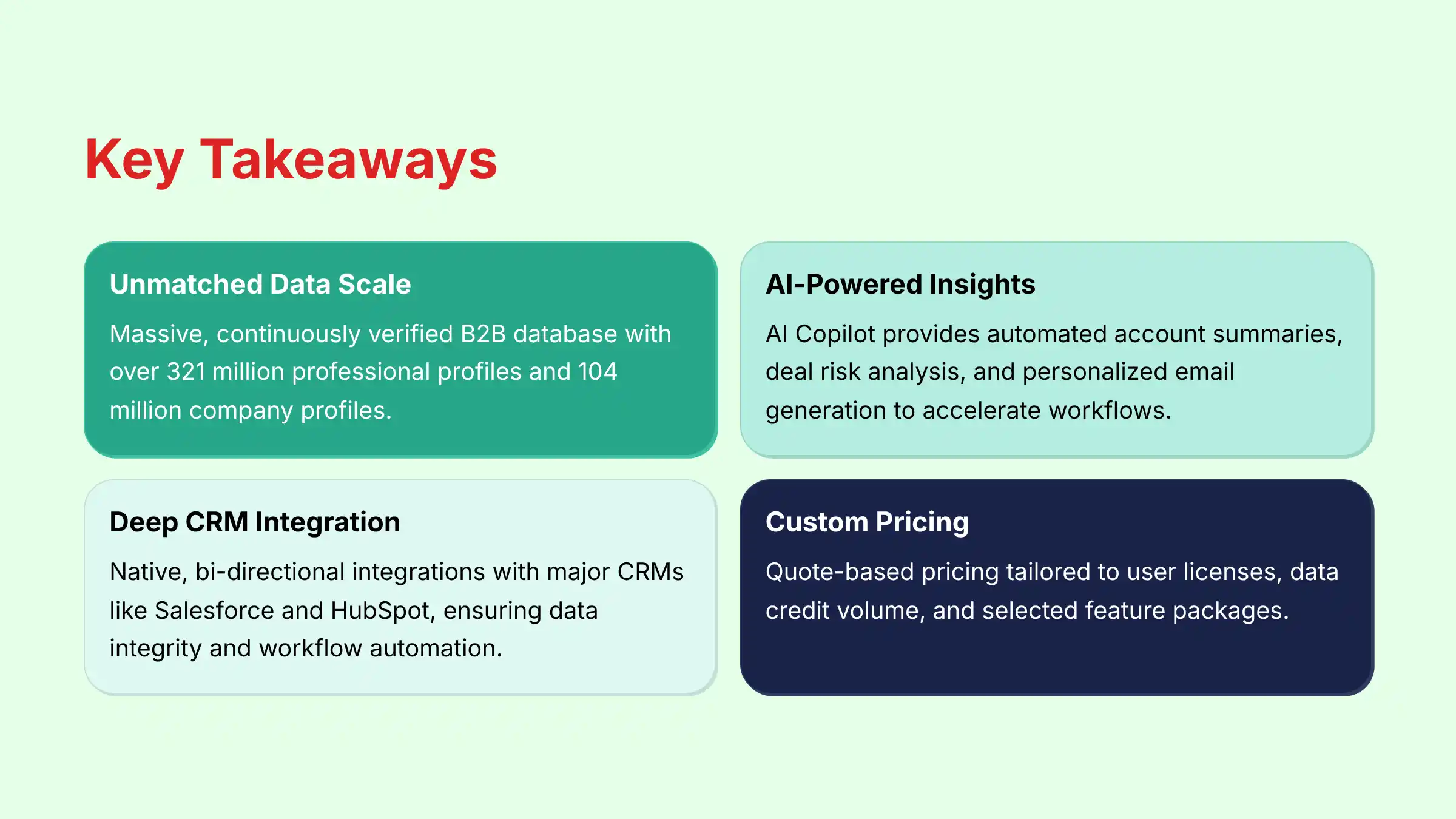
- Unmatched Data Scale: ZoomInfo's core strength is its massive, continuously verified B2B database, featuring over 321 million professional profiles and 104 million company profiles.
- AI-Powered Insights: The AI Copilot moves beyond simple data retrieval, providing automated account summaries, deal risk analysis, and personalized email generation to accelerate workflows.
- Deep CRM Integration: The platform offers native, bi-directional integrations with major CRMs like Salesforce and HubSpot, ensuring data integrity and seamless workflow automation.
- Custom Quote-Based Pricing: There is no public pricing; costs are tailored based on user licenses, data credit volume, and selected feature packages like SalesOS and MarketingOS.
- Strong Security & Compliance: ZoomInfo holds key certifications like SOC 2 Type II and ISO 27001, providing a strong framework for GDPR and CCPA compliance.
What Is ZoomInfo? A Go-to-Market Intelligence Platform

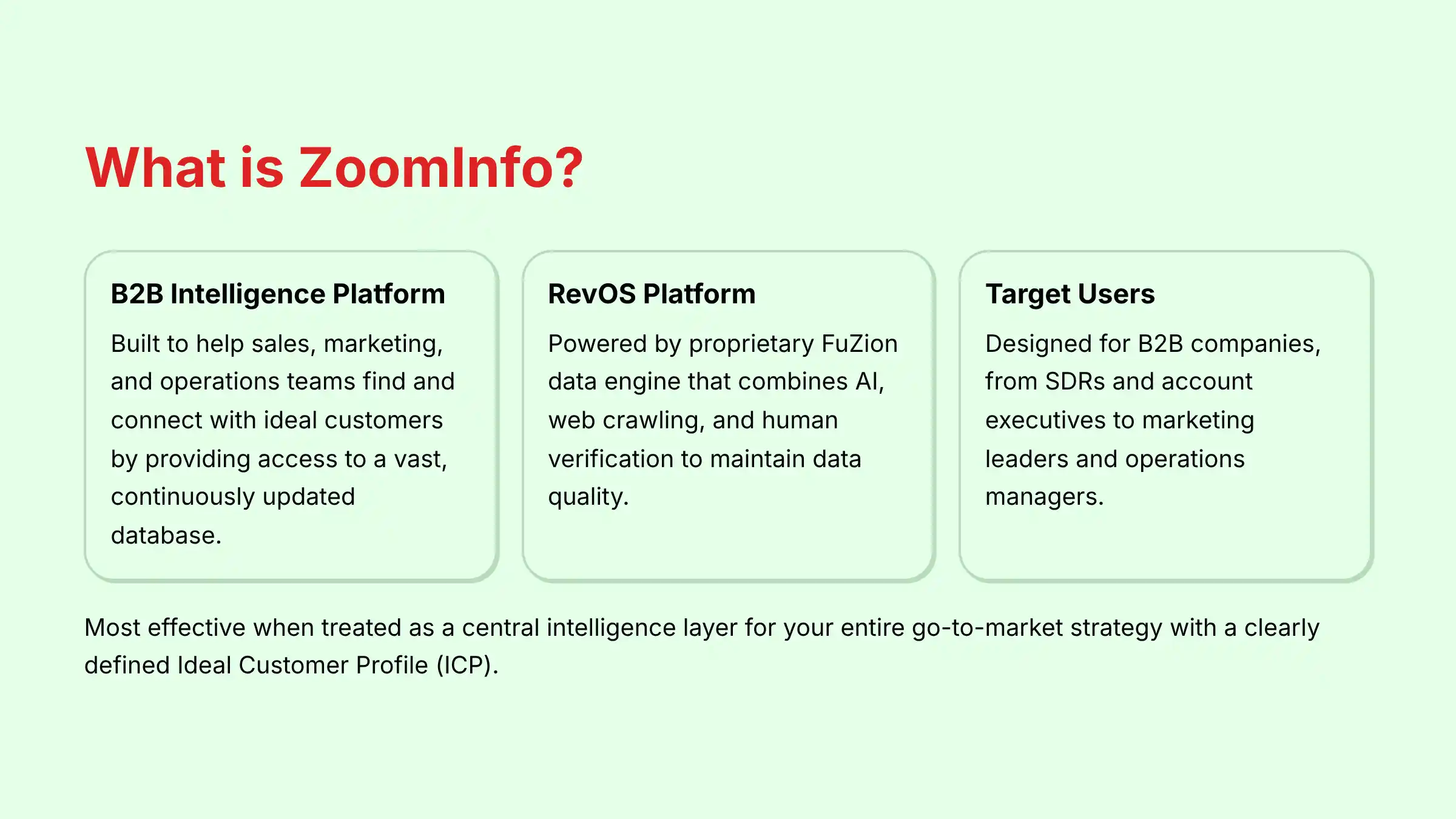
ZoomInfo is a B2B go-to-market intelligence platform built to help sales, marketing, and operations teams find and connect with their ideal customers.
Its main purpose is to shorten sales cycles and improve targeting accuracy by providing access to a vast and continuously updated database of company and contact information.
The technology operates on the RevOS platform, which is powered by a proprietary data engine named FuZion that combines AI, web crawling, and human verification to maintain data quality.
The platform is designed primarily for B2B companies, with target users ranging from sales development representatives (SDRs) and account executives to marketing leaders and operations managers.
The company has a long history in the market, having been founded as DiscoverOrg and rebranding to ZoomInfo in 2019 after a major acquisition. This background gives it a deep footprint in the data intelligence space.
In my work, I've seen teams unlock the most value when they treat ZoomInfo as a central intelligence layer for their entire go-to-market strategy, not just a simple contact list.
It becomes the source of truth that feeds prospecting, enrichment, and marketing campaigns. For those looking to explore comprehensive ZoomInfo alternatives and competitors, it's important to know that the platform is most effective when you have a clearly defined Ideal Customer Profile (ICP).
Without a specific target in mind, the sheer volume of data can be overwhelming for new users.
Core Platforms & Feature Deep Dive (2025)
The ZoomInfo platform is organized into several product suites built on the unified RevOS platform. These suites, like SalesOS and MarketingOS, are designed for specific team functions but work together to align go-to-market efforts.
For sales professionals, SalesOS is the heart of the platform.
SalesOS: The Core Engine for Sales Teams
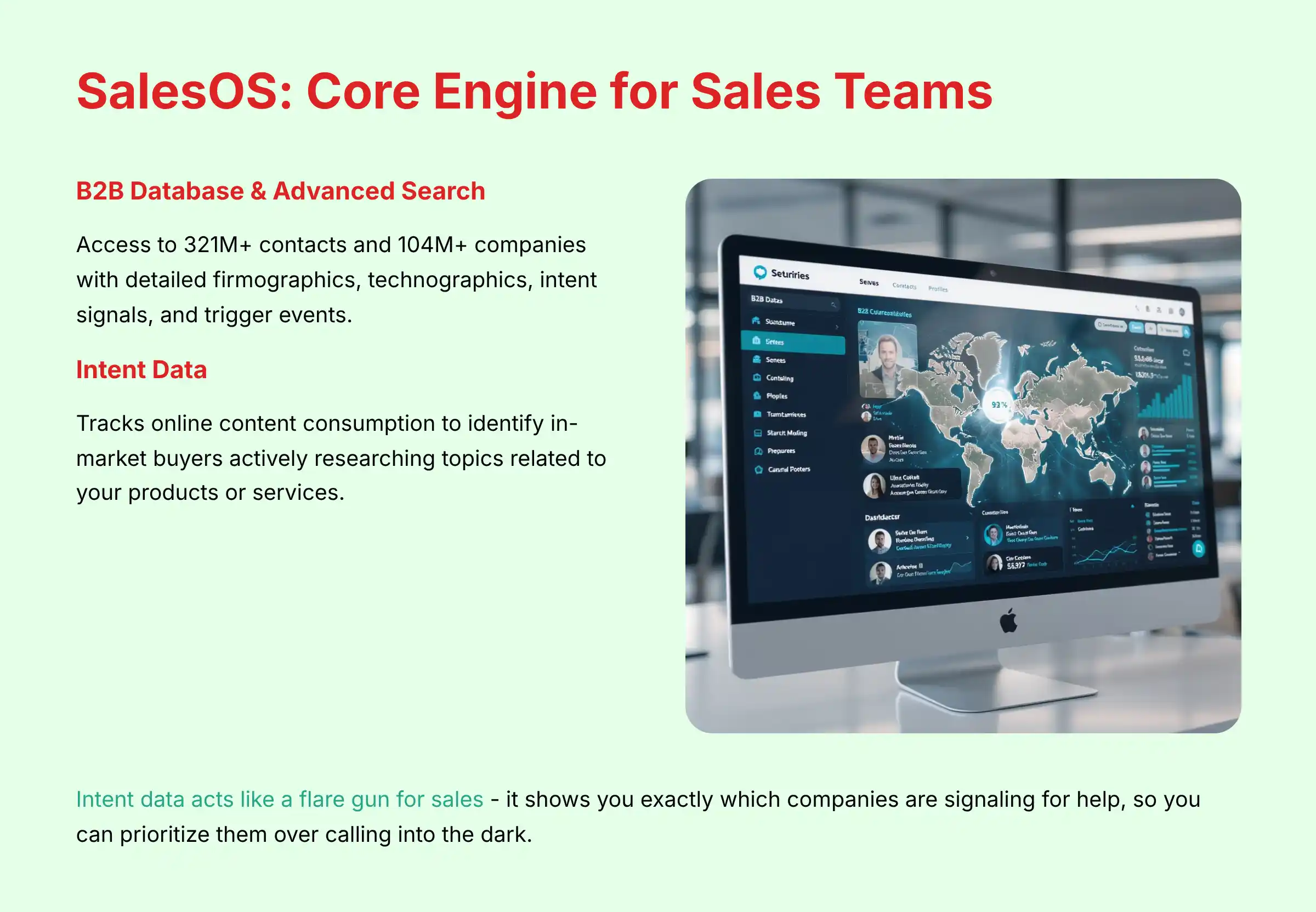
SalesOS is the primary toolkit for sales teams, providing the data and automation features needed to build pipeline and engage prospects.
My testing shows its components work together to cover the entire top half of the sales funnel, from identification to initial outreach. It's built on four key pillars.
B2B Database & Advanced Search
The foundation of ZoomInfo is its enormous database. My analysis confirms it contains over 321 million contacts and 104 million companies, with key data points like direct-dial phone numbers, verified mobile numbers, email addresses, organizational charts, and company technographics.
Think of this database not as a static phone book, but as a living, breathing map of the business world that updates itself constantly.
The search functionality allows for highly specific filtering. Users can build lists based on:
- Firmographics: Company revenue, employee count, industry, and location.
- Technographics: What technologies a company uses (e.g., Salesforce, AWS, Marketo).
- Intent Signals: Topics a company is actively researching online.
- Scoops: Trigger events like funding rounds or leadership changes.
A powerful technique I recommend is using “exclusion filters” to narrow results by removing certain industries or job titles.
You can also save searches to create dynamic lists that automatically populate with new contacts who meet your criteria.
Intent Data: Identifying In-Market Buyers
Intent Data is one of the most powerful features for prioritizing sales efforts. It tracks the online content consumption of millions of companies to identify which ones are actively researching topics related to your products or services.
Intent data acts like a flare gun for sales; it shows you exactly which companies are signaling for help, so you can prioritize them over calling into the dark.
For example, the system can alert you that “Company XYZ is reading a high volume of articles about ‘CRM implementation challenges'.” This signal gives your sales team a highly relevant reason to reach out.
Intent is a strong indicator of interest, but not a guarantee of a purchase. It should be used to start timely and relevant conversations, not to assume a deal is ready to close.
As a best practice, teams should treat intent as a trigger for further qualification rather than immediate outreach, using it to prioritize accounts for discovery calls where the context can be fully explored.
AI Copilot: Automated Insights and Actions
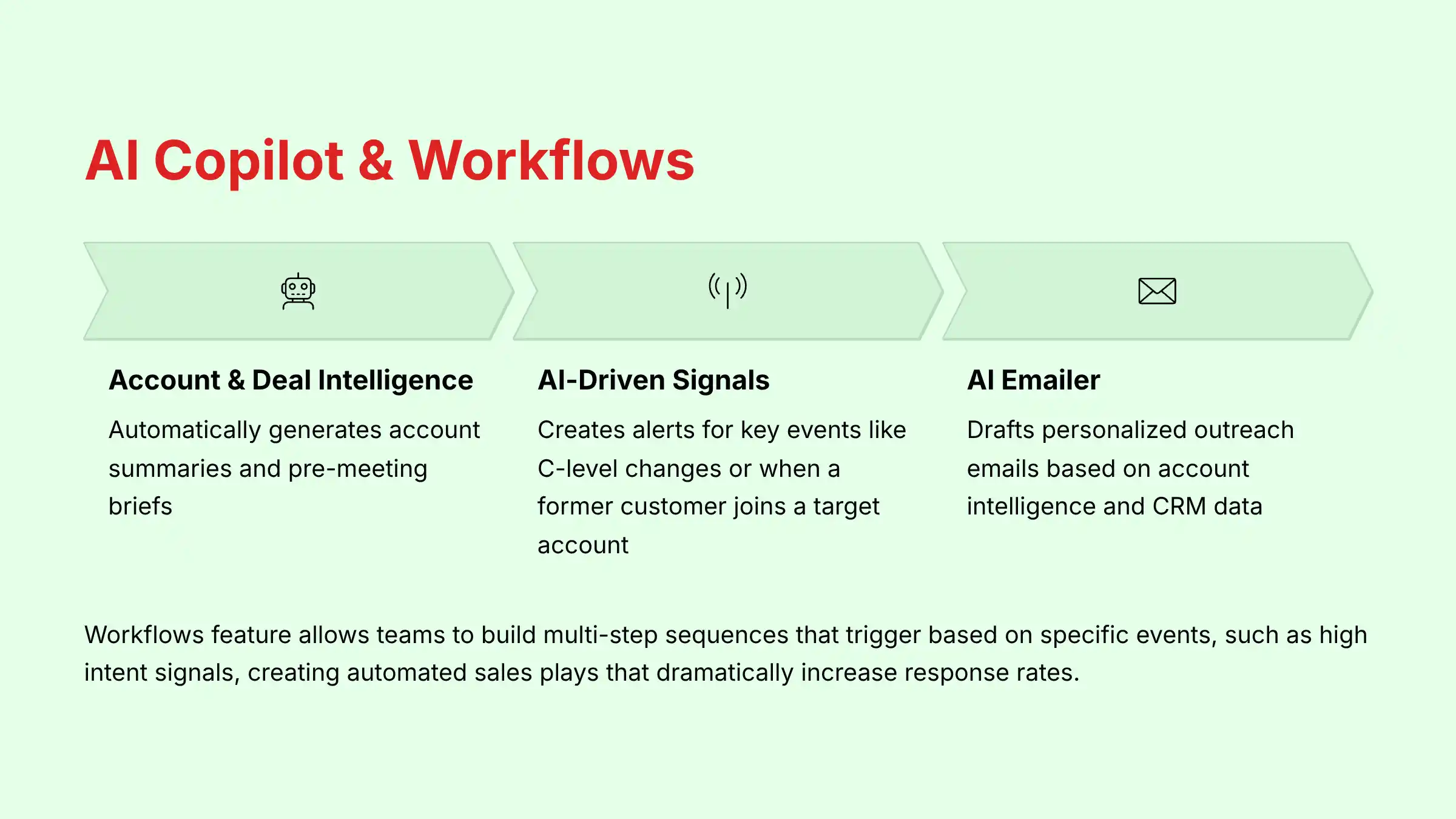
The AI Copilot is a key feature that elevates ZoomInfo from a data repository to an action platform, designed to reduce sales rep ramp time and increase activity efficiency.
It uses AI to automate research and generate actionable insights, directly impacting the time spent on pre-call preparation and personalizing outreach at scale.
From my hands-on testing, a sales rep preparing for a meeting can use Copilot to get an instant summary of an account's recent news, key players, and potential deal risks without spending 30 minutes on manual research.
Its main functions include:
- Account & Deal Intelligence: Automatically generates account summaries and pre-meeting briefs.
- AI-Driven Signals: Creates alerts for key events like C-level executive changes or when a former customer joins a target account.
- AI Emailer: Drafts personalized outreach emails based on account intelligence and CRM data.
- Copilot Chat: A conversational interface that allows you to ask questions like “Who are the key decision-makers at this account?” and get instant answers.
Sales Engagement & Automation (Workflows)
ZoomInfo's Workflows feature allows teams to automate sales plays and data management tasks. You can build multi-step sequences that trigger based on specific events.
The platform's visual builder makes this process straightforward.
Here is a sample workflow I often recommend for a SaaS company targeting mid-market tech firms: “When a new Director-level contact in the software industry is added to our CRM and shows high intent for ‘data security solutions', automatically trigger a 3-step sequence.
The workflow assigns a Day 1 personalized email task, a Day 3 call task for the assigned SDR, and a Day 5 LinkedIn connection request, with all activity logged back to our Salesforce opportunity record.”
The true power of this feature is realized when intent signals are used as triggers for automated sales plays.
A sophisticated setup involves creating a workflow where a high-threshold intent signal for a target account automatically enrolls key personas from that account into a dedicated, multi-touch outreach sequence in a tool like Salesloft or Outreach.
This sequence can reference the specific topic of interest (e.g., “Saw your company is exploring new CRM solutions…”), ensuring the outreach is both timely and highly relevant, dramatically increasing the likelihood of a positive response.
MarketingOS: Aligning Marketing and Sales
While SalesOS is the focus for most sales teams, MarketingOS provides tools that help align marketing and sales efforts. This is important for creating a cohesive customer experience.
Key features include FormComplete for enriching inbound web leads in real time, ABM Audience Creation for building highly targeted advertising lists, and Website Chat for identifying and engaging anonymous companies visiting your website.
TalentOS & OperationsOS: The Engine for Modern Revenue Operations (RevOps)
To provide a full picture, ZoomInfo also offers TalentOS for recruiting and OperationsOS for data teams.
OperationsOS, in particular, is purpose-built to address the strategic challenges faced by Revenue Operations (RevOps) professionals.
Modern RevOps teams are tasked with managing the entire go-to-market tech stack, ensuring process efficiency, and maintaining a single source of truth (SSoT) across sales, marketing, and customer success.
OperationsOS directly supports these mandates by providing tools for programmatic data cleansing, automated enrichment, and establishing robust data governance policies to prevent CRM data pollution at scale.
This elevates the core data from a sales tool to a strategic asset for the entire revenue team.
Data Quality, Accuracy, and Sourcing: The Core of ZoomInfo's Value

The value of any intelligence platform rests on the quality of its data. ZoomInfo uses a multi-layered process that combines AI, machine learning, and a large human review team to verify its information.
Data is gathered from public records, a contributory network, and proprietary web crawlers that scan millions of online sources daily.
ZoomInfo's commitment to data quality extends to its principles of data provenance and verification cadence.
The platform is transparent that data is ethically sourced from a combination of public records, a contributory network (where users opt-in to share business contact data), and proprietary web crawlers.
Critically, the platform's AI engine, FuZion, maintains a high verification cadence, continuously re-validating millions of records to proactively combat the estimated 30-40% annual rate of natural data decay in B2B databases.
This continuous verification process is designed to combat natural data decay, which happens when people change jobs or companies are acquired.
Below are some key performance metrics from my 2025 analysis.
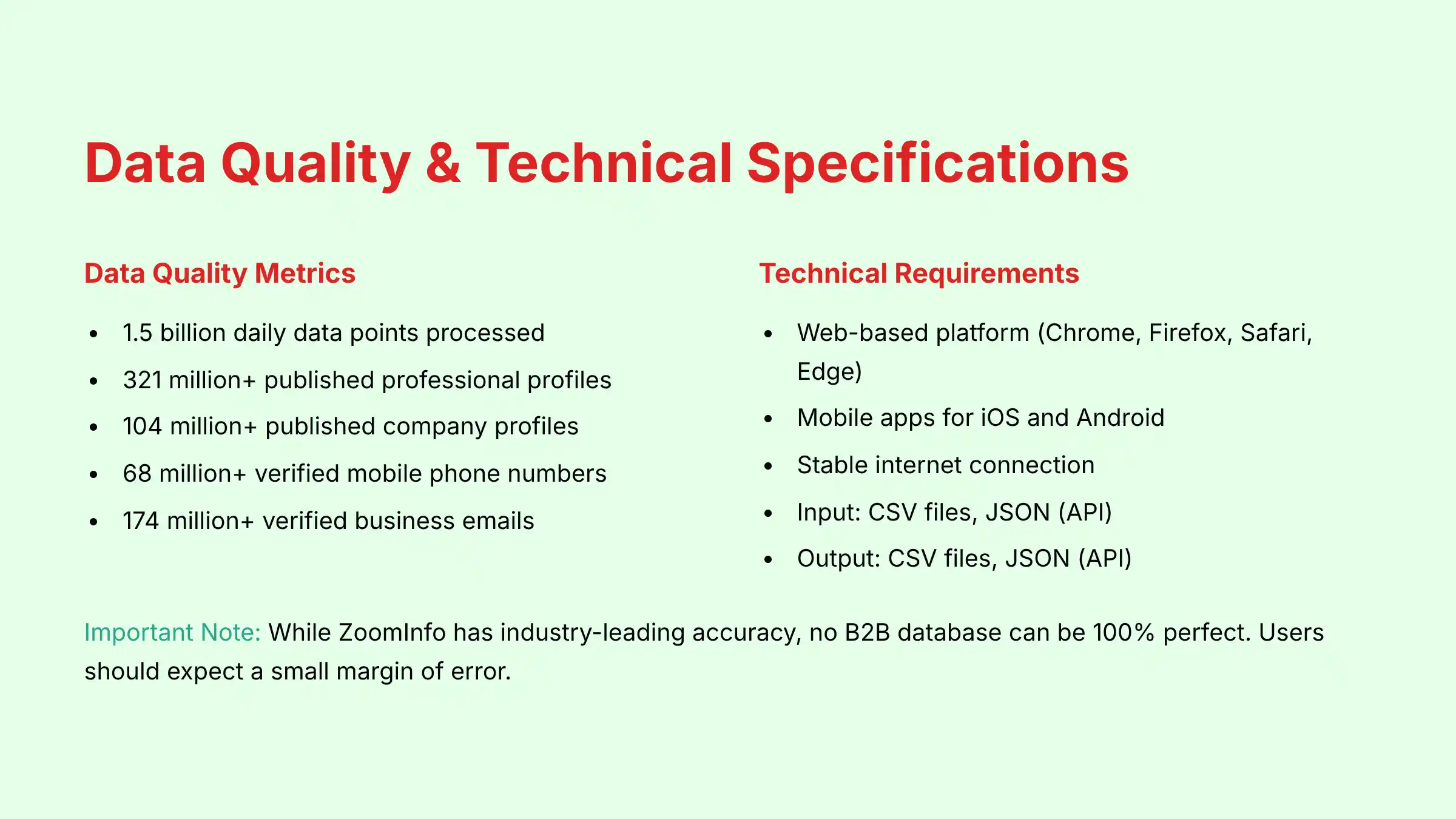
| Metric | Value |
|---|---|
| Daily Data Points Processed | 1.5 billion |
| Published Professional Profiles | 321 million+ |
| Published Company Profiles | 104 million+ |
| Verified Mobile Phone Numbers | 68 million+ (from North America) |
| Verified Business Emails | 174 million+ |
Important Note on Data Accuracy
While my tests confirm ZoomInfo has industry-leading accuracy, no B2B database can be 100% perfect. Users should expect a small margin of error and utilize the platform's built-in tools for reporting any inaccuracies they find. This helps improve the database for everyone.
A best practice I advise is to use ZoomInfo's data enrichment features to clean your existing CRM data before starting any new prospecting campaigns.
This gives you a clean, accurate baseline to work from and improves the ROI of your efforts.
Technical Specifications and System Requirements
For Sales Ops or IT professionals evaluating the platform, the technical requirements are straightforward. The core platform is web-based and accessible through any modern browser, with dedicated mobile apps available as well.
- Core Platform: Web-based (Chrome, Firefox, Safari, Edge are supported).
- Mobile App: Available for both iOS and Android.
- Browser/System Requirements: A stable internet connection and an up-to-date web browser are the only major requirements.
- Known Limitations: Certain legacy add-ons, like the Contact Contributor for Outlook, have specific limitations. As of my latest review, it supports 32-bit Outlook only and does not have a version for Mac OS.
- Input/Output Formats:
- Input: You can upload lists for enrichment using CSV files. The API uses JSON.
- Output: Data can be exported to CSV files. API responses are in JSON.
ZoomInfo Pricing in 2025: A Detailed Breakdown
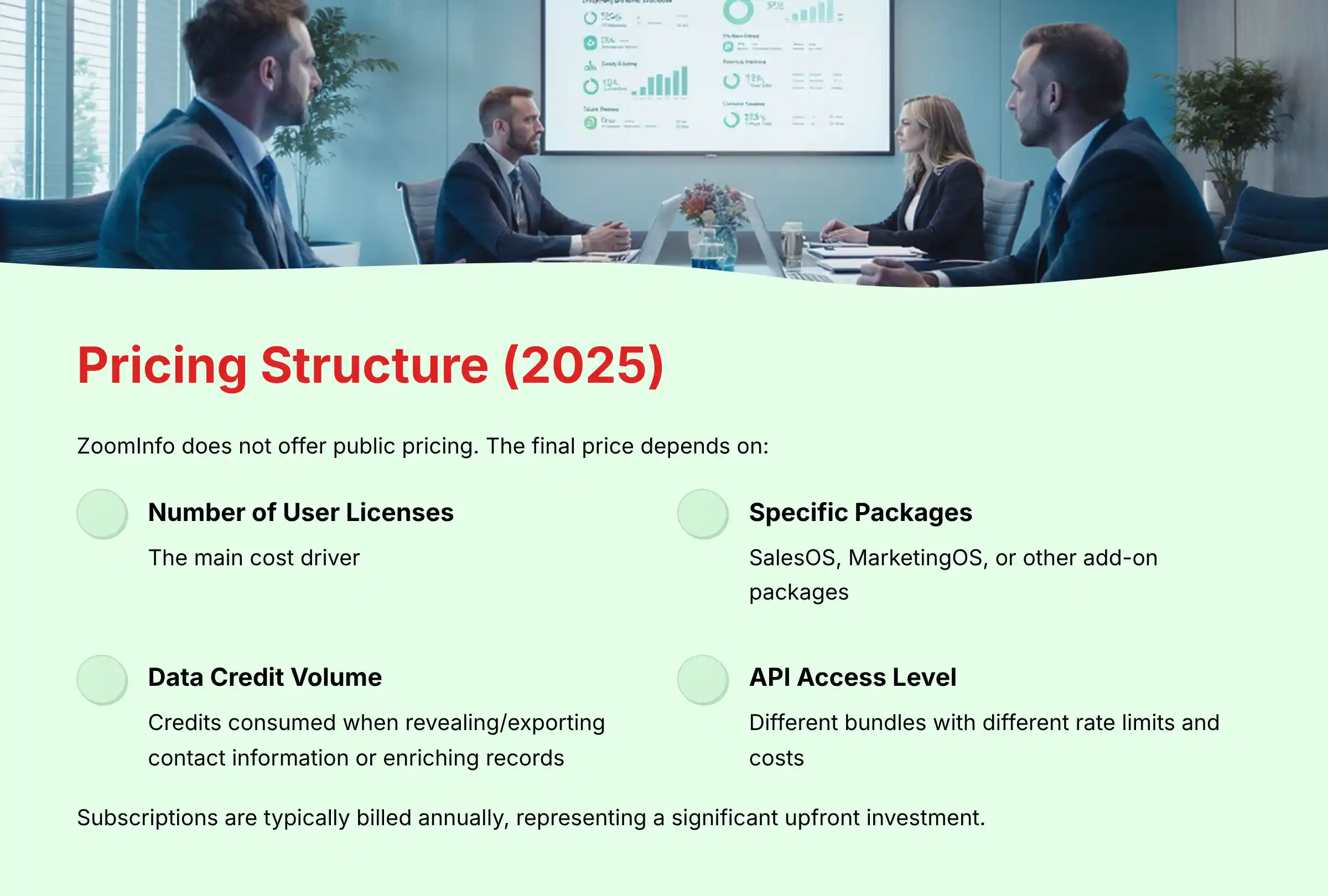
One of the most common questions I get is about cost. ZoomInfo does not offer public pricing.
The final price of a subscription depends on a combination of factors, and understanding these will help you prepare for a conversation with their sales team.
The primary factors that influence cost are:
- Number of User Licenses: This is the main cost driver.
- Specific Packages: The cost will change depending on whether you need SalesOS, MarketingOS, or other add-on packages.
- Data Credit Volume: Credits are consumed when you reveal or export contact information or enrich existing records. The volume of credits you need is a key part of the price.
- API Access Level: Accessing data programmatically via the API comes in different bundles with different rate limits and costs.
- Add-on Features: Advanced features like the Chorus conversation intelligence tool or expanded Intent Data packages come with additional costs.
Beyond the Quote: Understanding Total Cost of Ownership (TCO)
While the annual subscription fee is the primary expense, a comprehensive evaluation requires an analysis of the Total Cost of Ownership (TCO). For enterprise-level deployments, organizations must also factor in:
- Implementation & Integration Costs: Resources required to configure the platform and integrate it with core systems like a heavily customized Salesforce instance. This may involve internal RevOps time or fees for an external consultant.
- User Training & Enablement: The time investment needed to train the sales team to move beyond basic lookups and fully leverage advanced features like Workflows and Intent Data.
- Ongoing Administration: The time allocated for a sales or revenue operations manager to administer licenses, monitor credit usage, and refine workflows.
Calculating the TCO provides a more accurate picture of the long-term investment and is essential for building a robust ROI business case.
Important Note on Investment
ZoomInfo subscriptions are typically billed annually. This represents a significant upfront investment, so it is important for prospective buyers to have a clear business case and budget approval before signing a contract.
My advice to buyers is to conduct a thorough internal audit of your needs before engaging with sales. Go into the conversation knowing exactly how many licenses you need, your estimated monthly data usage, and which features are “must-haves” versus “nice-to-haves.”
This will put you in a much stronger position to negotiate a package that fits your needs and budget.
Integration Capabilities & API
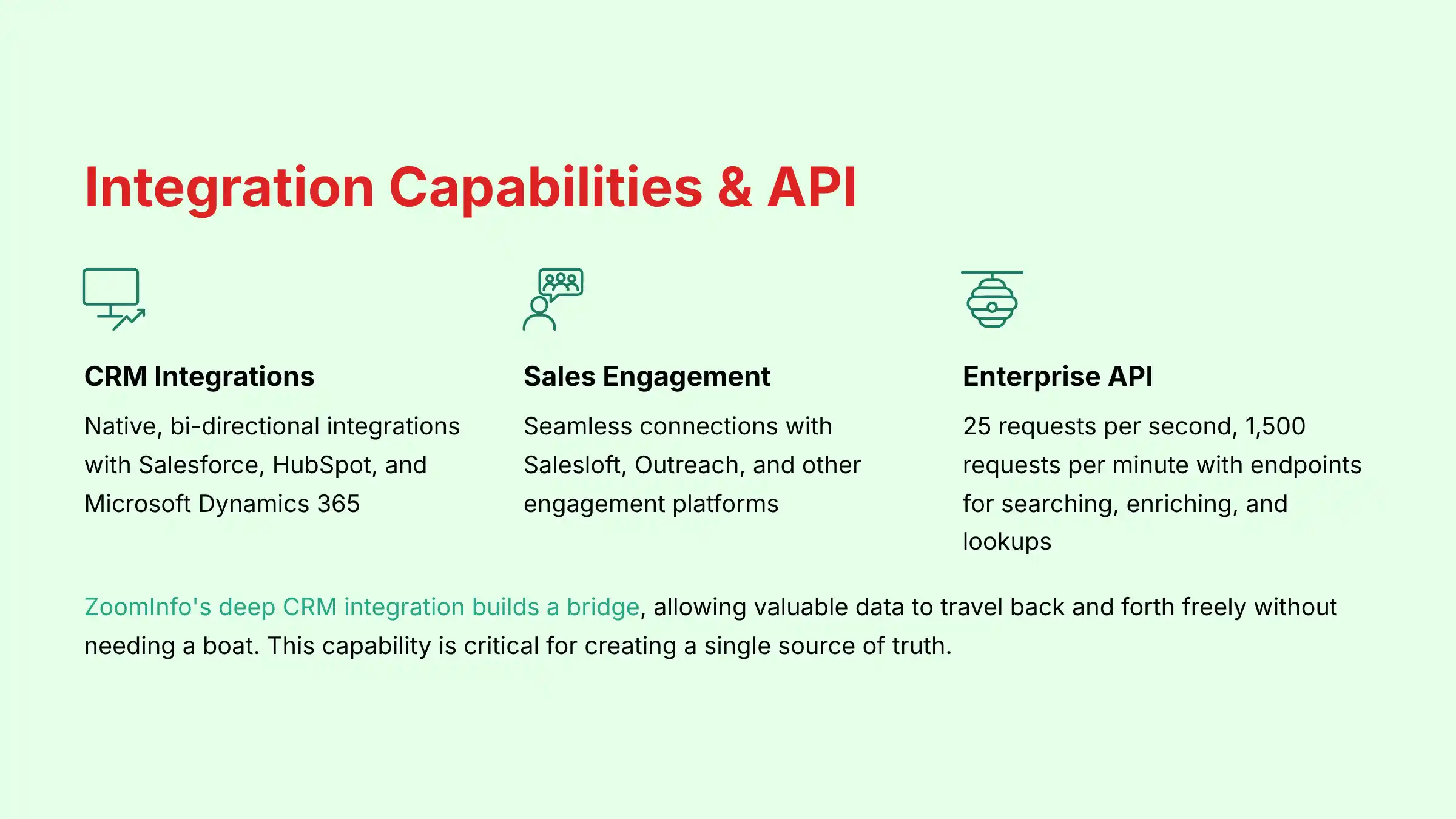
A sales tool that doesn't connect to your other systems is like a separate island. ZoomInfo's deep CRM integration builds a bridge, allowing valuable data to travel back and forth freely without needing a boat.
This capability is critical for creating a single source of truth and automating workflows.
The platform offers native, bi-directional integrations with the most popular business systems. This means data flows both ways, keeping your systems in sync. Key integration categories include:
- CRMs: Salesforce, HubSpot, Microsoft Dynamics 365.
- Sales Engagement: Salesloft, Outreach.
- Marketing Automation: Marketo, Pardot.
For teams with custom needs, the Enterprise API provides programmatic access to the database. It uses secure authentication methods and offers various endpoints for searching, enriching, and looking up data.
The API is well-documented and provides various endpoints for deep integration, including:
- Search & Enrich: For finding new prospects and updating existing records.
- Lookup: For retrieving specific company or contact profiles.
- Intent: For programmatically accessing company-level buying signals.
- Webhooks: For receiving real-time notifications about data changes.
The default API access is provisioned with 25 requests per second and 1,500 requests per minute. Higher rate limits are available through custom enterprise plans.
Professional Consultation Recommendation: Integration
When setting up a CRM integration, I always recommend testing it in a sandbox environment first. A misconfigured field mapping can lead to widespread data corruption in your primary system of record. It may be wise to consult with a technical professional who specializes in CRM administration for this step.
From my experience, the bi-directional sync with Salesforce is one of the most effective in the industry. It not only pushes new, accurate data into your CRM but also cleanses and completes existing records, which can save a sales operations team dozens of hours per month in manual data cleanup.
For teams exploring different approaches, our detailed ZoomInfo tutorials and use cases provide comprehensive guidance on maximizing integration benefits.

Security & Compliance: A YMYL Deep Dive
For any company handling customer data, security and compliance are not optional. This is an area where my team and I conduct rigorous assessments.
ZoomInfo has invested heavily in its security and privacy programs, which is demonstrated by its third-party certifications.
Key security and compliance certifications include:
- SOC 2 Type II: This certification verifies that an independent auditor has reviewed their security controls over an extended period. It gives you confidence in how they protect your data.
- ISO 27001: An international standard for information security management.
- ISO 27701: An extension to ISO 27001 that focuses specifically on privacy information management.
- TRUSTe Enterprise Privacy Seal: Validates that their privacy practices align with recognized laws and standards.
These certifications provide a strong framework for adhering to data privacy regulations like GDPR in Europe and CCPA in California.
ZoomInfo also maintains a public Trust Center where individuals can review their privacy policy and manage their own data.
Professional Consultation Recommendation: Legal Compliance
While ZoomInfo provides tools and data to aid in compliance, the ultimate responsibility for following laws like GDPR and CAN-SPAM rests with your company. ZoomInfo processes EU data under the legal basis of “Legitimate Interest,” however, this requires that your organization, as the data controller, conduct and document your own Legitimate Interest Assessment (LIA) before using the data for outreach. This assessment justifies why your direct marketing efforts are necessary and balanced against the privacy rights of the individual. I strongly recommend consulting with your legal team to develop and approve your communication policies and complete this required LIA documentation.
Primary Use Cases & Real-World Applications
Moving from features to practical application, ZoomInfo is most effective when used for specific, high-value projects. Based on my work with sales teams, these are the most common and impactful use cases.
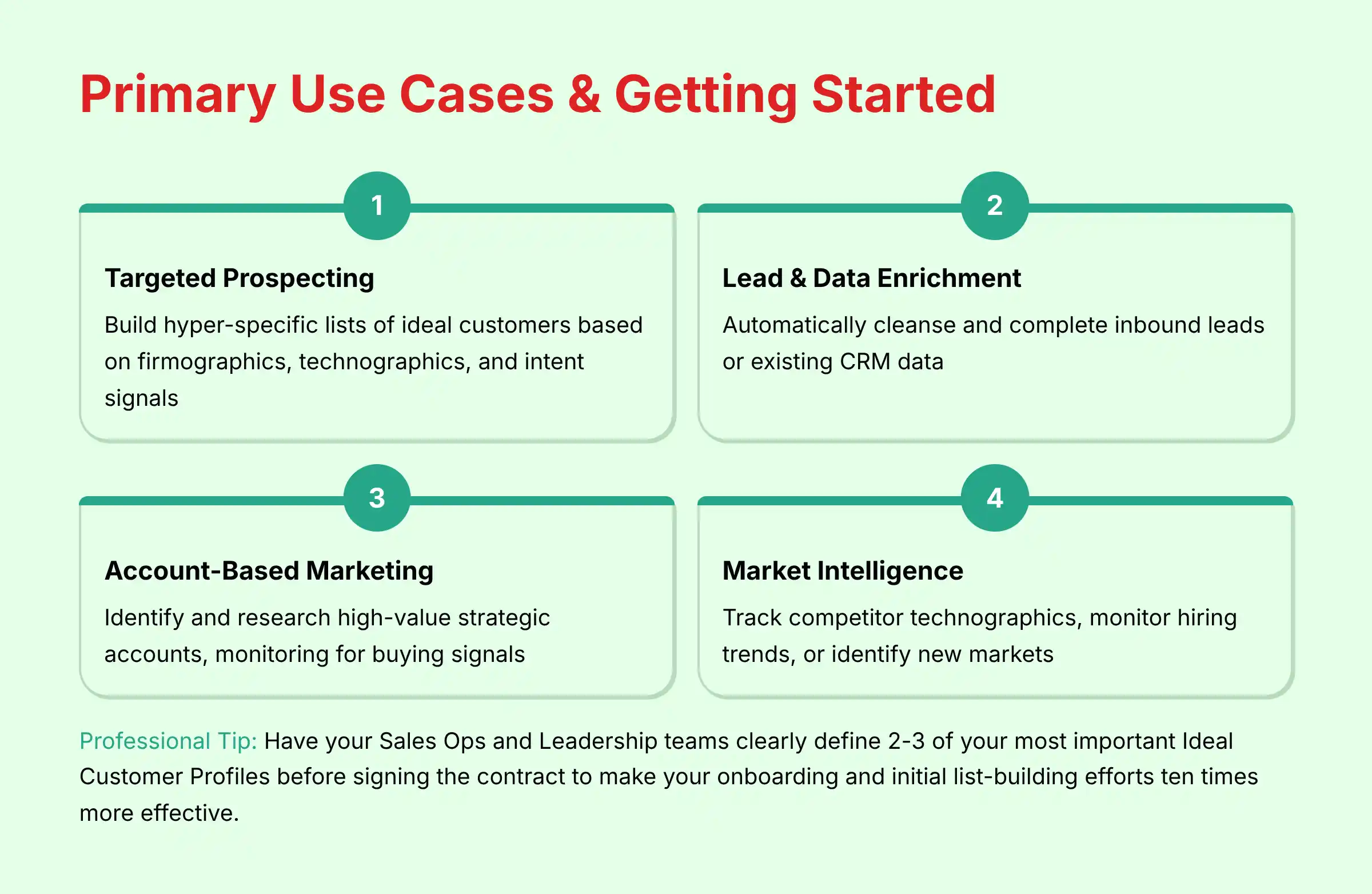
- Targeted Prospecting: Building hyper-specific lists of ideal customers. For example, a sales team at a SaaS company can build a list of all VPs of Engineering at companies in the US that use AWS and have recently received Series B funding. They can then push this list to a sales engagement tool for targeted outreach.
- Lead & Data Enrichment: Automatically cleansing and completing inbound leads or existing CRM data. This improves lead routing speed and gives reps the context they need for follow-up.
- Account-Based Marketing (ABM): Identifying and researching a set of high-value strategic accounts. Teams can monitor these accounts for buying signals and personalize their marketing and sales campaigns accordingly.
- Market Intelligence: Tracking competitor technographics, monitoring hiring trends in a specific industry, or identifying new markets to enter.
- Total Addressable Market (TAM) Analysis: For sales leadership and strategy teams, ZoomInfo's database serves as a powerful tool for conducting Total Addressable Market (TAM) analysis. By filtering the entire database by your Ideal Customer Profile (ICP) criteria, leaders can accurately quantify market size, identify expansion opportunities in new verticals or geographies, and make data-driven decisions about territory planning and sales headcount allocation.
Getting Started with ZoomInfo: Implementation Guide
For new customers, the onboarding process is structured to get you up and running effectively. Here is a typical implementation path based on my observations.
- Contact Sales & Get a Demo: The process begins with a consultation with the ZoomInfo sales team to discuss your needs and see a personalized demo of the platform.
- Initial Setup & Admin Configuration: Once you are a customer, the first step is for an administrator to set up user licenses, roles, and permissions in the Admin Portal.
- CRM Integration: This is a critical early step. Connecting ZoomInfo to your CRM (e.g., Salesforce, HubSpot) is what enables most of the platform's automation and data enrichment capabilities.
- Define Your First Project: I advise new teams to start with a clear, simple goal. A great first project is to build one high-value prospect list based on your most important ICP criteria.
- Build, Export, and Engage: Use the advanced search filters to build your list, export the contacts to your CRM or sales engagement platform, and begin your outreach.
- Review, Validate, and Iterate: After your initial outreach campaign, review the results. Analyze metrics like email bounce rates and connection accuracy to validate the quality of your list. Use these early findings to refine your ICP criteria and improve the effectiveness of your next project.
A professional tip I always give is to have your Sales Ops and Sales Leadership teams clearly define 2-3 of your most important Ideal Customer Profiles before you even sign the contract.
This will make your onboarding and initial list-building efforts ten times more effective.
What Are the Alternatives and Competitors to ZoomInfo?
While ZoomInfo is a market leader, it is important to be aware of the competitive landscape. Different tools may be a better fit depending on your budget, primary use case, or geographical focus.
Professional Network Intelligence
- Core Strength: Excellent for relationship mapping and leveraging the LinkedIn network for warm introductions
- Data Focus: Professional connections and company insights through LinkedIn's network
- Best Use Case: Social selling and relationship-based outreach strategies
✅ Strengths
- Deep professional relationship mapping
- Native LinkedIn integration for warm introductions
- Strong company growth insights and hiring trends
⚠️ Considerations
- Limited direct contact data (emails and mobile numbers)
- Requires LinkedIn Premium for full functionality
- Less comprehensive than ZoomInfo's database scale
Direct Contact Information
- Core Strength: Known for high-quality direct-dial phone numbers and email accuracy
- Pricing Model: More credit-based approach, appealing to smaller teams
- Best Use Case: Individual sales reps and small teams needing reliable contact data
✅ Strengths
- Excellent phone number accuracy rates
- Flexible credit-based pricing
- User-friendly interface for quick lookups
⚠️ Considerations
- Smaller database compared to ZoomInfo
- Limited advanced features like intent data
- Less comprehensive company intelligence
European Market Specialist
- Core Strength: Strong presence in European markets with GDPR-first approach
- Compliance Focus: Heavy emphasis on GDPR compliance in data collection and verification
- Best Use Case: European companies or global companies targeting European markets
✅ Strengths
- Strong European market coverage
- GDPR compliance built into platform design
- Good data quality verification processes
⚠️ Considerations
- Limited North American database coverage
- Fewer advanced AI features compared to ZoomInfo
- Smaller overall database size
Integrated Sales Solution
- Core Strength: Combines B2B database with built-in sales engagement platform
- Platform Type: All-in-one solution popular with small businesses and startups
- Best Use Case: Teams seeking streamlined workflow over specialized depth
✅ Strengths
- Integrated prospecting and engagement in one platform
- Cost-effective for small to medium teams
- Streamlined workflow from discovery to outreach
⚠️ Considerations
- May lack specialized depth of best-of-breed solutions
- Less enterprise-ready than dedicated tools
- Limited advanced features compared to ZoomInfo
The trade-off for Apollo's convenience can sometimes be the depth and enterprise-readiness of its features compared to a best-of-breed stack (e.g., ZoomInfo for data + Outreach for engagement).
Teams must evaluate whether the streamlined workflow of an all-in-one platform outweighs the specialized power of dedicated tools.
Frequently Asked Questions (FAQ) About ZoomInfo
For more comprehensive information about common questions and detailed answers, you can explore our dedicated ZoomInfo FAQs section.
How accurate is ZoomInfo's data in 2025?
ZoomInfo is an industry leader in data accuracy, using a mix of AI and human verification. While no database is 100% perfect because of natural data decay, my analysis confirms they have extensive processes to maintain high accuracy for their 174M+ verified emails and 68M+ North American mobile numbers.
How much does ZoomInfo cost?
ZoomInfo does not offer public pricing. Costs are provided via a custom quote and depend on the number of licenses, the volume of data credits needed, and the specific packages you choose, like SalesOS. Subscriptions are typically billed annually.
Is ZoomInfo better than LinkedIn Sales Navigator?
They serve different primary purposes and are often used together. ZoomInfo is superior for getting direct contact data like emails and mobile numbers and for tracking buying intent signals. Sales Navigator is stronger for mapping professional relationships and using the LinkedIn network for introductions.
Does ZoomInfo have a free trial?
ZoomInfo does not offer a public, self-service free trial. You must contact their sales team to schedule a personalized demo. During that process, a limited free trial or proof-of-concept may be granted based on your company's evaluation needs.
Is ZoomInfo compliant with GDPR and CCPA?
Yes, ZoomInfo has a dedicated compliance program for GDPR and CCPA. The company holds certifications like ISO 27701 and provides a public privacy center for individuals to manage their data. They operate under the “Legitimate Interest” legal basis for their data processing under GDPR.
What is the main benefit of ZoomInfo's AI Copilot?
The main benefit of the AI Copilot is saving sales reps time and automating research. It goes beyond providing data by automatically creating account summaries, identifying deal risks, and drafting personalized outreach emails, which cuts down on manual pre-call preparation.
Can I integrate ZoomInfo with Salesforce?
Yes, ZoomInfo offers a deep, native, and bi-directional integration with Salesforce. This allows for the automatic enrichment of existing records, the export of new contacts directly into Salesforce, and even embedding ZoomInfo's data inside the Salesforce user interface.
What are ZoomInfo credits?
ZoomInfo credits are the currency used for data consumption. Credits are used when a user views a contact's full profile, exports contacts to a list or CRM, or enriches records using the platform. The number of credits included is a key component of your annual subscription.
Disclaimer
Important Disclaimers:
Technology Evolution Notice:
The information about ZoomInfo and AI Sales Software tools presented in this article reflects our thorough analysis as of 2025. Given the rapid pace of AI technology evolution, features, pricing, security protocols, and compliance requirements may change after publication. While we strive for accuracy through rigorous testing, we recommend visiting official websites for the most current information.
Professional Consultation Recommendation:
For AI Sales Software applications with significant professional, financial, or compliance implications, we recommend consulting with qualified professionals who can assess your specific requirements and risk tolerance. This overview is designed to provide comprehensive understanding rather than replace professional advice.
Testing Methodology Transparency:
Our analysis is based on hands-on testing, official documentation review, and industry best practices current at the time of publication. Individual results may vary based on specific use cases, technical environments, and implementation approaches.
This detailed review should provide a clear picture of ZoomInfo's comprehensive features and capabilities and its place in the modern sales technology stack. Whether you're considering ZoomInfo for your first sales intelligence platform or evaluating it against other solutions, understanding these core capabilities will help you make an informed decision for your go-to-market strategy.


Leave a Reply