Is SalesIntel the Right AI Sales Software For You?
Take This 2-Minute Quiz to Find Out!
Key Takeaways
- AI-Powered Solution: SalesIntel combines AI automation with human verification to deliver 95% accurate B2B contact data, solving the time-consuming challenge of manual prospecting
- Human Verification Advantage: Every contact record undergoes human verification every 90 days, providing higher accuracy than purely automated competitors
- Intent Data Capabilities: Monitors millions of online content consumption events to identify accounts actively researching solutions, enabling warmer outreach
- Compliance Ready: Maintains GDPR and CCPA compliance with SOC 2 Type II certification, providing secure and legally compliant B2B prospecting
- Productivity Impact: Reduces time spent on non-selling activities from 40% to focus on revenue-generating conversations and qualified prospect engagement
What is SalesIntel and what problem does it solve for sales teams?
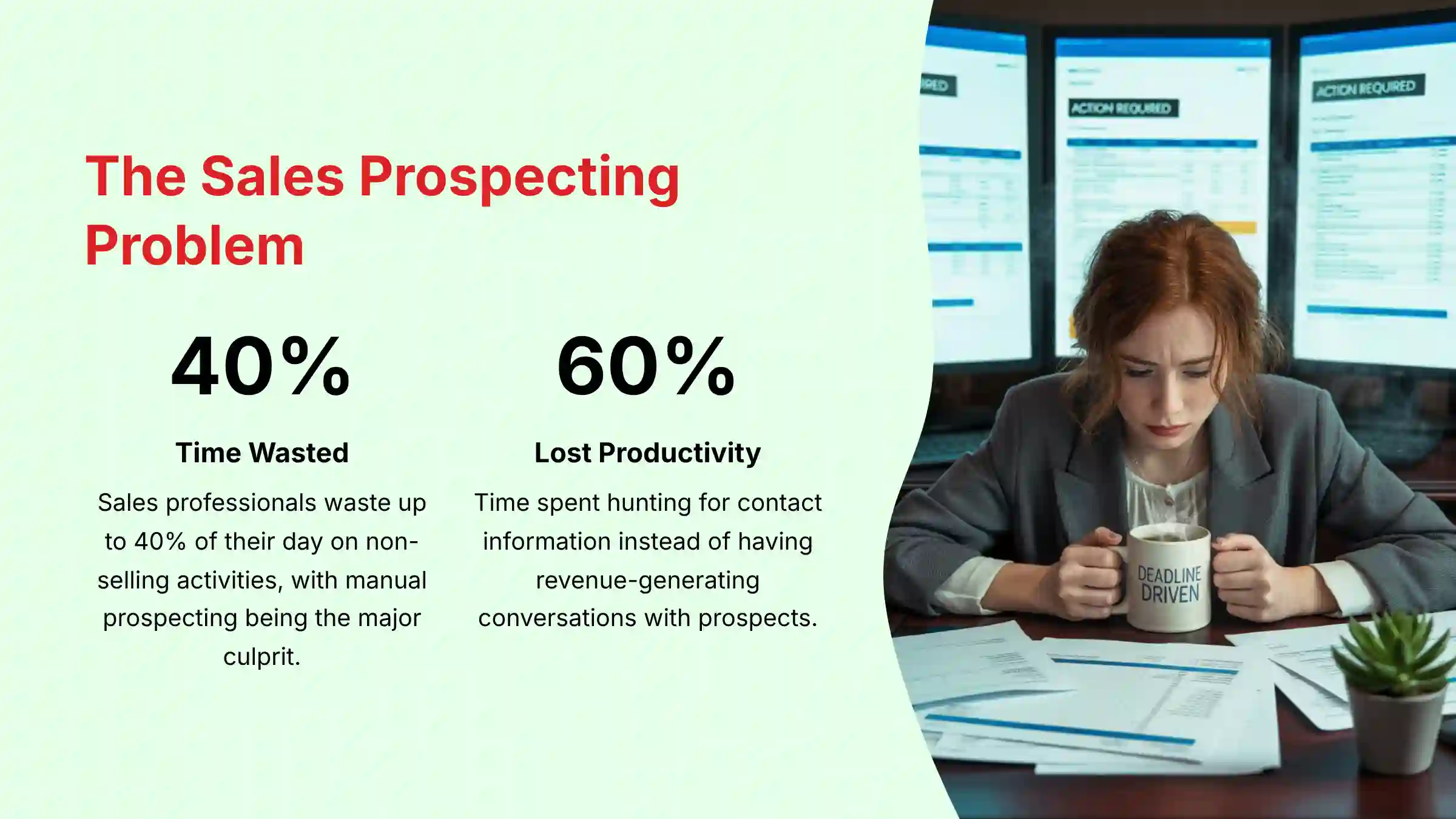
SalesIntel is an AI-powered B2B data platform designed to help sales and marketing teams accelerate their pipeline and revenue growth by solving one of sales' most time-consuming challenges: finding accurate and complete contact and company information for ideal prospects.
Sales professionals often waste up to 40% of their day on non-selling activities, with manual prospecting being a major culprit that prevents them from focusing on actual revenue-generating conversations.
The platform addresses this inefficiency by providing a comprehensive database of human-verified contact details, including direct-dial mobile numbers and email addresses, alongside detailed company firmographics and technographics. What sets SalesIntel apart in the AI sales software landscape is its hybrid approach that combines automated data collection with human verification every 90 days, aiming to deliver industry-leading accuracy rates.
By leveraging SalesIntel, sales development reps (SDRs) and account executives (AEs) can dramatically reduce time spent on prospecting while increasing the quality of their outreach. The platform enables teams to build targeted prospect lists, enrich existing CRM data with accurate contact information, and identify in-market buyers through intent data signals.
This transformation allows sales professionals to spend more time on high-value activities like qualifying prospects, conducting discovery calls, and closing deals rather than hunting for contact information across multiple sources. For organizations looking to maximize their SalesIntel Overview and Features, this foundational understanding is crucial.
How does SalesIntel leverage AI technology in its platform?
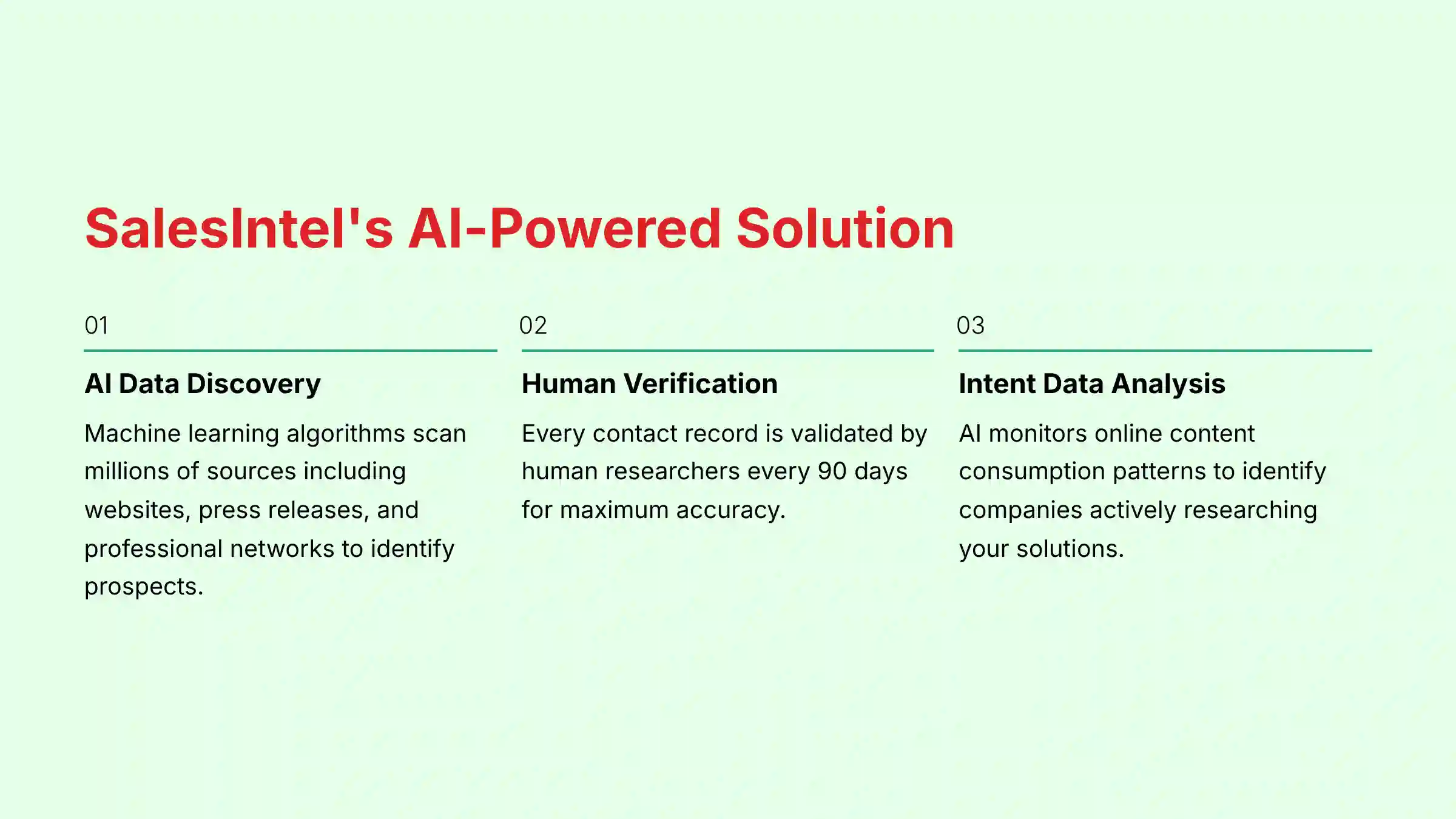
SalesIntel strategically integrates Artificial Intelligence to enhance both the scale of its data collection and the quality of its insights, while maintaining a crucial “human-in-the-loop” verification process that differentiates it from purely automated solutions.
The AI serves as a powerful engine for data discovery and processing, continuously scanning millions of public and private data sources including company websites, press releases, SEC filings, job postings, and professional networks to identify signals of organizational change, new contacts, and company growth patterns.
The machine learning algorithms structure and categorize this raw data intelligently, parsing job titles into standardized seniority levels and departments, identifying company hierarchies, and flagging potential data decay indicators such as contacts who have likely changed positions.
SalesIntel's AI also powers its Intent Data feature, which analyzes online content consumption patterns across thousands of B2B websites to signal which companies are actively researching specific topics related to your products or services.
However, SalesIntel's key differentiator in the AI sales software space is that it doesn't rely solely on automated processes. Every piece of contact data identified by AI is routed to their global team of human researchers for final verification before publication.
This hybrid approach ensures higher accuracy rates while leveraging AI's scale and speed advantages. The AI continuously learns from human feedback, improving its ability to identify high-quality prospects and predict data accuracy over time, creating a self-improving system that becomes more valuable as it processes more data. Those seeking a comprehensive SalesIntel Review should understand this technological foundation.
How accurate is SalesIntel's B2B contact and company data?
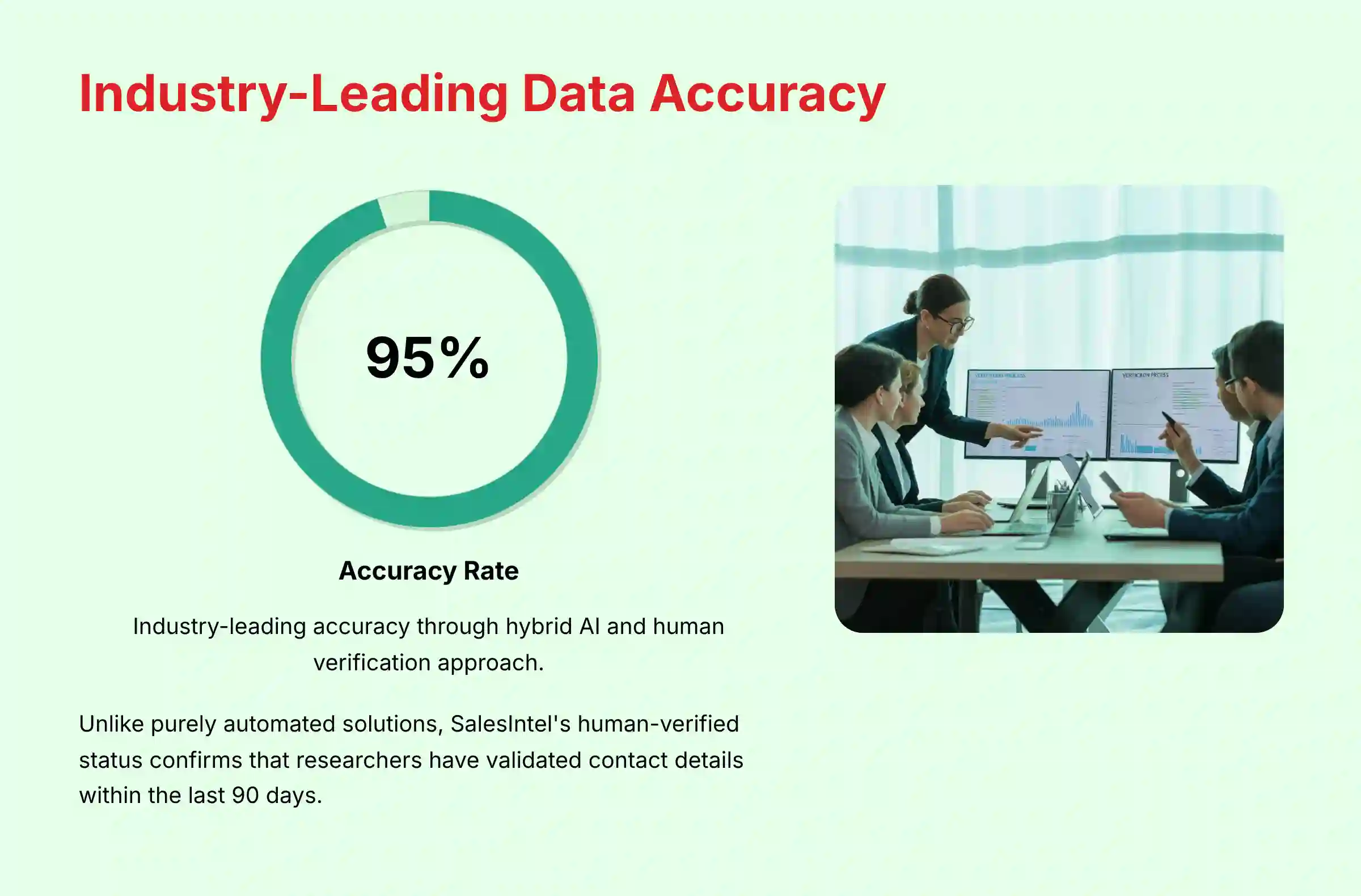
SalesIntel claims an industry-leading 95% accuracy rate for its B2B contact and company data, achieved through their unique hybrid approach that combines AI-powered data collection with rigorous human verification.
Unlike platforms that rely solely on automated web scraping and algorithmic data aggregation, SalesIntel employs a large, distributed team of human researchers who validate every single contact record on a rolling 90-day cycle to ensure information remains current in today's rapidly changing business environment.
When you see the “human-verified” status on a contact record, it confirms that a researcher has validated the details—including job title, company affiliation, email address, and direct-dial phone number—within the last 90 days.
This verification process is critical for maintaining email sender reputation, improving call connection rates, and building trust with prospects through accurate first-touch communications.
For data that hasn't been re-verified within the 90-day window or for specific research requests, SalesIntel offers their “Research on Demand” service, allowing users to submit contact lists for verification at no additional cost, typically with rapid turnaround times.
However, it's important to understand that no B2B database achieves 100% accuracy indefinitely, as people change jobs daily and companies undergo constant organizational changes. Best practice involves implementing a pre-sequence data hygiene step before major outreach campaigns, potentially using secondary email validation services to catch the small percentage of contacts that may have changed since verification, ensuring optimal deliverability and protecting your domain's sending reputation.
How does SalesIntel compare to ZoomInfo in the AI sales software market?
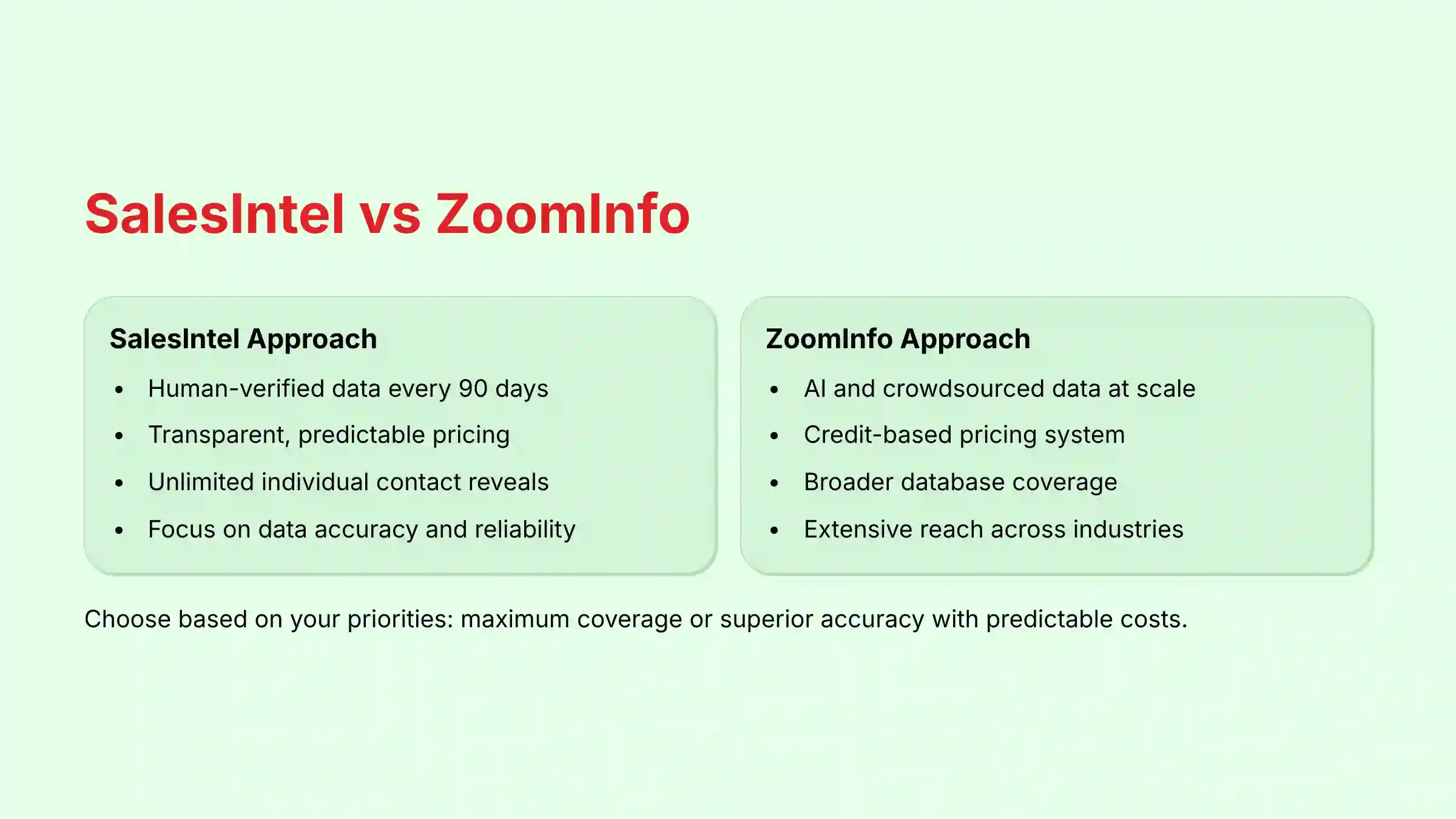
SalesIntel and ZoomInfo represent different philosophies in the B2B data and sales intelligence market, with their primary distinction lying in data verification methodology and pricing models.
SalesIntel built its reputation on human-verified data quality, where every contact record undergoes verification by human researchers every 90 days. In contrast, ZoomInfo operates at massive scale, relying more heavily on AI, machine learning, and crowdsourced data from its extensive user community to build and maintain its database.
This philosophical difference creates practical implications for users. ZoomInfo typically offers broader contact coverage and database size, making it valuable for teams needing extensive reach across multiple industries and geographies.
However, SalesIntel focuses on superior accuracy and reliability for its verified records, particularly excelling in providing direct-dial mobile numbers and recently validated contact information.
The pricing structures also differ significantly. SalesIntel has traditionally positioned itself with more transparent, user-friendly pricing that includes unlimited individual contact reveals for licensed users, though bulk export limits apply based on subscription tiers.
ZoomInfo operates primarily on a credit-based system where users consume credits to unlock contact information, which can create unpredictable costs for high-volume prospecting teams.
For AI sales software evaluation, consider your team's priorities: if you need maximum database coverage and have robust data cleaning processes, ZoomInfo might suit you better. If you prioritize data accuracy, want predictable costs, and prefer recently human-verified contacts for higher-stakes outreach campaigns, SalesIntel could provide better ROI despite potentially smaller overall database size. Teams evaluating options should also consider SalesIntel Top Alternatives and Competitors for comprehensive comparison.
What type of buyer intent data does SalesIntel provide?
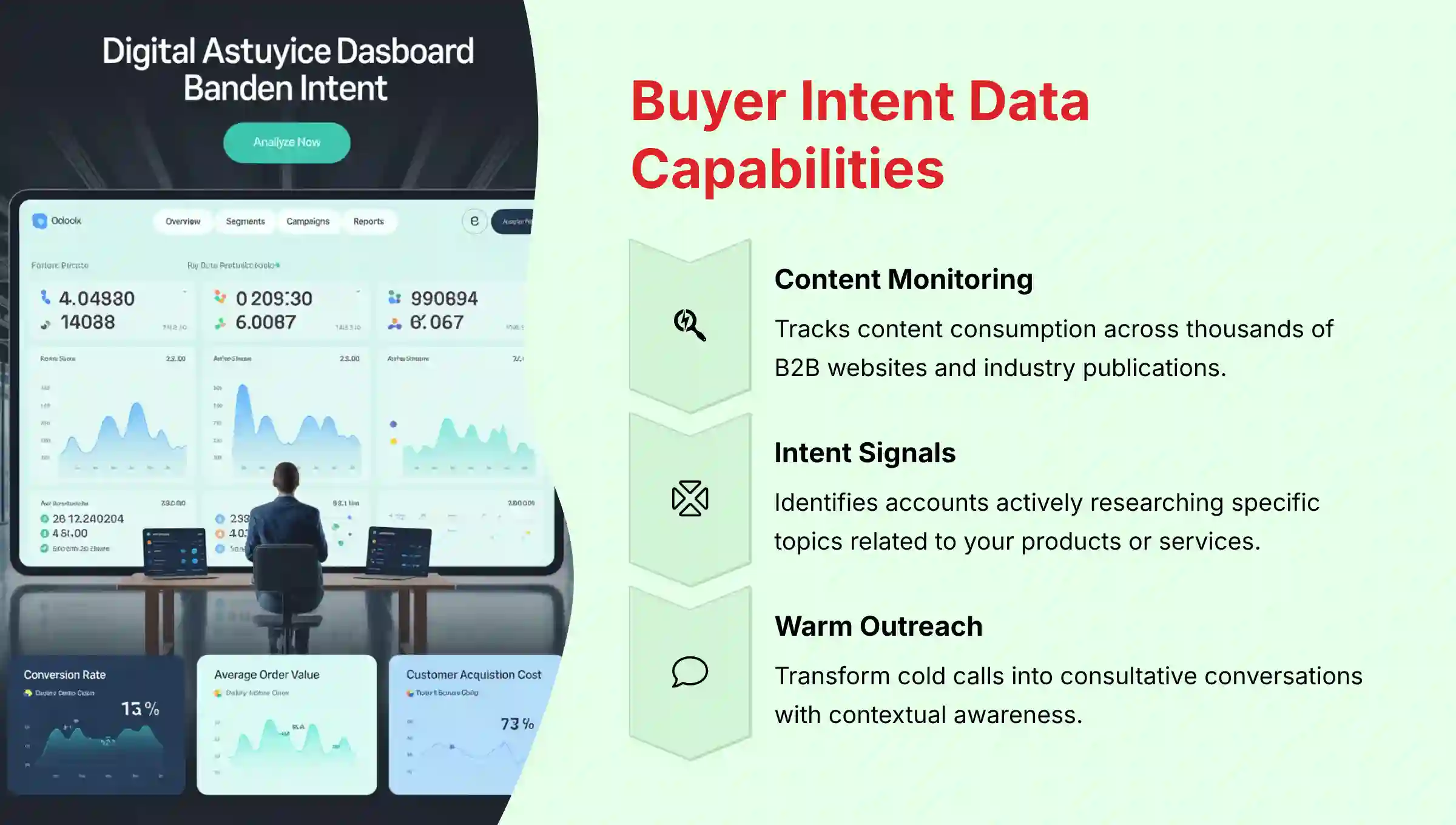
SalesIntel provides comprehensive third-party buyer intent data designed to help sales and marketing teams identify accounts actively researching solutions, moving beyond static firmographic information to focus on dynamic behavioral signals that indicate immediate buying interest.
This capability addresses the critical question of “Who is in-market to buy right now?” rather than simply “Who fits our ideal customer profile?”
The platform monitors millions of online content consumption events across thousands of B2B websites, industry publications, and media sources to track when employees from specific companies are consuming content related to particular topics.
When research volume and intensity around specific subjects—such as “AI sales software,” “CRM integration,” competitive solutions, or industry-specific terms—spike at a target account, SalesIntel flags it as showing buying intent.
Users can access several key data points:
- The specific topics being researched by the account
- Intent intensity levels (high, medium, or low)
- Trend graphs showing how interest has evolved over time
This information enables sales teams to prioritize outreach efforts on accounts already in active buying cycles, leading to more relevant conversations and significantly higher conversion rates.
Instead of making purely cold outreach attempts, sales professionals can approach prospects with contextual awareness, saying “I noticed your team is actively exploring solutions for [specific topic].” This transforms cold calling into warm, consultative conversations.
The intent data also helps marketing teams create more targeted content and campaigns, while enabling account-based marketing strategies that focus resources on accounts showing genuine buying signals rather than broadcasting to uninterested prospects. For practical implementation guidance, explore SalesIntel Tutorials and Usecase resources.
What are the key limitations of using SalesIntel as a data provider?
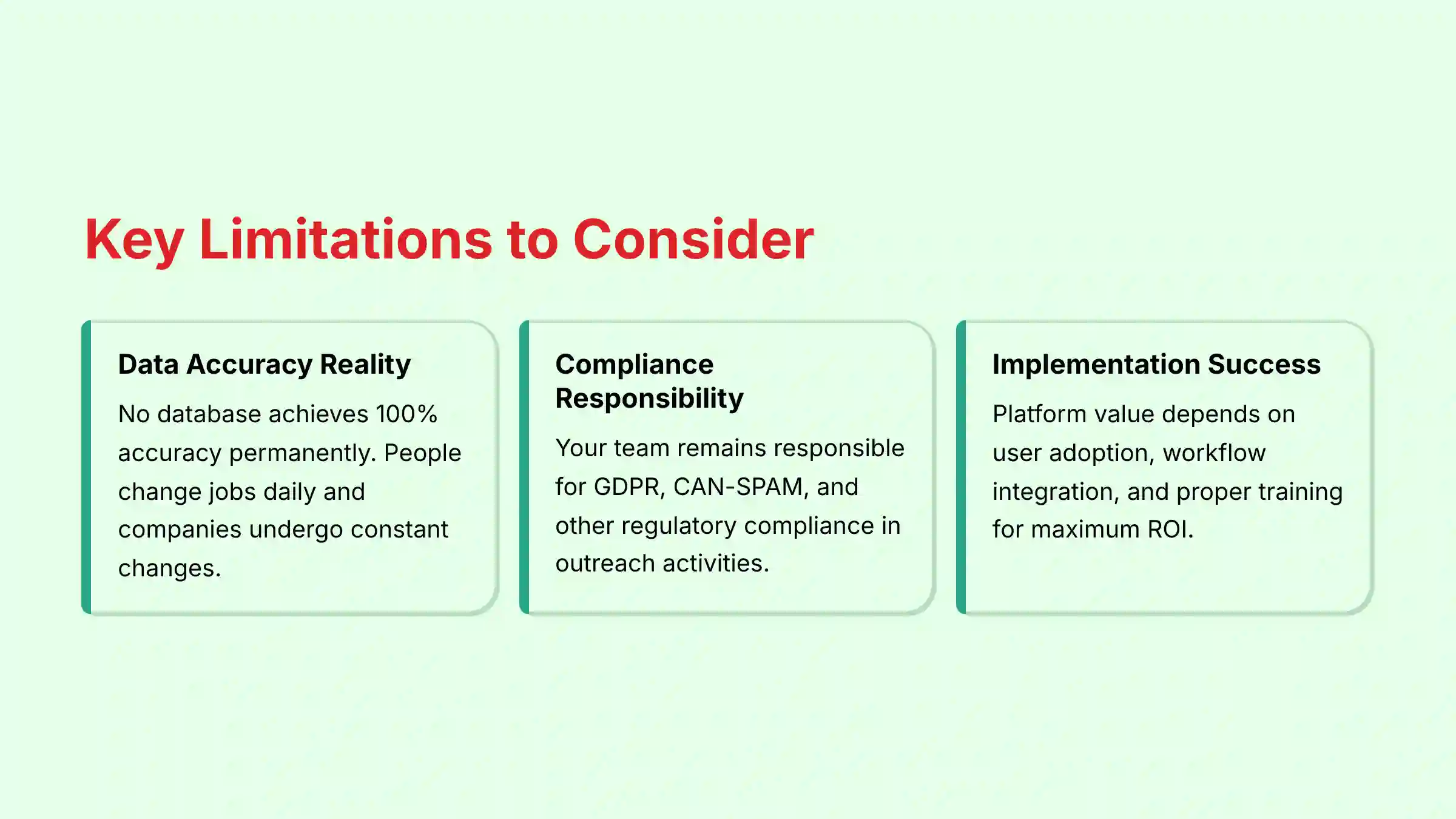
While SalesIntel offers significant competitive advantages in the AI sales software landscape, understanding its limitations is crucial for setting realistic expectations and maximizing ROI.
The most significant limitation, common to all B2B data platforms, is that no database achieves 100% accuracy permanently. Despite SalesIntel's rigorous 90-day human verification cycle, people change jobs, companies get acquired, phone numbers are disconnected, and organizational structures evolve continuously.
A contact verified 89 days ago could have changed positions yesterday.
Access to contact data doesn't equate to permission for outreach. Your team remains responsible for complying with relevant regulations like GDPR in Europe (requiring legitimate interest basis) and CAN-SPAM in the United States.
Over-reliance on any single data source can create blind spots, as different providers excel in different regions, industries, or contact types. You might miss prospects better covered by niche or regional data providers.
The platform's value depends heavily on user adoption and workflow integration. If sales reps find the interface cumbersome, don't integrate it with their daily routines, or lack proper training on advanced features, even the highest-quality data will remain unused, resulting in negative ROI.
Additionally, intent data requires interpretation and strategic application—raw intent signals without proper context or follow-up strategies won't automatically convert to pipeline.
Cost considerations also matter. While SalesIntel offers unlimited individual contact reveals, bulk export limits based on subscription tiers can impact large-scale data enrichment projects.
Teams must carefully evaluate their actual usage patterns against pricing tiers to avoid unexpected limitations or additional costs during critical prospecting campaigns. Consider exploring the broader landscape with Best 10 AI Sales Prospecting & Intelligence tools for comprehensive evaluation.
How much does SalesIntel cost for AI sales software implementation?
SalesIntel employs a customized pricing model based on specific organizational needs rather than publishing standard rate cards, which is common practice in the enterprise B2B data industry.
The final investment depends on several key factors that sales leaders should consider when budgeting for AI sales software implementation.
Primary pricing variables include the number of user licenses required, as costs scale with team size and the number of sales or marketing professionals needing platform access.
Data scope significantly impacts pricing—access to global versus US-only databases, industry-specific data sets, and premium features like Intent Data or advanced Technographics influence total costs.
Feature tier selection affects pricing, with basic prospecting capabilities priced differently from comprehensive packages including CRM integrations, API access, and advanced analytics.
Contract length also influences pricing, with annual or multi-year commitments typically offering substantial discounts compared to shorter-term agreements. SalesIntel has historically positioned itself as providing better ROI through transparent pricing and unlimited individual contact reveals, contrasting with credit-based competitors where high-volume prospecting can create unpredictable costs.
When engaging with SalesIntel's sales team for pricing, prepare to discuss your current sales process, monthly prospecting volume, CRM requirements, and team size. This information helps them recommend appropriate packages and ensures you're not overpaying for unused features or underestimating your needs.
Request specific details about bulk export limits for your anticipated usage, as this can impact large-scale list building activities. Consider the total cost of ownership, including implementation time, training requirements, and potential productivity gains when evaluating the investment against your current prospecting costs and results.
Is SalesIntel compliant with GDPR and CCPA data privacy regulations?
Yes, SalesIntel maintains comprehensive compliance with major data privacy regulations including the General Data Protection Regulation (GDPR) in Europe and the California Consumer Privacy Act (CCPA), providing a robust framework to help customers use B2B data in a legally compliant manner.
For GDPR compliance, SalesIntel operates under the legal basis of “Legitimate Interest” for processing B2B contact information, arguing that such processing serves necessary business purposes of B2B marketing and sales activities.
Their compliance infrastructure includes:
- Detailed data governance with comprehensive records of data sources and processing activities
- Clear processes for data subject rights including access, correction, and deletion requests through a dedicated privacy portal
- Transparent notice procedures directing data subjects to their privacy policy
- Enterprise-grade security measures including encryption and access controls backed by SOC 2 Type II certification
SalesIntel provides customers with tools and guidance for compliant usage, including opt-out management capabilities, data source transparency, and documentation supporting legitimate interest claims.
However, it's crucial to understand that while SalesIntel provides the compliant framework and data infrastructure, your organization remains ultimately responsible for how you implement and use that data in your sales and marketing activities.
This shared responsibility model means your company must ensure outreach practices align with applicable laws in your target markets. Different regions have varying requirements for consent, opt-out mechanisms, and communication preferences.
It's strongly recommended to consult with your legal and compliance teams before implementing SalesIntel data in outreach campaigns, particularly for international prospecting or when targeting residents of privacy-regulated jurisdictions. Proper implementation includes honoring opt-out requests, maintaining suppression lists, and ensuring your email and calling practices meet local requirements.
What customer support and onboarding does SalesIntel include?
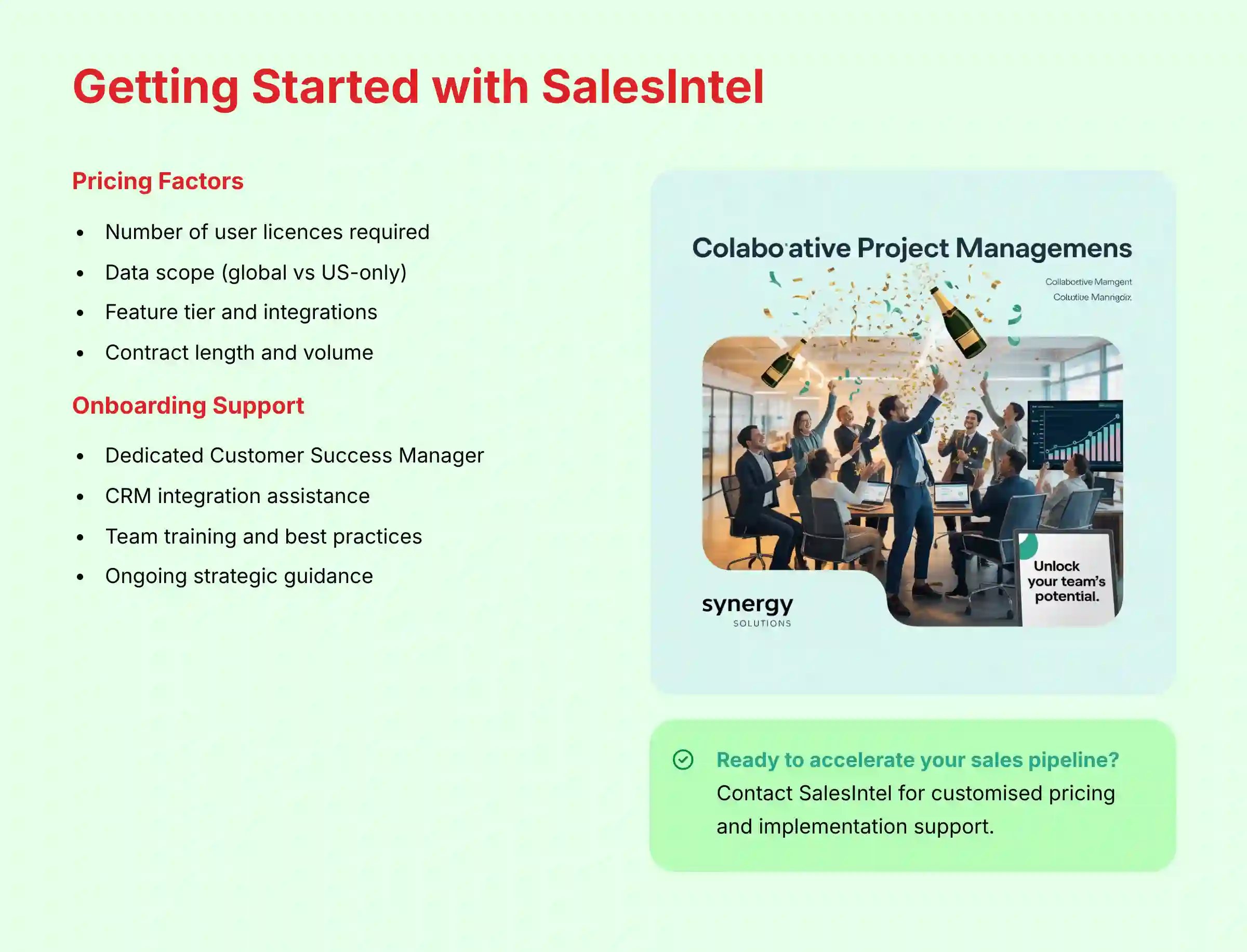
SalesIntel provides comprehensive customer success and onboarding programs designed to ensure rapid time-to-value and long-term platform adoption, recognizing that AI sales software success depends heavily on proper implementation and user training.
Upon contract signing, new customers are assigned a dedicated Customer Success Manager (CSM) who serves as the primary relationship owner and orchestrates the entire onboarding experience.
The structured onboarding process begins with technical setup, where the CSM assists with:
- CRM integrations including Salesforce, HubSpot, or other sales platforms
- Configures field mappings to ensure clean data flow
- Validates that prospecting workflows integrate seamlessly with existing sales processes
Team training follows, with live sessions customized to your specific workflow covering:
- Platform navigation
- RevDriver Chrome extension usage
- Intent data interpretation
- Advanced search techniques
- List building best practices
Strategic guidance extends beyond technical training, as CSMs work with sales leadership to align platform usage with revenue goals, establish prospecting best practices, define data hygiene processes, and create accountability frameworks for adoption.
This consultative approach helps teams maximize ROI rather than simply learning button-clicking.
Post-onboarding support continues through multiple channels:
- Users maintain access to their dedicated CSM for strategic questions and optimization opportunities
- Technical support teams for troubleshooting and integration issues
- Extensive online knowledge bases with articles, video tutorials, and best practice guides
Many customers also benefit from user community forums and regular webinar training sessions covering advanced features and industry best practices.
The key to maximizing onboarding value is preparation. Before your first CSM meeting, document your exact lead-to-opportunity workflow, identify required CRM field mappings, and outline your prospecting volume expectations.
This preparation transforms generic training into specific, high-impact implementation sessions that deliver immediate value and prevent common integration pitfalls. For ongoing support and common questions, reference the comprehensive SalesIntel FAQs resource.


Leave a Reply