Is LeadIQ the Right Prospecting Tool for Your Sales Team?
Take This 2-Minute Quiz to Find Out!
LeadIQ stands as one of the most powerful AI-driven sales prospecting platforms in the B2B space, transforming how sales teams identify, capture, and connect with high-quality prospects. This comprehensive guide explores everything you need to know about LeadIQ's capabilities, limitations, pricing, and competitive position in the sales intelligence market.
Key Takeaways
- AI-powered prospecting: LeadIQ uses advanced AI for real-time data verification with 95%+ deliverability guarantee for verified emails
- Workflow integration: Chrome extension seamlessly captures LinkedIn prospects and syncs to CRM in seconds
- Ideal for SDR teams: Best suited for sales development representatives focused on high-volume prospecting activities
- Competitive positioning: Workflow-focused alternative to data-heavy platforms like ZoomInfo and Apollo
- ROI measurement: Quantifiable efficiency gains through time savings, improved data quality, and increased pipeline generation
What is LeadIQ and how does it use AI for sales prospecting?
LeadIQ is an AI-powered sales prospecting and intelligence platform designed to help B2B sales teams find, capture, and sync accurate contact data directly into their CRM systems. Its primary function is to eliminate the time-consuming manual work of searching for prospect information, allowing sales development representatives (SDRs) and account executives (AEs) to focus more on selling activities rather than administrative tasks.
The platform's AI capabilities work through several sophisticated mechanisms. First, it powers a massive, constantly updated database of B2B contact and company information. When a user searches for a prospect, LeadIQ's algorithms analyze countless data sources to identify and present the most likely contact details. Second, and critically important, its AI performs real-time data verification. Before presenting an email address or phone number, the system executes automated validation checks to confirm deliverability and accuracy, assigning confidence scores to each data point. This AI-driven verification distinguishes it from static contact lists, as it actively works to reduce bounce rates and connection failures that plague manual prospecting efforts.
By integrating directly into the tools where sales reps already work—such as LinkedIn Sales Navigator and company websites—LeadIQ uses AI to streamline the entire top-of-funnel workflow. The platform transforms hours of manual research into seconds of automated, verified data capture, fundamentally changing how modern sales teams approach prospecting efficiency.
For a comprehensive understanding of LeadIQ's core features and capabilities, explore our detailed LeadIQ Overview and Features analysis.
How does the LeadIQ Chrome Extension work within a sales rep's workflow?
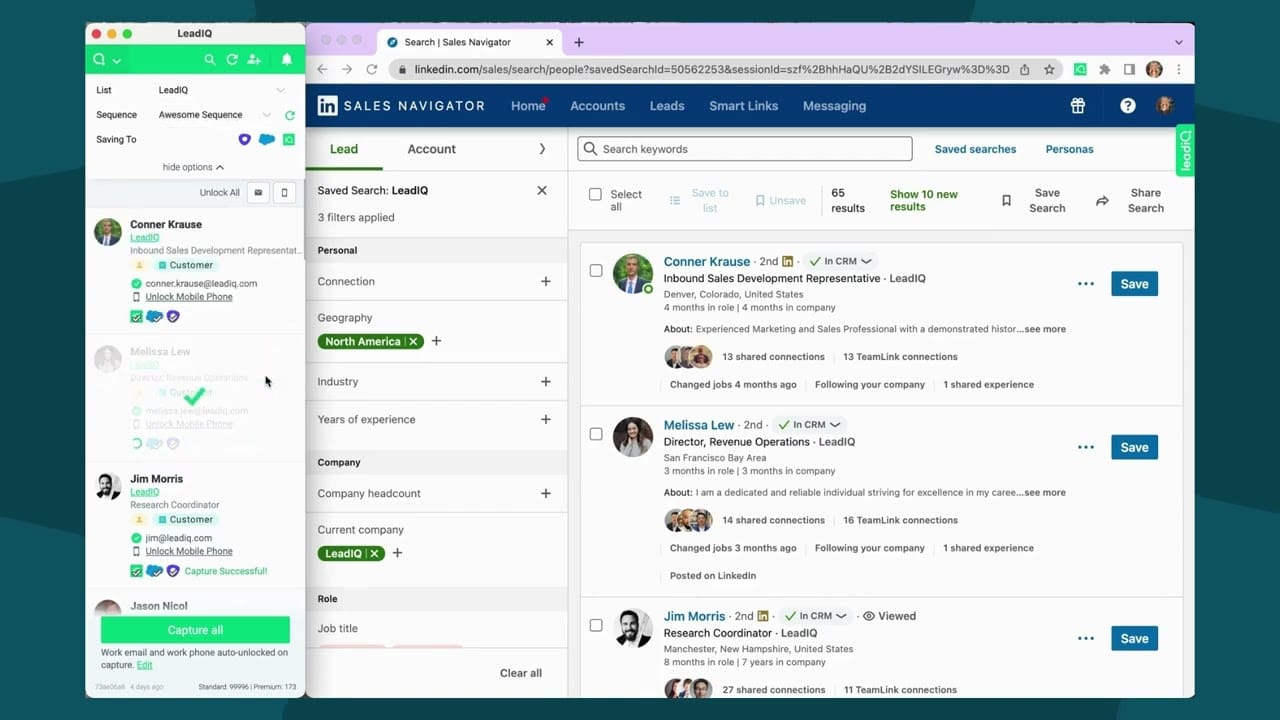
The LeadIQ Chrome Extension is the central component of its user experience, designed to integrate seamlessly into a sales representative's existing daily workflow. Instead of forcing users to switch between multiple tabs and applications, the extension overlays itself directly on key prospecting websites, primarily LinkedIn and LinkedIn Sales Navigator.
Here's how the typical workflow functions:
Prospecting on LinkedIn: A sales rep identifies a target prospect while browsing LinkedIn. With the LeadIQ extension active, a sidebar automatically appears on the page, ready for action.
Capturing Data: By clicking the “Capture” button within the extension, the rep instructs LeadIQ to find contact information for that specific prospect. The tool's AI immediately scours its database and performs real-time verification checks against multiple data sources.
Revealing Information: Within seconds, the extension displays available work emails, company phone numbers, and sometimes mobile numbers for the prospect. Each data point includes accuracy indicators showing verification status, helping reps prioritize which contacts to pursue first.
One-Click Sync to CRM: The user selects the desired prospect and, with a single click, sends all captured data directly to their connected CRM (like Salesforce or HubSpot) and/or sales engagement platform (like Outreach or Salesloft). The system automatically checks for duplicates before creating new records.
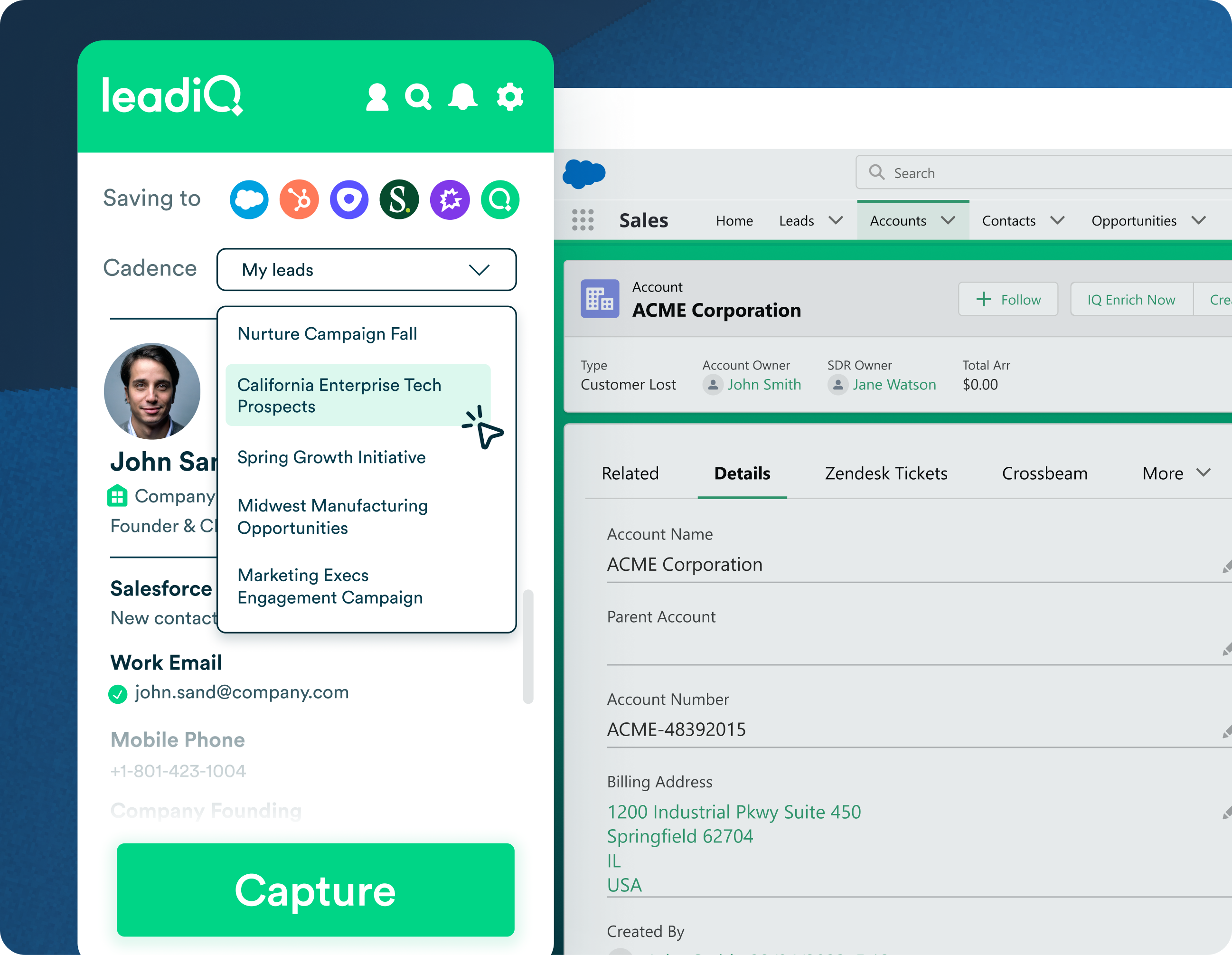
This process transforms what was previously a multi-step, copy-paste-heavy task taking several minutes into a fluid, 10-second action. This “in-workflow” approach represents LeadIQ's core value proposition, dramatically increasing the efficiency and activity volume of SDRs without disrupting their natural prospecting rhythm.
Who is the ideal user for LeadIQ?
LeadIQ is primarily built for B2B sales teams, with specific focus on roles responsible for top-of-funnel pipeline generation. The most common and ideal users are Sales Development Representatives (SDRs) and Business Development Representatives (BDRs). These roles are measured on their ability to book meetings and generate qualified opportunities, which requires a high volume of accurate contact data to fuel their outreach sequences. LeadIQ directly serves this need by maximizing their efficiency and reducing time spent on non-selling activities.
However, its use cases extend across several other key roles:
Account Executives (AEs): AEs who manage the full sales cycle, including some of their own prospecting, use LeadIQ to quickly find contact information for key decision-makers within target accounts. This is particularly valuable when pursuing strategic accounts where speed matters.
Sales Leaders & Managers: Sales managers value LeadIQ for providing their team with a standardized, efficient prospecting tool that leads to more predictable pipeline growth and better activity metrics. The platform helps managers ensure data quality and consistency across their entire team.
Marketing & Revenue Operations: These teams often leverage LeadIQ's data enrichment capabilities to clean and enhance existing database records, ensuring marketing campaigns target the right people with accurate information. This improves campaign performance and reduces wasted marketing spend.
The platform delivers maximum effectiveness for companies that have a structured sales process, use a modern CRM like Salesforce or HubSpot, and rely on outbound prospecting as a key revenue driver. Teams that prioritize data quality, workflow efficiency, and CRM hygiene will find LeadIQ particularly valuable for their go-to-market strategy.
To understand how LeadIQ performs in real-world scenarios, check out our comprehensive LeadIQ Review with hands-on testing results.
How accurate is LeadIQ's contact data and how is it verified?
LeadIQ's data accuracy is its cornerstone feature, and the platform uses a multi-layered, AI-driven process for verification. The company claims high accuracy rates for its “Verified” emails, which it guarantees are over 95% deliverable. This is achieved not by simply scraping and storing static data, but by actively validating it in real-time at the moment of capture.
The verification process includes several sophisticated steps:
Data Aggregation: LeadIQ pulls information from thousands of public sources and strategic data partnerships to build its foundational database. This includes professional networking sites, company websites, public records, and proprietary data sources.
AI-Powered Pattern Recognition: The platform's algorithms analyze corporate email patterns (such as firstname.lastname@company.com) and cross-reference them with known data points to construct likely email addresses. The AI learns from millions of data points to predict accurate formats for different organizations.
Real-Time Validation: This represents the most critical step. When a user requests a contact's email, LeadIQ's system performs a live, automated SMTP check (essentially a “ping”) on the recipient's mail server. This check confirms whether the server recognizes the address as valid without actually sending an email, protecting both data integrity and the user's sender reputation.
Confidence Scoring: Based on verification results, data is categorized with clear indicators. “Verified” emails have passed rigorous testing and carry the 95%+ deliverability guarantee. Other emails may be shown with lower confidence scores, allowing users to make informed decisions about which contacts to prioritize.
For mobile numbers, the sourcing and verification process is more complex and relies on different proprietary data partnerships. While generally reliable, mobile number accuracy across the entire B2B data industry typically runs lower than work emails due to privacy considerations and data availability challenges. Users should set realistic expectations that mobile coverage will not be universal, even with premium plans.
What are the limitations of LeadIQ's data I should be aware of?
While LeadIQ is a powerful tool, understanding its limitations is essential for setting realistic expectations and building a resilient prospecting strategy. No contact data provider can ever achieve 100% accuracy, and being aware of these boundaries helps teams use the platform more effectively.
The primary limitations include:
Mobile Number Scarcity: High-quality, verified mobile numbers represent the most difficult data point to acquire in B2B prospecting. While LeadIQ's mobile database is competitive within the industry, coverage is not universal. You will not find a mobile number for every prospect, particularly for individuals in regions with strict privacy laws (like the EU under GDPR) or those who intentionally keep their numbers private. This limitation affects all major prospecting platforms, not just LeadIQ.
Data Freshness Lag: The B2B world moves rapidly. People change jobs, receive promotions, and companies undergo acquisitions or restructuring. While LeadIQ's database receives constant updates, there can be a lag between when a person changes roles and when the database reflects that change. This can occasionally lead to outdated titles, company information, or defunct email addresses. The platform mitigates this through real-time verification, but some lag is inevitable.
“Catch-All” Email Servers: Some companies configure their email servers to accept any email sent to their domain (known as a “catch-all” configuration) to avoid rejecting legitimate correspondence. This makes real-time SMTP verification impossible, and LeadIQ will often mark these emails with a lower confidence score since definitive validation cannot be performed.
Focus on Corporate Data: The platform is exclusively designed for B2B prospecting. It is not a source for personal email addresses (such as @gmail.com) or personal contact information. Providing such data would violate major privacy regulations like GDPR and CCPA. This is an intentional limitation that protects both LeadIQ and its users from compliance violations.
Geographic Coverage Variations: Data availability and accuracy can vary significantly by geographic region. North American and Western European data tends to be most comprehensive, while coverage in other regions may be less robust depending on local data availability and privacy regulations.
Understanding these limitations means teams should maintain a multi-channel approach to prospecting and train reps to use LeadIQ data as a powerful starting point rather than an infallible source. Combining LeadIQ with other research methods and engagement strategies produces the best results.
For practical guidance on maximizing LeadIQ's effectiveness, explore our LeadIQ Tutorials and Usecase guide with step-by-step implementation strategies.
What are the current LeadIQ pricing plans?
LeadIQ offers a tiered pricing model primarily based on a per-user, per-month subscription structure, with costs varying based on features included and the number of data credits allocated. While specific prices are subject to change and may vary based on team size and contract terms, the structure typically includes several plans designed for different organizational needs.
The plans generally follow this framework:
Free Plan: A limited free version is often available, providing a small number of email credits per month (typically 20-40 credits). This is designed for individual users to test the core functionality of the Chrome extension and data capture capabilities before committing to a paid subscription. The free plan usually includes basic CRM integration but excludes mobile number access and advanced features.
Starter/Essential Plan: This entry-level paid plan targets small teams or individual users, typically priced around $75-$100 per user per month when billed annually. It includes a set number of monthly credits for capturing verified emails (usually 500-1,000 credits) and standard CRM integrations with platforms like Salesforce and HubSpot. Mobile number credits are usually not included or are very limited in this tier.
Pro Plan: This represents the most popular tier, designed for professional sales teams, typically priced around $125-$165 per user per month. It offers significantly higher volumes of email credits (often 1,000-2,000+ per month) and includes mobile number credits. This tier also typically provides more advanced features such as deeper CRM integration capabilities, team-level administration settings, and priority customer support.
Enterprise Plan: This is a custom plan for large organizations with advanced needs. Pricing is quote-based and includes the highest volume of credits, premium customer support with dedicated success managers, advanced security features (including SOC 2 Type II compliance), API access for custom integrations, and often includes features like single sign-on (SSO) and advanced user management.
When evaluating plans, pay close attention to the number of mobile credits allocated, as this is often the key differentiator between tiers and represents significant value for teams that rely on phone outreach. Annual subscriptions typically offer 15-20% discounts compared to monthly billing. For the most current and accurate pricing information, visit LeadIQ's official pricing page or contact their sales team directly for a customized quote based on your team size and specific needs.
LeadIQ vs. ZoomInfo: What are the key differences?
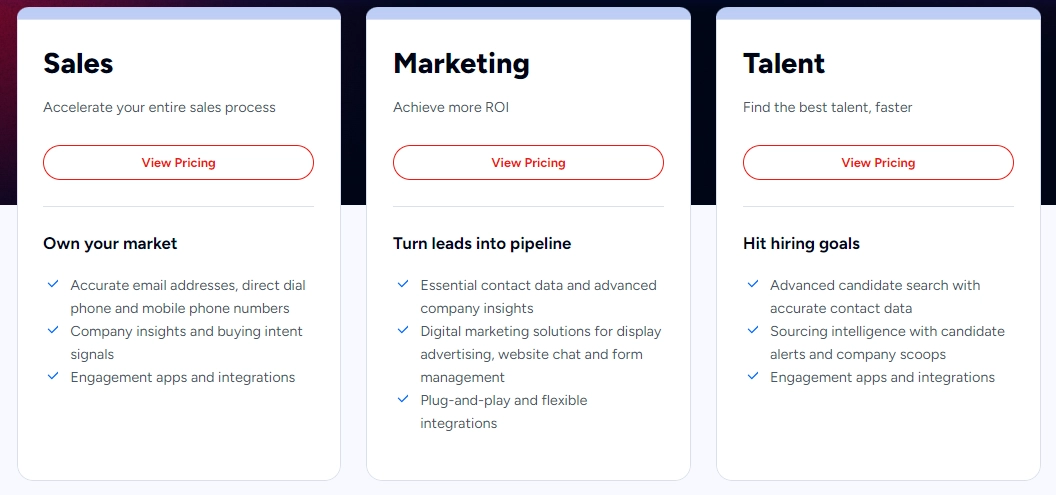
Comparing LeadIQ and ZoomInfo is one of the most common evaluations in the sales intelligence space, as both are industry leaders but serve fundamentally different strategic purposes. The primary distinction lies in their core focus: LeadIQ is a workflow-centric prospecting tool optimized for SDR efficiency, while ZoomInfo is a comprehensive, data-first intelligence platform designed for enterprise-wide go-to-market strategies.
LeadIQ's Strengths:
Workflow Integration: Its primary competitive advantage is the seamless, in-workflow experience provided by its Chrome Extension. It's specifically built for SDR speed and efficiency, making the process of capturing and syncing data from LinkedIn incredibly fast—often completing in under 10 seconds what would take several minutes manually.
Ease of Use: The platform is generally considered more intuitive with a significantly shorter learning curve than ZoomInfo. New SDRs can typically become productive within their first day of using the tool, minimizing training time and onboarding friction.
Real-Time Verification: Its focus on live verification at the point of capture helps ensure high email deliverability rates, which is critical for maintaining sender reputation and avoiding spam filters.
Cost-Effectiveness: LeadIQ's pricing is generally more accessible for small to mid-sized sales teams, making it an attractive option for companies that need quality data without enterprise-level investment.
ZoomInfo's Strengths:
Data Depth and Breadth: ZoomInfo's database is widely regarded as one of the most extensive in the industry, with deeper company-level intelligence including detailed organizational charts, technology stacks (technographics), funding information, and extensive firmographic data.
Platform Scope: It functions as a much broader platform that serves not just sales but also marketing, recruiting, and strategic research needs. This makes it valuable for account-based marketing (ABM) strategies and cross-functional alignment.
Intent Data: ZoomInfo provides powerful buying intent signals that indicate when companies are actively researching solutions in specific categories, giving sales teams a significant competitive advantage by enabling them to reach prospects at the optimal moment in their buying journey.
Advanced Search and Filtering: The platform offers incredibly sophisticated search capabilities, allowing users to build highly targeted lists based on dozens of criteria including job changes, company growth signals, and technology adoption.
Conclusion: Choose LeadIQ if your primary objective is equipping your SDR team with the fastest, most efficient tool for capturing contact data from LinkedIn and syncing it seamlessly to your CRM. It's ideal for teams that prioritize ease of use, rapid deployment, and workflow optimization. Choose ZoomInfo if you need a deep, comprehensive data platform to drive enterprise-wide account-based marketing strategies, uncover buying intent signals, perform extensive market research, and require the most extensive database with the deepest company intelligence. Many sophisticated sales organizations actually use both tools in tandem—ZoomInfo for strategic account planning and research, and LeadIQ for tactical, day-to-day prospecting efficiency.
For a detailed comparison of LeadIQ with other leading alternatives, visit our LeadIQ Top Alternatives and Competitors analysis.
LeadIQ vs. Apollo.io: Which is better for prospecting?
The choice between LeadIQ and Apollo.io fundamentally comes down to whether you want a specialized, best-in-class prospecting tool or an all-in-one platform. LeadIQ is a specialized data capture and enrichment tool designed to integrate with your existing sales stack, whereas Apollo.io combines a large contact database with a fully integrated sales engagement platform.
LeadIQ's Strengths:
Data Accuracy & Verification: LeadIQ's reputation is built on the quality and real-time verification of its contact data, particularly for email addresses. Their proprietary verification technology performs live SMTP checks at the moment of capture, resulting in industry-leading deliverability rates. Teams that prioritize data quality and sender reputation often prefer LeadIQ for this reason.
Simplicity and Speed: Its laser focus on the “capture and sync” workflow makes it extremely fast and intuitive for reps to use without getting distracted by additional features. The Chrome extension's interface is clean and purpose-built for rapid prospecting.
Integration with Best-of-Breed Tools: LeadIQ is designed to work seamlessly with specialized sales engagement tools like Outreach, Salesloft, and SalesLoft, fitting neatly into an existing tech stack. This allows teams to maintain their preferred workflow while upgrading their data quality.
Workflow Optimization: The tool lives where reps already work—directly on LinkedIn and company websites—eliminating context switching and maintaining focus on the prospecting task at hand.
Apollo.io's Strengths:
All-in-One Platform: Apollo provides not only a massive B2B database (claiming over 275 million contacts) but also the complete toolkit to act on that data: email sequencing, a built-in cloud-based dialer, meeting scheduling, and comprehensive analytics. This can be highly cost-effective for teams that don't have separate sales engagement tools.
Database Size & Advanced Filters: Apollo's database is enormous, and it offers incredibly granular filtering options across 65+ data points, allowing users to build highly specific lead lists directly within the platform. This is particularly valuable for teams doing targeted account-based prospecting.
Cost-Effectiveness: For the price, Apollo offers a vast range of features at very competitive rates, making it a compelling choice for startups and SMBs looking to consolidate their tech stack and reduce overall software costs.
Self-Service List Building: Unlike LeadIQ's capture-focused approach, Apollo allows users to build entire lists within the platform before exporting or engaging with them, which some teams prefer for campaign planning.
Conclusion: Choose LeadIQ if you already have sales engagement tools you're satisfied with (like Outreach or Salesloft) and your top priority is arming your team with the highest-quality, most accurately verified contact data available. It's ideal for teams that value specialized tools and want to maintain their current workflow. Choose Apollo.io if you're looking for a single, consolidated platform that combines a large prospect database with solid sequencing and outreach capabilities at a very competitive price point. Apollo is particularly attractive for smaller teams, startups, or companies looking to simplify their tech stack and reduce the number of tools their reps need to learn and manage.
Can LeadIQ find verified mobile phone numbers in addition to emails?
Yes, LeadIQ can find and provide mobile phone numbers for prospects, which is a valuable feature available in its higher-tier plans. However, the availability and verification process for mobile numbers differ significantly from that of work emails, and it's important to set realistic expectations about coverage and accuracy.
Here's what you need to understand about mobile number access:
Plan Dependent: Access to mobile numbers is typically reserved for the “Pro” and “Enterprise” level plans. Lower-tier plans and the free version are usually limited to work email addresses and company phone numbers (main switchboard numbers). This tiering reflects the higher cost and complexity of sourcing quality mobile data.
Credit System: Mobile numbers are unlocked using a separate credit allocation system. Your subscription will include a specific number of “mobile credits” per user per month, which are distinct from your email capture credits. Mobile credits typically have a lower monthly allocation because mobile data is more valuable and harder to source.
Data Sourcing: The mobile data comes from a variety of proprietary and third-party data partnerships that specialize in collecting business contact information in a compliant manner. Sources may include professional registrations, public business filings, conference attendee lists, and verified contributor databases.
Accuracy and Coverage Varies: While LeadIQ strives for high accuracy, the verified accuracy rate for mobile numbers across the entire B2B data industry is inherently lower than for corporate email addresses. Industry-wide, mobile number accuracy typically ranges from 60-75%, compared to 90-95%+ for verified work emails. Users should expect that some numbers may be outdated, incorrect, or unavailable due to privacy settings and data availability constraints.
Geographic and Industry Variations: Mobile number availability varies significantly by geography and industry. North American contacts, particularly those in technology and professional services, tend to have higher mobile data availability. European contacts have lower coverage due to GDPR privacy protections.
When a sales team decides to invest in a plan with mobile credits, it can be a powerful tool for direct outreach and for connecting with prospects who are less responsive to email. However, it's crucial to train your team on compliant and respectful calling practices, including understanding consent requirements and call recording laws that vary by jurisdiction. Mobile outreach should be used strategically, not as a primary prospecting method, and always in compliance with local regulations.
Is LeadIQ compliant with GDPR and CCPA?
Yes, LeadIQ states its commitment to complying with major data privacy regulations including the General Data Protection Regulation (GDPR) in Europe and the California Consumer Privacy Act (CCPA) in the United States. This is a critical consideration for any company handling contact data, and LeadIQ has implemented several measures and policies to align with these regulatory requirements.
Key compliance features and policies include:
Focus on Business Data: LeadIQ's platform is specifically designed to find and provide business contact information (such as work emails, company phone numbers, and professional titles), not sensitive personal data. This fundamental distinction is central to B2B data compliance, as business contact information generally falls under different regulatory treatment than personal consumer data. However, GDPR applies to business contacts in the EU, and LeadIQ acknowledges this scope.
Data Processing Agreements (DPA): LeadIQ offers Data Processing Agreements to customers, which are legally required contracts under GDPR that outline the responsibilities, obligations, and mechanisms for processing personal data in a compliant manner. These DPAs specify how data is collected, stored, processed, and protected, providing the contractual foundation for compliant data operations.
Data Subject Rights: LeadIQ provides documented processes for individuals to exercise their data subject rights, including the right to request access to, correction of, or deletion of their information from the LeadIQ database. This is a core requirement of both GDPR (under “Right to be Forgotten”) and CCPA (under “Right to Deletion”). Users can typically visit a dedicated privacy center on LeadIQ's website to submit these requests.
Regular Audits and Security Certifications: The company invests in security infrastructure and undergoes regular third-party audits, including achieving SOC 2 Type II certification. This certification demonstrates that LeadIQ has implemented appropriate controls for security, availability, and confidentiality of customer data, which is essential for GDPR's data protection requirements.
Lawful Basis for Processing: LeadIQ asserts that its data processing is based on legitimate business interests, which is one of the lawful bases for processing under GDPR Article 6. The company maintains that providing accurate business contact information serves the legitimate interest of efficient business communication.
Important Caveat: While LeadIQ provides a compliant platform and infrastructure, the ultimate responsibility for compliant outreach and data usage rests with the customer. Your company must still ensure that its own outreach practices adhere to all relevant laws. For example, under CAN-SPAM (US), emails must include an opt-out mechanism. Under GDPR, you may need to demonstrate legitimate interest or obtain consent for certain types of outreach. LeadIQ provides the tools, but your team must use them in a legally compliant manner based on your specific use case and jurisdiction.
For common questions about compliance and best practices, check our LeadIQ FAQs section.
How does LeadIQ integrate with Salesforce and what data gets synced?
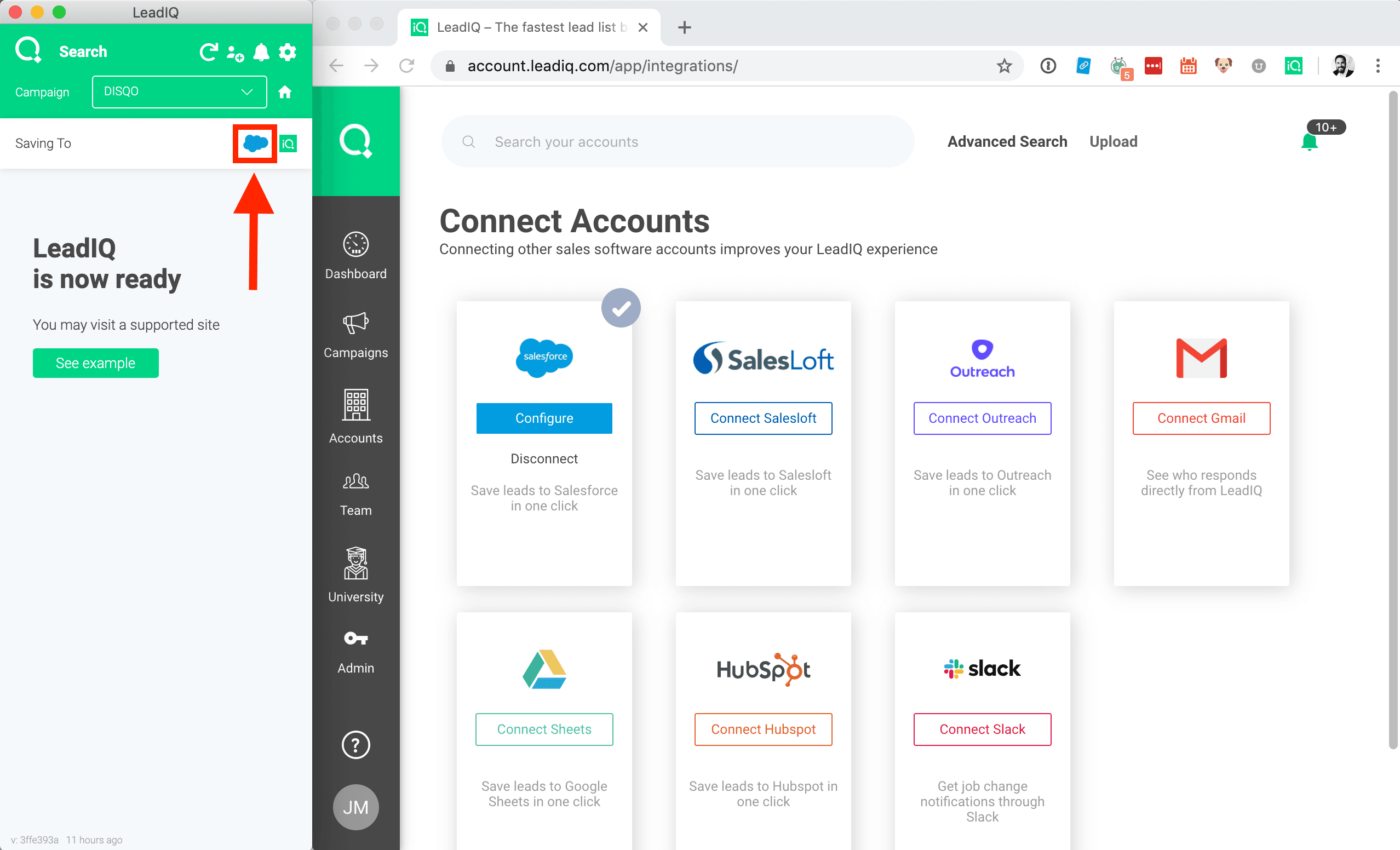
LeadIQ offers a deep and robust integration with Salesforce, which is one of its most critical features for sales teams using the world's leading CRM platform. The integration is designed to be bi-directional, not only pushing new prospecting data into Salesforce but also pulling existing information from it to prevent duplication and maintain data integrity.
Here's a comprehensive overview of what you can expect from the Salesforce integration:
One-Click Record Creation: Directly from the LeadIQ Chrome extension, a user can instantly create a new Lead or Contact record in Salesforce without leaving their prospecting workflow. The system automatically populates standard Salesforce fields including Name, Title, Company, Email Address, Phone Number, LinkedIn URL, and any other captured data points.
Intelligent Duplicate Detection: Before creating a new record, LeadIQ automatically searches your Salesforce instance using multiple matching criteria (email address, name, and company domain) to determine if the record already exists. This is a crucial feature that helps maintain a clean and reliable CRM database by preventing duplicate records, which are a major source of data quality issues. If a duplicate is detected, LeadIQ alerts the user and allows them to either update the existing record with new information or skip the sync entirely.
Custom Field Mapping: Salesforce administrators can configure LeadIQ to map captured data to specific custom fields in their Salesforce instance. This is essential for aligning with your company's unique sales processes, data requirements, and reporting needs. For example, you might map LeadIQ's “Source” field to a custom “Lead Source Detail” field in Salesforce to track that the contact came from LinkedIn prospecting.
Activity Logging: Depending on your configuration, the integration can automatically log activities in Salesforce when a prospect is captured via LeadIQ. This provides sales managers with visibility into prospecting activity and helps track rep performance against activity-based KPIs.
Data Enrichment of Existing Records: The integration can be used to update and enrich existing incomplete records in Salesforce. If you have a contact with a name and company but missing an email address, LeadIQ can search for and append that missing information, improving overall database quality.
Bi-Directional Sync: The integration pulls data from Salesforce to inform its duplicate detection and can push captured prospect information back into Salesforce, creating a seamless data flow that ensures your CRM remains the single source of truth.
Setup Requirements: Initial setup requires a Salesforce administrator to authorize the connection and configure field mapping settings. Most teams can complete the basic setup in 15-30 minutes, though custom field mapping may take additional time depending on complexity. Once configured, the integration operates transparently for end users, requiring no additional technical knowledge from sales reps.
How can our sales team measure the ROI of implementing LeadIQ?
Measuring the Return on Investment (ROI) of LeadIQ involves tracking both quantitative efficiency gains and qualitative downstream impacts on your sales pipeline. A clear, data-driven framework for measurement is essential to justify the subscription cost to leadership and demonstrate business value.
Here is a comprehensive, step-by-step approach to calculating and demonstrating ROI:
Step 1: Benchmark Current Activity (Pre-Implementation): Before implementing LeadIQ, measure your team's baseline metrics for one month. Key metrics to track include:
- Time spent on manual prospecting per rep per day (use time tracking or surveys)
- Number of net new contacts added to your CRM per rep per week
- Average email bounce rate on initial cold outreach campaigns
- Number of qualified meetings booked per SDR per month
- Number of prospecting activities (calls, emails, LinkedIn touches) per rep per day
Step 2: Calculate Direct Efficiency Gains (Post-Implementation): After your team has used LeadIQ for 30-60 days, measure the same metrics. The most direct ROI comes from time saved. For example: If LeadIQ saves each of your 5 SDRs 1 hour per day on prospecting research, that's 25 hours per week of recovered selling time. Multiply that by your fully-loaded SDR cost per hour (including salary, benefits, and overhead—typically $40-60/hour) to get a direct dollar value of time saved. In this example: 25 hours/week × $50/hour × 4.3 weeks/month = $5,375 in monthly recovered labor value.
Step 3: Track Data Quality Improvements: Compare your email bounce rate before and after implementation. A significant reduction (for example, from 10% to 2%) means your reps are reaching more actual inboxes and protecting your domain's sender reputation. Calculate the value: If reducing bounces from 10% to 2% means 80 more emails per week per rep actually get delivered, and your reply rate is 3%, that's 2.4 more conversations per rep per week that wouldn't have happened with lower-quality data.
Step 4: Measure Activity Volume Increases: With less time spent on research, SDRs should be able to increase their daily activity volume. Track whether reps are making more calls, sending more emails, and having more conversations. If your team increases their daily prospecting activities by 20% (from 50 to 60 activities per day), that's meaningful capacity expansion without hiring additional headcount.
Step 5: Track Downstream Pipeline Impact: The ultimate goal is more revenue. Track these critical downstream metrics:
- Number of qualified meetings booked from LeadIQ-sourced leads
- Number of sales-qualified opportunities created from those meetings
- Total pipeline value generated from LeadIQ-sourced opportunities
- Actual closed/won revenue from those opportunities
If the tool costs $1,500/month for your team but helps generate just one extra sales-qualified opportunity per month that converts to a $10,000 deal with a 25% close rate, that's $2,500 in monthly recurring value—a 167% ROI.
Step 6: Calculate Total ROI: Combine all value drivers: (Time Saved Value + Improved Data Quality Value + Increased Pipeline Value – LeadIQ Subscription Cost) ÷ LeadIQ Subscription Cost = ROI Percentage. Present this as a comprehensive business case that goes beyond “it saves time” to “it generates X dollars in recovered productivity and Y dollars in incremental new pipeline.”
The Hidden ROI—SDR Morale and Retention: The often-overlooked ROI of a tool like LeadIQ is its impact on SDR morale and retention. Manual prospecting is one of the most tedious and burnout-inducing tasks in sales. By providing a tool that removes the most frustrating part of the job, you create a better work environment. While harder to quantify directly, improved morale leads to lower SDR turnover, which has a massive positive financial impact by reducing recruiting costs (typically $5,000-15,000 per hire) and training time (typically 2-3 months to full productivity). Mentioning this “soft ROI” in your business case can be a powerful supplement to the hard numbers and often resonates strongly with senior leadership concerned about talent retention.
To explore how LeadIQ compares to other leading sales prospecting platforms, visit our comprehensive guide to the Best 10 AI Sales Prospecting & Intelligence tools.


Leave a Reply