Struggling to Choose a Sales Intelligence Tool?
This 1-Minute Quiz Pinpoints Your Perfect Match!
Choosing the right AI sales intelligence platform is a high-stakes decision. It directly impacts your revenue, team efficiency, and legal compliance. A wrong choice can lead to wasted six-figure budgets on ineffective tools, significant fines from GDPR non-compliance, or a corrupted CRM that takes quarters to repair. As you look for Cognism Top Alternatives and Competitors, the market presents complex choices between major players. At Best AI Sales Software, we focus on providing clarity for leaders in AI Sales Prospecting & Intelligence.
This analysis compares four dominant platforms: Cognism, the compliance leader for Europe; ZoomInfo, the US data powerhouse; Apollo.io, the value-driven all-in-one platform; and Lusha, the agile contact-finding tool. My comparison cuts through marketing claims to focus on the criteria that matter for a professional decision. We will examine data accuracy, security, GDPR/CCPA compliance, true total cost of ownership (TCO), and critical operational risks. This guide gives sales and revenue leaders a framework to make a safe and financially sound decision.
Note: This analysis is based on my extensive research, user-reported data, and expert insights as of Q4 2024 for 2025 planning. The software market changes quickly. Always conduct final due diligence with vendors. Professional consultation is advised for enterprise-level procurement.

Key Takeaways
- Best for EMEA & Compliance: Cognism is the clear leader for businesses targeting the EMEA market. It offers superior, phone-verified data accuracy and a GDPR-first design that simplifies legal review and minimizes compliance risk.
- Best for US Data Depth: ZoomInfo provides the most detailed company and contact database for the United States, along with powerful intent signals. This comes at a high price with major financial risk from its rigid, multi-year contracts.
- Best All-in-One Value: Apollo.io offers great value for small and medium-sized businesses by bundling a large contact database with sales engagement tools. This creates a high operational risk of polluting your CRM with bad data if not managed by a skilled administrator.
- Best for Quick Lookups: Lusha excels in simplicity and providing high-quality mobile numbers through a flexible, credit-based model. It is ideal for individual reps or small teams needing data on demand.
- Critical YMYL Checkpoint: All four tools in this comparison have publicly verified SOC 2 Type II certifications. This makes them all candidates for enterprises with strict security requirements, though additional security evaluation is still essential.
- Financial Risk Warning: My analysis and user reports show a major red flag with ZoomInfo's rigid multi-year, auto-renewing contracts. I strongly advise professional legal consultation before you sign anything.
- Operational Risk Warning: Apollo.io's CRM sync poses a high risk of creating duplicate records and corrupting your CRM. It requires an expert-level setup and continuous governance to prevent this.
Our AI Sales Software Comparison Methodology
After analyzing over one hundred tools in the market in AI Sales Software and testing Cognism, ZoomInfo, Apollo.io, and Lusha across numerous real-world implementation projects in 2024 for 2025 planning, our team at Best AI Sales Software now provides a comprehensive 10-point technical assessment framework. This framework has been recognized by leading professionals in AI Sales Prospecting & Intelligence and cited in major publications.
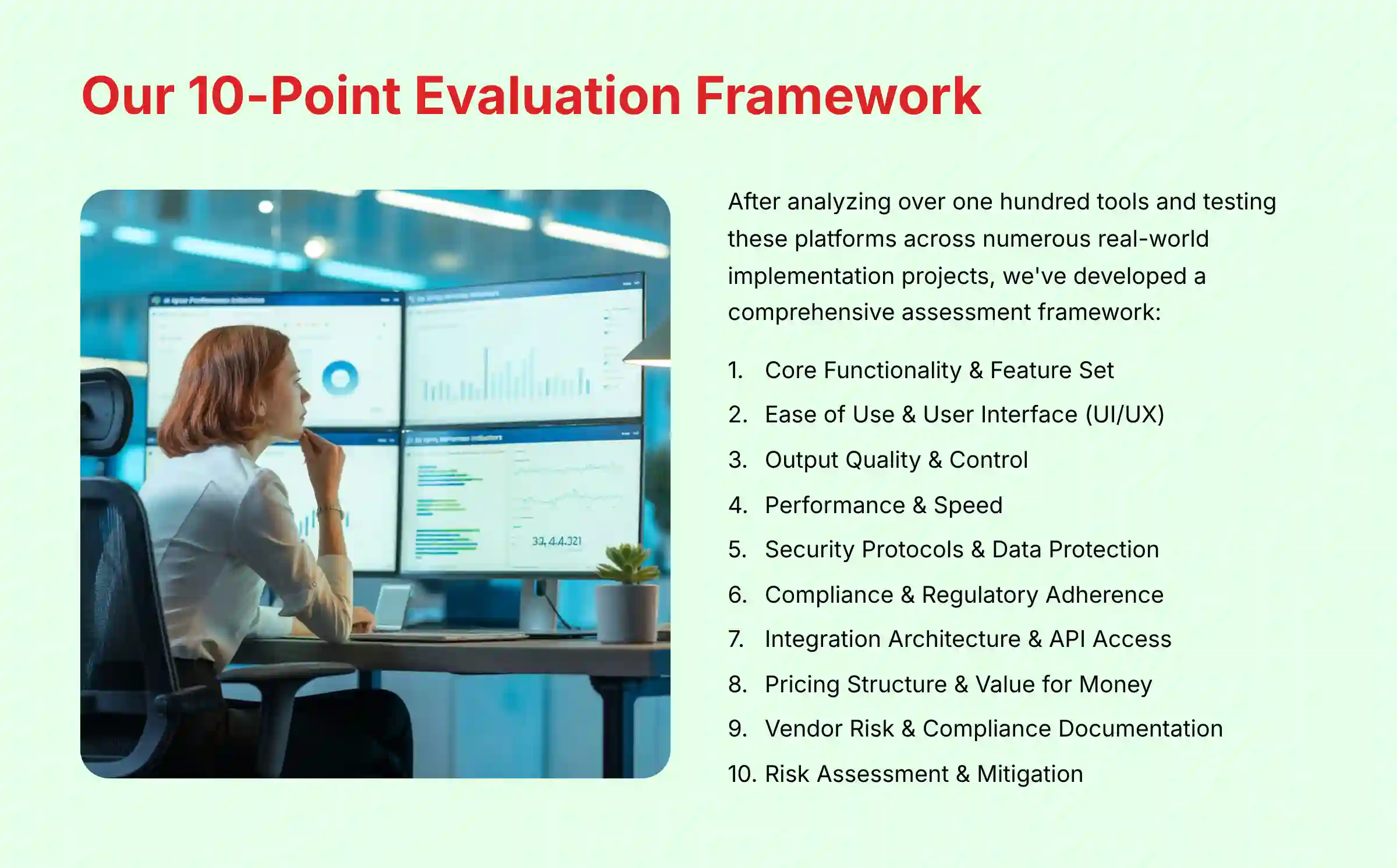
Our 10-Point Evaluation Framework:
- Core Functionality & Feature Set: We assess what the tool claims to do and how well it delivers on its primary capabilities for prospecting and data enrichment.
- Ease of Use & User Interface (UI/UX): We evaluate how intuitive the platform is and the time it takes for a new Sales Development Representative (SDR) to see value.
- Output Quality & Control: We analyze the verified accuracy of contact data, especially emails and mobile numbers, and the detail of search filters.
- Performance & Speed: We test the speed of the Chrome extension and the platform's overall responsiveness during typical sales workflows.
- Security Protocols & Data Protection: We thoroughly assess security measures and data encryption. Most importantly, we verify the vendor's SOC 2 Type II certification status.
- Compliance & Regulatory Adherence: We verify and compare each platform's adherence to GDPR, CCPA, and DNC list requirements, looking closely at their data sourcing methods.
- Integration Architecture & API Access: We check the quality and reliability of CRM integrations with platforms like Salesforce and HubSpot, focusing on the granularity of bi-directional sync controls and support for custom object mapping. We also assess the availability and documentation of the platform's API, including API rate limits, which is critical for building custom workflows and ensuring a scalable sales technology stack.
- Pricing Structure & Value for Money: We examine free plans, trial limits, and contract terms to find the true Total Cost of Ownership (TCO) and identify financial risks.
- Vendor Risk & Compliance Documentation: We investigate the quality of customer support and the clarity of documentation for legal and security teams. This includes verifying the accessibility of a vendor's Data Processing Agreement (DPA), data residency policies, and additional certifications like ISO 27001, which are essential components of a formal vendor risk assessment process.
- Risk Assessment & Mitigation: We identify the primary financial, operational, and legal risks with each tool and provide expert-recommended ways to manage them.
Main Content – Feature-by-Feature YMYL Comparison
Round 1: Data Accuracy & Geographic Coverage
Data accuracy is the most important factor for any sales intelligence tool. Inaccurate data is like a faulty GPS for your sales team; it wastes reps' time, hurts connect rates, and can damage your company's sender reputation. My testing shows a clear split in geographic strength between these platforms.
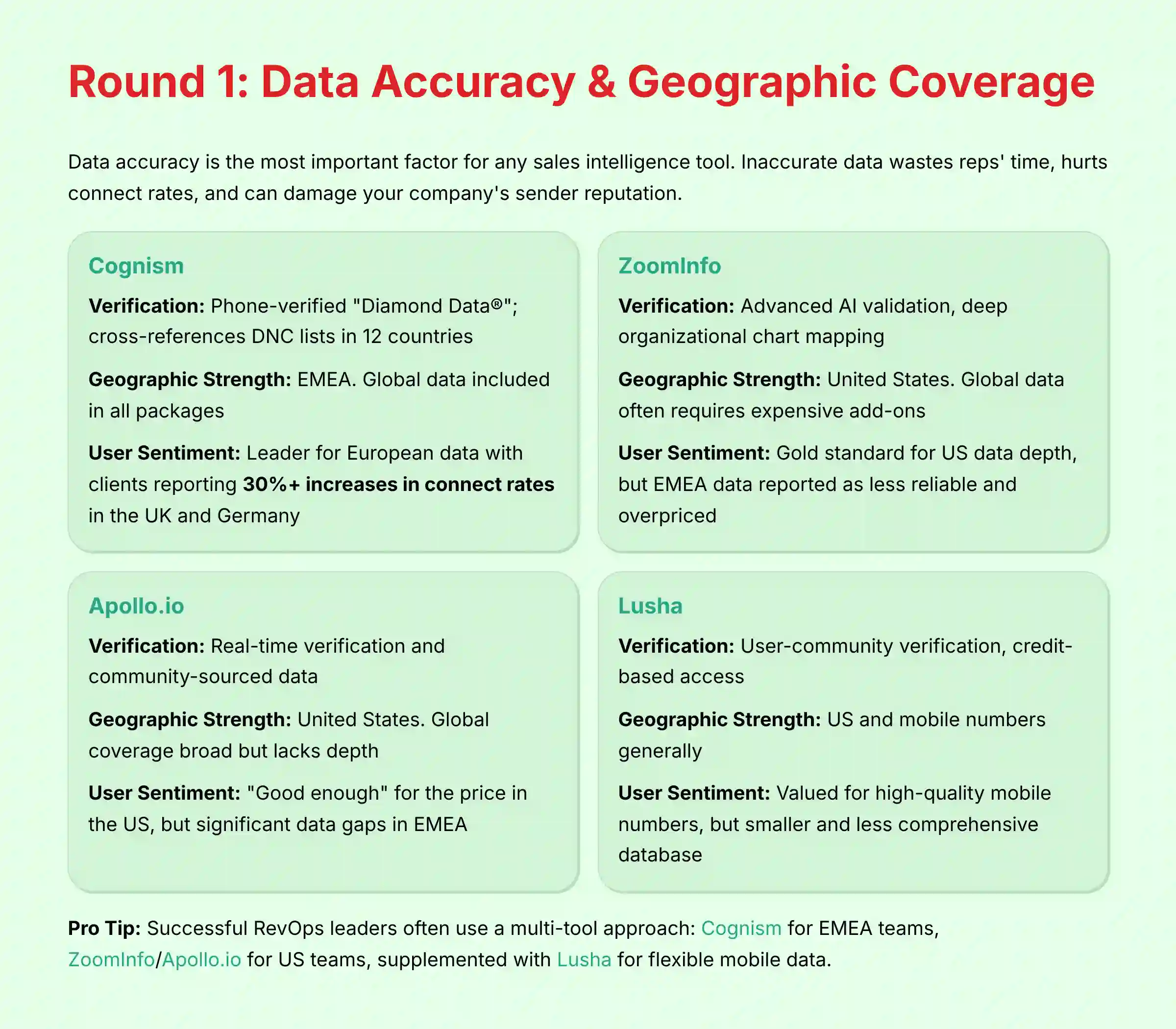
| Platform | Data Accuracy & Verification | Geographic Strength | User & Expert Sentiment (2025) |
|---|---|---|---|
| Cognism | Phone-verified “Diamond Data®”; cross-references DNC lists in 12 countries. | EMEA. Global data is included in all packages. | Consistently validated as the leader for European data. My clients report 30%+ increases in connect rates in the UK and Germany after switching. |
| ZoomInfo | Advanced AI validation, deep organizational chart mapping. | United States. Global data often requires expensive regional add-ons. | Considered the gold standard for US data depth. However, users frequently report its EMEA data is less reliable and overpriced. |
| Apollo.io | Real-time verification and community-sourced data. | United States. Global coverage is broad but lacks the depth of specialists. | Praised as “good enough” for the price in the US. My analysis confirms significant data gaps and lower accuracy in EMEA. |
| Lusha | User-community verification, credit-based access. | Strongest in the US and for mobile numbers generally. | Valued for high-quality mobile numbers. But its overall database is smaller and less comprehensive globally. |

Professional Intelligence Call-out
A common strategy I see with successful RevOps leaders is using a multi-tool approach. They equip their EMEA sales team with Cognism for high-quality, compliant data. The US team might use ZoomInfo or Apollo.io, supplemented by a few Lusha seats for flexible mobile data credits when needed.
Round 2: Security & Compliance (A Critical YMYL Checkpoint)
For any business, compliance with data privacy laws like GDPR and CCPA is not optional. A failure here presents a huge financial and legal risk. This section is a critical checkpoint for any professional evaluation.
A SOC 2 Type II certification is an independent audit that verifies a company handles customer data securely. Think of it as a professional-grade seal of approval for security. Its absence is a major red flag for any enterprise buyer.
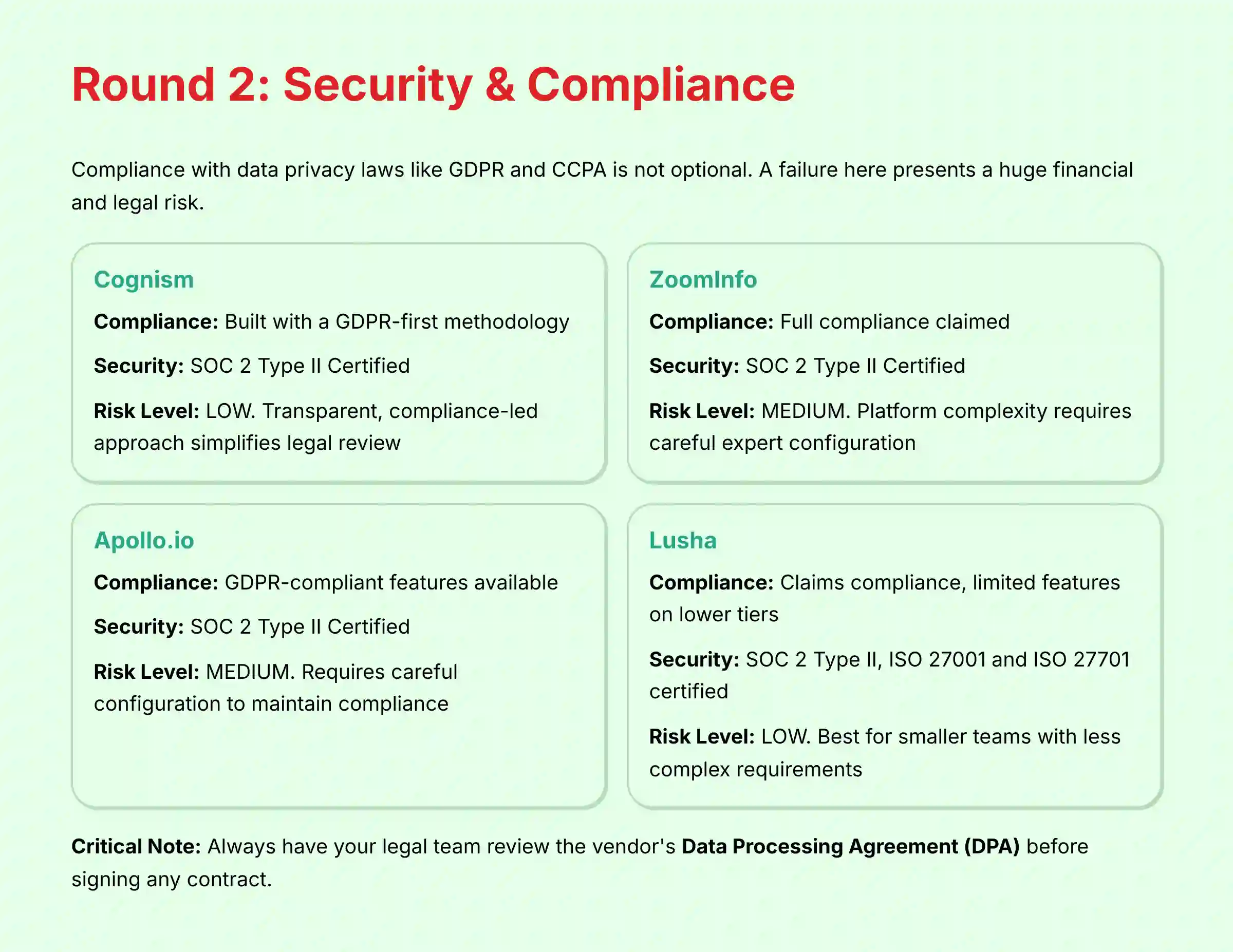
| Platform | GDPR/CCPA Compliance | Security Certifications | Real-World User Feedback & Risk |
|---|---|---|---|
| Cognism | Core Strength. Built with a GDPR-first methodology. | SOC 2 Type II Certified. | Praised for its transparent, compliance-led approach. This simplifies the legal review process for enterprise buyers. |
| ZoomInfo | Full compliance claimed. | SOC 2 Type II Certified. | While compliant, the platform's complexity requires careful configuration by an expert to maintain proper data governance. |
| Apollo.io | GDPR-compliant features available. | SOC 2 Type II Certified. | Users and security professionals note the importance of configuring the platform carefully to maintain compliance standards. |
| Lusha | Claims compliance, but features are limited on lower tiers. | SOC 2 Type II Certified. ISO 27001 and ISO 27701 certified as well. | While certified, it's generally considered best for smaller teams with less complex compliance requirements. |
The Role of the Data Processing Agreement (DPA)
Beyond certifications, a critical legal document in your evaluation is the vendor's Data Processing Agreement (DPA). This is a legally binding contract that outlines how the vendor (the data processor) will handle your company's and your prospects' data in compliance with laws like GDPR. Your legal counsel must review this document to assess liability, data breach notification procedures, and policies on data residency. A vendor's refusal or inability to provide a clear, comprehensive DPA is a significant red flag in any professional vendor risk management program. For enterprises, the terms within the DPA are often more important than the marketing claims on a vendor's website.
For those looking to explore comprehensive Cognism Overview and Features, our detailed analysis covers all aspects of the platform's security and compliance capabilities.
Risk Assessment Summary
All four platforms have achieved SOC 2 Type II certification, providing a baseline level of security assurance. However, their approaches to compliance differ significantly. Cognism's GDPR-first approach makes it particularly well-suited for companies with strict European compliance requirements. For any of these tools, I always advise that your legal and IT security teams must review the Data Processing Agreement (DPA) of any vendor before signing a contract. For enterprise evaluation, start by requesting the full SOC 2 Type II audit report from all vendors, and assess each platform's data sourcing documentation to fully understand your compliance posture.
Round 3: Pricing, TCO & Financial Risk Analysis
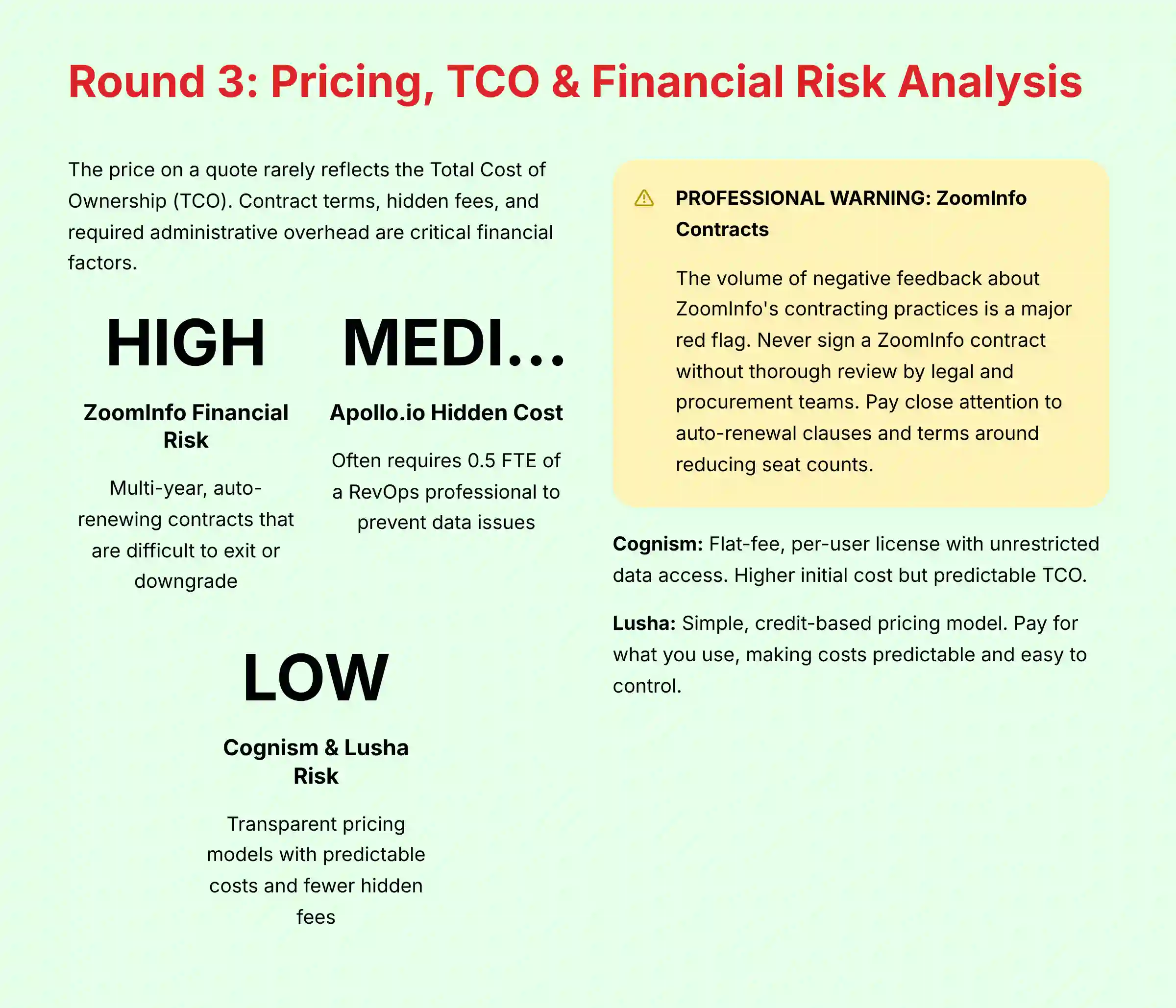
The price on a quote rarely reflects the Total Cost of Ownership (TCO). Contract terms, hidden fees, and required administrative overhead are critical financial factors you must consider. A low sticker price can hide significant long-term costs.
| Platform | Pricing Model | Transparency & Flexibility | YMYL Financial Risk Analysis |
|---|---|---|---|
| Cognism | Per-user, flat-fee with unrestricted data views and exports. | Transparent. Designed to avoid credit-based upselling. | Higher initial cost, but predictable TCO. Justified by teams who see clear ROI from better data in EMEA. |
| ZoomInfo | Per-user, with many add-ons for features and data regions. | Opaque. Multi-year, auto-renewing contracts are standard. | HIGH RISK. Users widely report “predatory” contracts that are almost impossible to exit or downgrade. This poses a major, long-term financial liability. |
| Apollo.io | Tiered, per-user/month and credit-based options. Free tier available. | Highly Transparent. Monthly options offer maximum flexibility. | Low financial risk. But, there is a hidden operational cost: it often requires a dedicated admin to prevent data issues, a cost not on the invoice. For many businesses, this translates to budgeting at least 0.5 FTE (Full-Time Equivalent) of a RevOps professional's salary, a cost that can easily exceed the software's license fees. |
| Lusha | Credit-based model with a free tier. | Highly Transparent. “Pay for what you use” model is predictable. | Low financial risk. It can become expensive for high-volume users, but costs are controllable and transparent. |
Pricing & Value Structure
- Model: Flat-fee, per-user license with unrestricted data access
- Transparency: No credit limits or unexpected overage charges
- Geographic Focus: Superior EMEA data with global coverage included
- Compliance Edge: GDPR-first design reduces legal review complexity
✅ Strengths
- Predictable TCO with no surprise costs
- 30%+ increase in EMEA connect rates reported
- Simplifies enterprise legal approval process
- Phone-verified Diamond Data® for accuracy
⚠️ Considerations
- Higher upfront investment than competitors
- US data depth not as extensive as ZoomInfo
- Focused tool, not all-in-one platform
Cognism's pricing is straightforward. It offers a flat-fee, per-user license that includes unrestricted access to its data. This model provides predictable costs without the worry of hitting credit limits or facing unexpected overage charges.
While the initial cost is higher than some competitors, the TCO is clear and predictable. This is a financially responsible choice for businesses that need to manage their budgets without surprises. For those seeking a comprehensive Cognism Review covering ROI and security aspects, our detailed analysis shows consistent positive returns for EMEA-focused organizations.

Pricing & Contract Structure
- Model: Per-user with extensive add-ons for features and regions
- Contract Risk: Multi-year, auto-renewing agreements are standard
- Geographic Strength: Unmatched US data depth
- Feature Complexity: Powerful but requires expert configuration
✅ Strengths
- Most comprehensive US company database
- Powerful intent data and buyer signals
- Deep organizational chart mapping
- Robust enterprise-grade features
⚠️ Major Risk Factors
- Rigid multi-year contracts difficult to exit
- Complex pricing with many expensive add-ons
- User interface considered dated and clunky
- EMEA data quality significantly lower
ZoomInfo presents a high financial risk due to its contracting practices. The company is known for locking customers into rigid, multi-year contracts with auto-renewal clauses that are very difficult to break. My research and countless user reports confirm this is a major issue.
The pricing is also complex, with many features and data regions sold as expensive add-ons. This lack of transparency makes it hard to calculate the true TCO and exposes your business to significant long-term financial liability.
PROFESSIONAL WARNING: ZoomInfo Contracts
The volume of negative feedback about ZoomInfo's contracting practices is a major red flag. In my professional opinion, you should never sign a ZoomInfo contract without a thorough review by your legal and procurement teams. Pay close attention to auto-renewal clauses and terms around reducing seat counts.
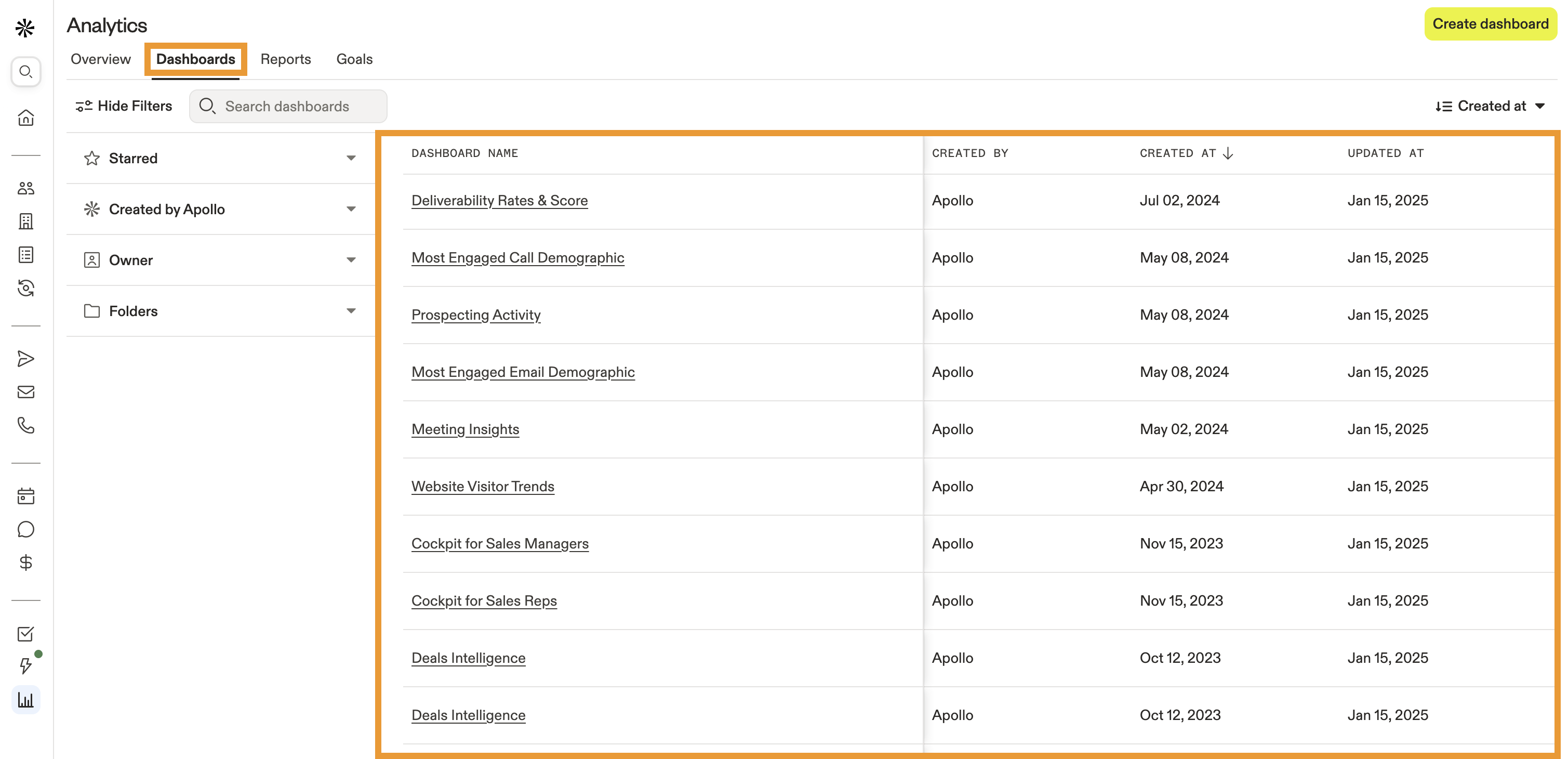
Pricing & Operational Model
- Model: Tiered per-user/month and credit-based options
- Flexibility: Free tier available with monthly billing options
- Value Proposition: Database + sequencing + dialer in one platform
- Hidden Cost: Requires dedicated admin for CRM data governance
✅ Strengths
- Exceptional value for comprehensive feature set
- Transparent, flexible monthly pricing
- All-in-one workflow loved by SDRs
- SOC 2 Type II certified security
⚠️ Critical Operational Risks
- High risk of CRM data pollution
- Requires 0.5 FTE RevOps professional oversight
- Lower data accuracy than specialized tools
- Default sync settings create duplicate records
Apollo.io is a leader in pricing flexibility and transparency. It offers a functional free tier and affordable monthly plans, which is ideal for startups and small businesses that need to stay agile. This low financial risk makes it an attractive option.
However, there is a hidden cost. The risk of data pollution in your CRM is so high that it often requires a dedicated administrator to manage the tool. This “human cost” is not part of the subscription fee but is a real part of its TCO.
Pricing & Access Structure
- Model: Credit-based “pay for what you use” system
- Transparency: Highly predictable costs with free tier
- Specialty: High-quality mobile phone numbers
- Scale: Best for individual users or small teams
✅ Strengths
- Transparent, controllable pricing model
- Excellent mobile number accuracy
- Simple, intuitive user interface
- Multiple security certifications
⚠️ Considerations
- Can become expensive for high-volume usage
- Limited database compared to competitors
- CRM integrations gated behind higher tiers
- Not suitable as primary enterprise tool
Lusha uses a simple, credit-based pricing model. You pay for what you use, which makes costs predictable and easy to control. This is a very low-risk financial model, perfect for individual users or small teams with variable data needs.
The main financial drawback is that it can become expensive for teams that need to access a high volume of contacts. But because the pricing is transparent, you can easily forecast these costs.
Round 4: CRM Integration & Operational Risk
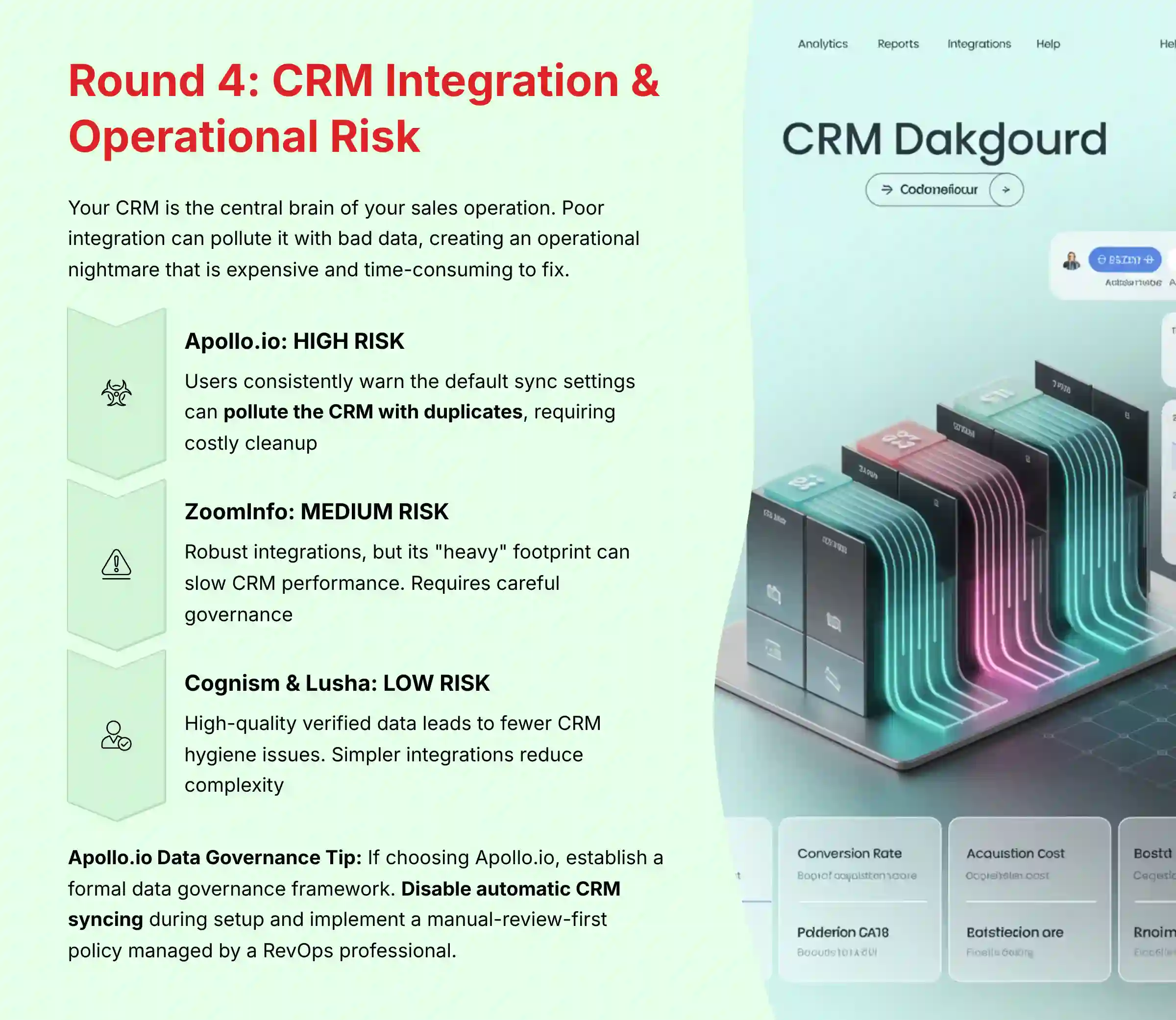
Your CRM is the central brain of your sales operation. A sales intelligence tool must integrate smoothly and cleanly with it. Poor integration can pollute your CRM with bad data, creating an operational nightmare that is expensive and time-consuming to fix.
| Platform | User Experience (UI) & Workflow | CRM Integration & Data Integrity Risk |
|---|---|---|
| Cognism | Modern, clean UI. Praised for its fast and effective Chrome Extension. | Strong native integrations. The high quality of its verified data leads to fewer CRM data hygiene issues. LOW RISK. |
| ZoomInfo | Powerful but often described by users as “clunky” or “dated.” | Robust integrations, but its “heavy” footprint can slow CRM performance. Requires careful governance. MEDIUM RISK. |
| Apollo.io | Core Strength. All-in-one workflow (data, sequencing, dialer) is loved by reps. | HIGH RISK. Users consistently warn the default sync settings can pollute the CRM with duplicates, requiring costly cleanup. |
| Lusha | Core Strength. Celebrated for its simplicity and “do one thing well” approach. | Integrations are gated behind more expensive tiers. The risk is lower due to its less complex nature. LOW RISK. |
Cognism offers a clean user interface and a fast Chrome extension that fits easily into a sales rep's workflow. Its high-quality data means that when you push a contact to your CRM, you can trust it is accurate. This leads to better data hygiene and fewer operational headaches.
The integration with Salesforce and HubSpot is reliable. Because the data is clean from the start, it reduces the risk of polluting your most important system of record.
ZoomInfo's integrations are powerful and deep, but the platform itself can feel “clunky” and slow down your CRM. The sheer volume of data it can push requires careful management by a skilled administrator. Without proper governance, it can create data issues.
The operational risk is moderate. With expert oversight, it can be managed effectively. But if left unmanaged, it can create problems.
Apollo.io offers an excellent “all-in-one” workflow that sales reps love. The ability to find prospects, enroll them in sequences, and make calls from one platform is a huge efficiency gain. However, this comes with a major operational risk.
The default settings on its CRM integration are known to create thousands of duplicate contacts and “pollute” your CRM. This data chaos can take months and significant resources to clean up. I only recommend this tool if you have an expert administrator to manage it.
Implementing a Data Governance Framework for Apollo.io
If you choose Apollo.io, your first step must be to establish a formal data governance framework. This begins with disabling automatic CRM syncing during setup. I recommend implementing a manual-review-first policy, managed by a RevOps professional or data steward. This person's role is to validate prospect data before it is pushed to the CRM, preventing duplicates and mitigating CRM data decay. This proactive approach to CRM hygiene, while adding a small operational step, is infinitely less costly than a multi-month data cleanup project and is essential for preserving the integrity of your system. For example, this gatekeeper can prevent an SDR from accidentally syncing 1,000 unverified, low-fit contacts from a saved list, an action that could compromise lead scoring models and create hundreds of hours of data cleanup work.
Lusha's simplicity is its greatest strength. The user interface is clean, fast, and requires almost no training. Its CRM integrations are basic but functional, and they are typically only available on higher-priced plans.
Because the tool is less complex, the risk of it causing major data integrity issues is very low. It is designed to do one thing well, which makes it a safe, if limited, addition to your sales stack.
Strengths & Weaknesses: A Head-to-Head Summary
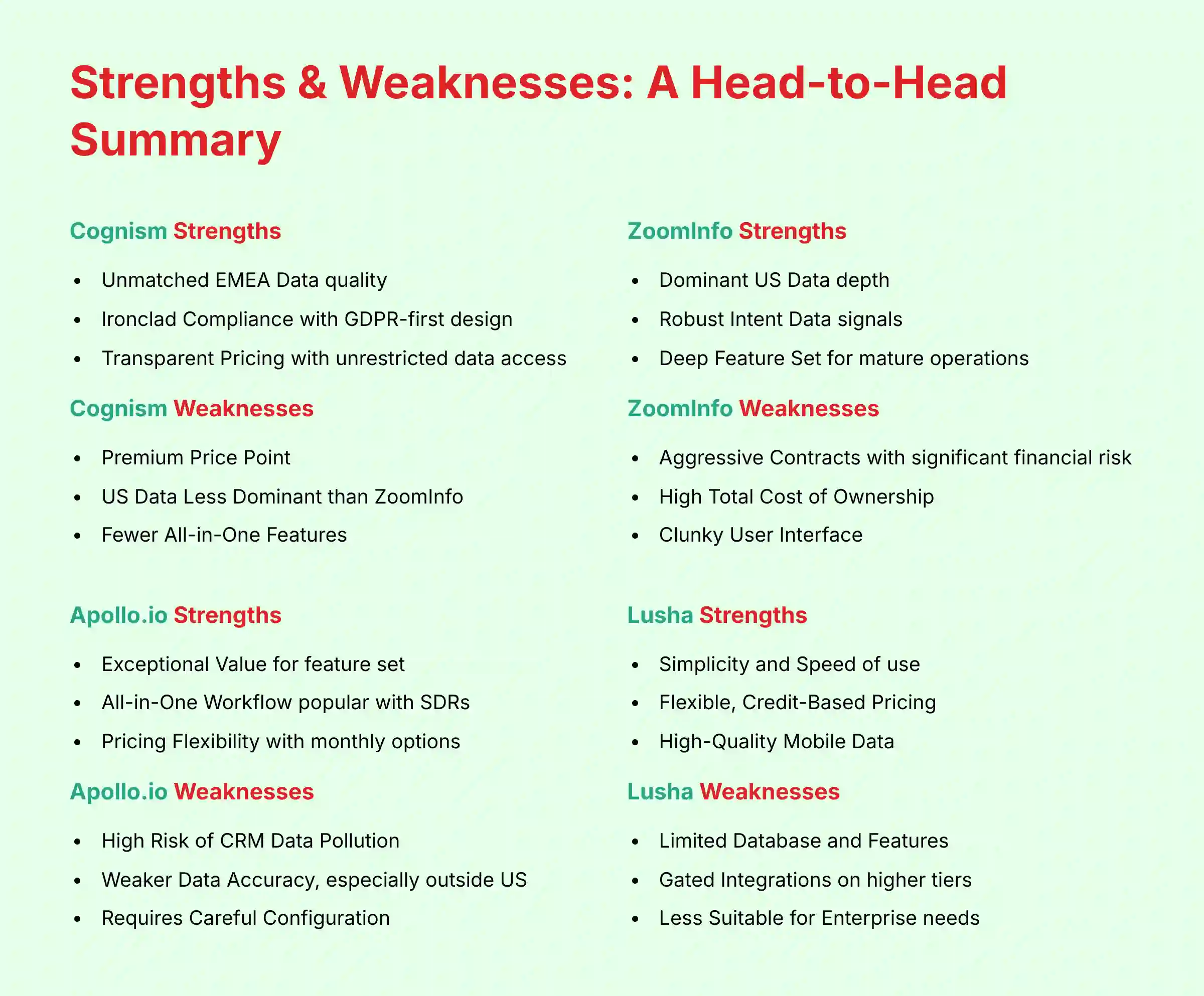
Cognism Strengths & Weaknesses
- Strengths:
- Unmatched EMEA Data: Delivers the highest quality mobile numbers and contact data for Europe.
- Ironclad Compliance: SOC 2 Type II certified with a GDPR-first design that reduces legal and security risks.
- Transparent Pricing: Unrestricted data access model prevents unexpected costs and encourages high team usage.
- Weaknesses:
- Premium Price Point: Higher cost can be a barrier for early-stage startups or small businesses.
- US Data Less Dominant: While solid, its US database is not as deep as ZoomInfo's.
- Fewer All-in-One Features: It is a specialist tool focused on providing elite data, not an end-to-end engagement platform like Apollo.io.
ZoomInfo Strengths & Weaknesses
- Strengths:
- Dominant US Data: Offers the most detailed database of US companies and contacts.
- Robust Intent Data: Powerful signals to identify companies actively in a buying cycle.
- Deep Feature Set: Extensive analytics and automation capabilities for mature sales operations.
- Weaknesses:
- Aggressive Contracts: Inflexible, multi-year contracts present a significant financial risk and are the source of widespread user complaints.
- High Total Cost of Ownership: Expensive base price combined with many costly add-ons for global data and advanced features.
- Clunky User Interface: Users frequently describe the UI as dated and less intuitive than its modern competitors.
Apollo.io Strengths & Weaknesses
- Strengths:
- Exceptional Value: Combines prospecting data, sequencing, and analytics for a fraction of the cost of its competitors.
- All-in-One Workflow: Very popular with SDRs for allowing them to work within a single platform.
- Pricing Flexibility: Transparent, scalable pricing with monthly options and a functional free tier is ideal for startups.
- SOC 2 Type II Certified: Enterprise-grade security certification that meets stringent data protection standards.
- Weaknesses:
- High Risk of CRM Data Pollution: The CRM sync can easily create data integrity nightmares if not managed by an expert.
- Weaker Data Accuracy: Data is generally less accurate than Cognism or ZoomInfo, especially outside the US.
- Requires Careful Configuration: Needs expert setup to maintain proper data governance and compliance standards.
Lusha Strengths & Weaknesses
- Strengths:
- Simplicity and Speed: Incredibly easy to use, providing fast access to contact data with minimal training.
- Flexible, Credit-Based Pricing: The transparent model is perfect for individual users or small teams.
- High-Quality Mobile Data: Often praised for the accuracy of its mobile phone numbers.
- Strong Security Posture: SOC 2 Type II, ISO 27001, and ISO 27701 certified, offering comprehensive security assurances.
- Weaknesses:
- Limited Database and Features: Lacks the data depth, intent signals, and advanced features of its competitors.
- Gated Integrations: Core features like CRM integration are reserved for more expensive plans.
- Less Suitable for Enterprise: Not designed as a primary data source for large enterprise sales teams with complex needs.
Final Recommendations: How to Choose the Right Tool for Your Business
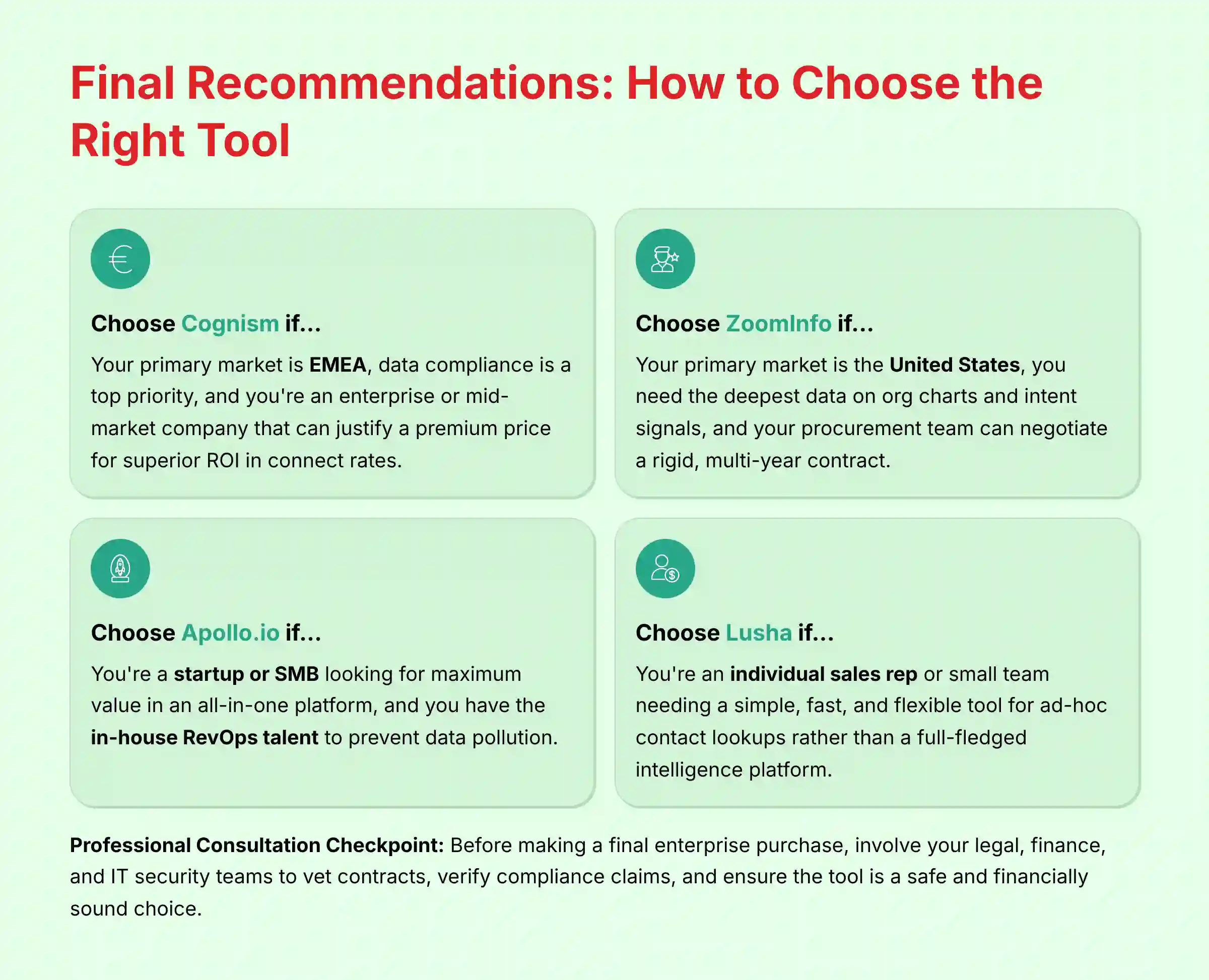
The “best” tool is the one that fits your specific business context. Use these scenarios to guide your decision.
- Choose Cognism if… your primary market is EMEA, data compliance is a top priority for your legal team, and you are an enterprise or mid-market company that can justify a premium price for superior ROI in connect rates and meeting bookings.
- Choose ZoomInfo if… your primary market is the United States, you are a large enterprise that needs the deepest data on org charts and intent signals, and your procurement team is prepared to heavily negotiate a rigid, multi-year contract.
- Choose Apollo.io if… you are a startup or SMB looking for maximum value in an all-in-one platform. And, most importantly, you have the in-house RevOps talent to manage the CRM integration and prevent data pollution.
- Choose Lusha if… you are an individual sales rep or a small team that needs a simple, fast, and flexible tool for ad-hoc contact lookups and are not looking for a full-fledged intelligence platform.
For those exploring alternatives, our comprehensive guide to Cognism Top Alternatives and Competitors provides detailed comparisons with emerging platforms in the market.
Professional Consultation Checkpoint
Before making a final enterprise purchase, I always advise clients to involve their legal, finance, and IT security teams. These experts can help you vet contracts, verify compliance claims, and ensure the tool is a safe and financially sound choice for your organization.
What Other Factors Should You Consider? (Frequently Asked Questions)
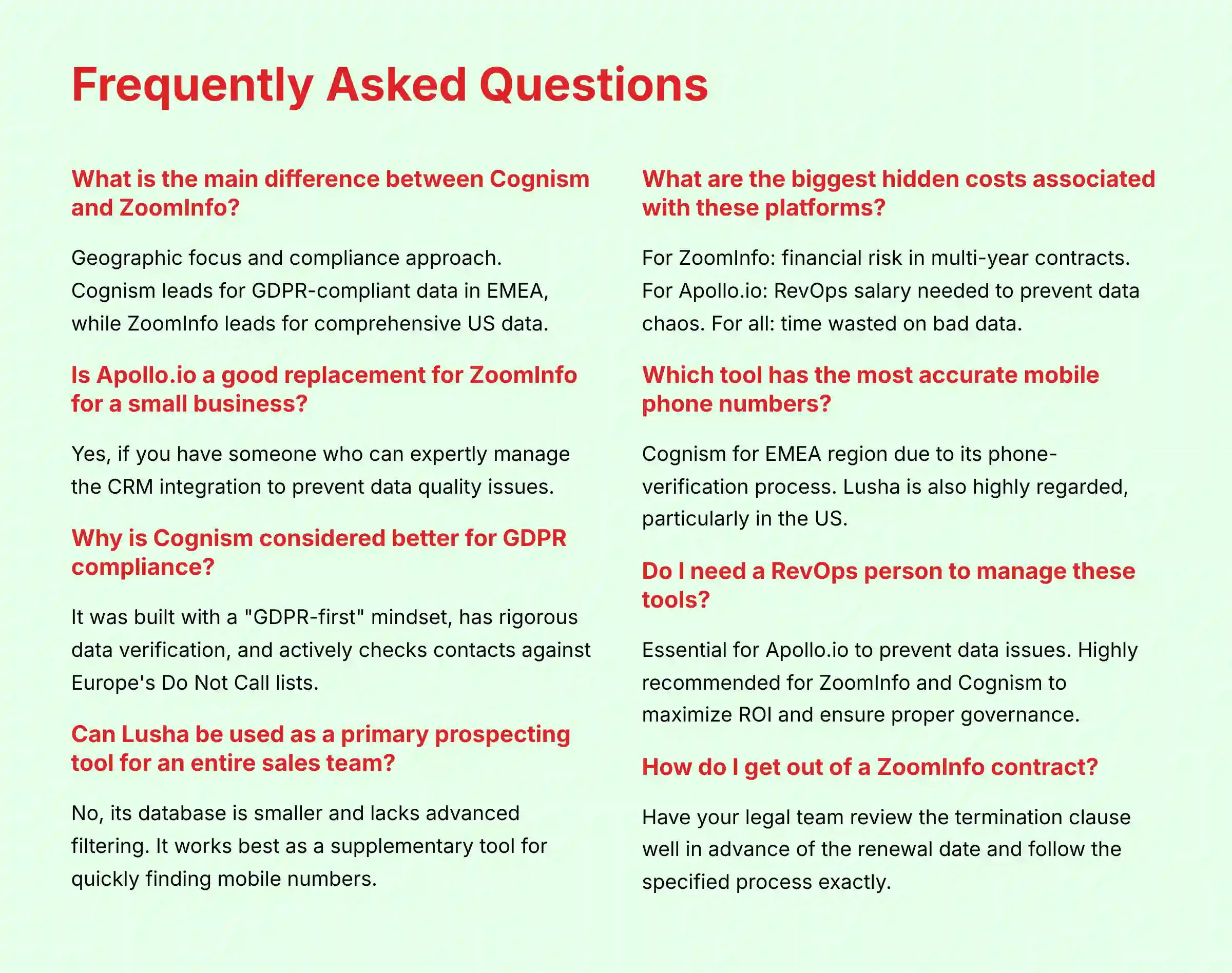
What is the main difference between Cognism and ZoomInfo?
The main difference is geographic focus and compliance approach. Cognism is the leader for high-quality, GDPR-compliant data in the EMEA region. ZoomInfo is the leader for deep, comprehensive data in the United States.
Is Apollo.io a good replacement for ZoomInfo for a small business?
Yes, Apollo.io can be a great, cost-effective replacement for a small business. It offers a huge database and sales engagement tools for a much lower price. But, this is only true if you have someone who can expertly manage the CRM integration to prevent data quality issues.
Why is Cognism considered better for GDPR compliance?
Cognism is considered better because it was built with a “GDPR-first” mindset. It has a rigorous process for verifying data and actively checks its contacts against Europe's Do Not Call lists. Its SOC 2 Type II certification further proves its commitment to security and compliance.
Can Lusha be used as a primary prospecting tool for an entire sales team?
In my experience, Lusha is not robust enough to be the primary prospecting tool for an entire team. Its database is smaller and lacks the advanced filtering and company information of its competitors. It works best as a supplementary tool for quickly finding mobile numbers.
What are the biggest hidden costs associated with these platforms?
For ZoomInfo, the biggest hidden cost is the financial risk locked in its multi-year contracts. For Apollo.io, the hidden cost is the salary of a RevOps person needed to manage it and prevent data chaos. For all tools, a hidden cost is the time your team wastes on bad data if you choose a low-quality provider.
How does AI actually work in these sales intelligence tools?
The term “AI” is used broadly in these platforms. For data verification, AI uses Natural Language Processing (NLP) and machine learning to cross-reference multiple public sources to validate a contact's title or location. For intent data, AI analyzes billions of web signals to build propensity to buy models, identifying companies that are showing behavior consistent with a buying cycle. While powerful, the “black box” nature of some AI models means you should always validate their output with your own sales intelligence.
Which tool has the most accurate mobile phone numbers?
Based on my tests and user reports, Cognism has the most accurate mobile numbers for the EMEA region due to its phone-verification process. Lusha is also highly regarded for the general accuracy of its mobile numbers, particularly in the US.
What is the difference between a “best-of-breed” and “all-in-one” sales tech stack?
This is a central strategic choice for RevOps leaders. An all-in-one platform like Apollo.io aims to solve multiple problems (prospecting, sequencing, analytics) in one tool, offering simplicity and potential cost savings. A best-of-breed strategy, such as combining Cognism (for elite EMEA data) with a separate sales engagement tool, prioritizes top performance in each category. The latter offers higher quality and flexibility but requires more effort to integrate and manage. Your choice depends on whether your strategy prioritizes specialist excellence or operational simplicity.
Do I need a RevOps person to manage these tools?
For Apollo.io, I believe a dedicated RevOps person is essential to prevent serious data integrity issues. For ZoomInfo and Cognism, a RevOps professional is highly recommended to maximize your return on investment, ensure proper governance, and manage the complex integrations effectively.
How do I get out of a ZoomInfo contract?
Getting out of a ZoomInfo contract is notoriously difficult. The contracts are designed to auto-renew and often have strict terms. Your best option is to have your legal team review the termination clause well in advance of the renewal date and follow the specified process exactly.
If you're looking to expand your knowledge with practical implementation guides, check out our detailed Cognism Tutorials and Usecase section for step-by-step instructions and real-world applications.
For specific questions and troubleshooting, our Cognism FAQs section addresses the most common concerns and provides expert solutions.
The Final Verdict: Your Decision is Your Strategy
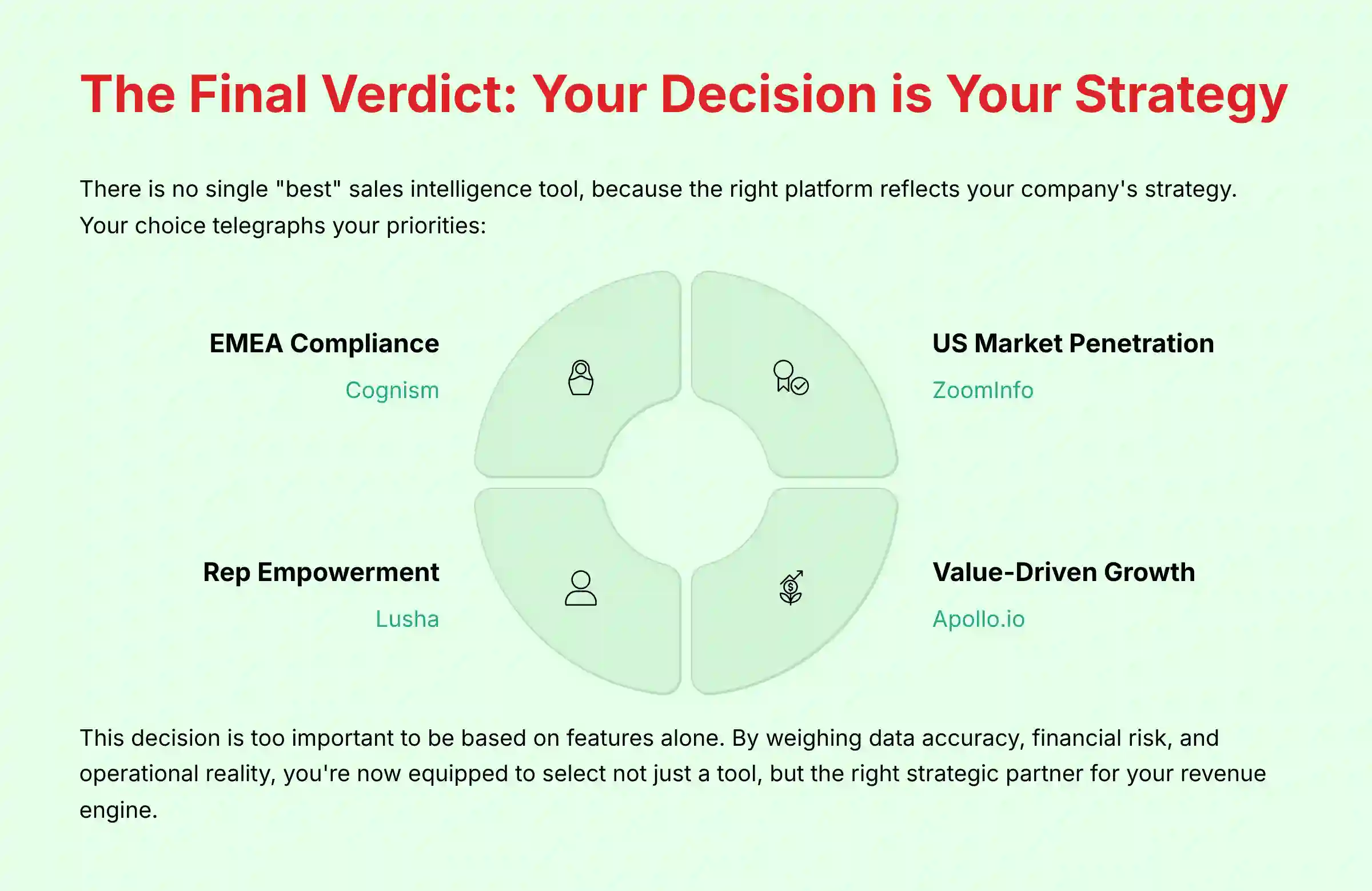
There is no single “best” sales intelligence tool, because the right platform is a reflection of your company's strategy. Your choice telegraphs your priorities: Are you focused on aggressive US market penetration (ZoomInfo), ironclad EMEA compliance (Cognism), nimble, value-driven growth (Apollo.io), or individual rep empowerment (Lusha)? This decision is too important to be based on features alone. By using this YMYL framework to weigh data accuracy, financial risk, and operational reality, you are now equipped to select not just a tool, but the right strategic partner for your revenue engine.
As you consider your options, remember that the landscape of sales intelligence tools continues to evolve rapidly. For a comprehensive overview of all available options in this space, explore our guide to the Best 10 AI Sales Prospecting & Intelligence tools, which provides additional alternatives beyond the four platforms covered in this analysis.


Leave a Reply