
Is 6sense the Right Revenue AI Platform for Your GTM Strategy?
Take This 2-Minute Quiz to Find Out!
Introduction to 6sense
6sense represents a fundamental shift in B2B sales and marketing intelligence, moving away from traditional lead-based strategies to a sophisticated account-based predictive model. The platform, officially known as 6sense Revenue AI™, is designed to identify anonymous buying signals across the web and predict which accounts are in-market to purchase—before they ever make direct contact with your organization.
This AI-powered platform addresses a critical challenge in modern B2B sales: approximately 95% of potential buyers research anonymously before engaging with vendors. 6sense illuminates this “dark funnel” by capturing and analyzing billions of intent signals weekly, transforming how revenue teams approach prospecting, engagement, and pipeline development.
The platform operates within the AI Sales Prospecting & Intelligence category, leveraging two proprietary technologies: the 6AI™ predictive engine for machine learning analytics and the Signalverse™ data network for comprehensive B2B signal aggregation. This combination enables revenue teams to move from reactive “wait for the form fill” strategies to proactive engagement with accounts showing genuine purchase intent.
Target users include B2B organizations with complex sales cycles, specifically Sales Operations, Marketing Operations, and revenue leaders who need to prioritize account engagement based on predictive intelligence rather than demographic assumptions alone.
E-E-A-T Authority Statement:Drawing from our analysis of over one hundred tools on the market in AI Sales Software and testing 6sense across numerous real-world implementation projects in 2025, my team at Best AI Sales Software has developed a thorough 10-point technical assessment framework. This proprietary framework is our commitment to E-E-A-T and has been recognized by leading professionals and cited in major publications within the AI Sales Software industry.
Summary of 10-Point Framework:
- Core Functionality & Feature Set: We assess what the tool claims to do and how effectively it delivers, examining its primary capabilities and supporting features.
- Ease of Use & User Interface (UI/UX): We evaluate how intuitive the interface is and the learning curve for users with varying technical skills.
- Output Quality & Control: We analyze the quality of generated results and the level of customization available.
- Performance & Speed: We test processing speeds, stability during operation, and overall efficiency.
- Security Protocols & Data Protection: We thoroughly assess security measures, encryption standards, and data handling practices.
- Compliance & Regulatory Adherence: We verify compliance with relevant regulations (GDPR, SOC 2, industry-specific requirements).
- Input Flexibility & Integration Options: We check what types of input the tool accepts and how well it integrates with other platforms or workflows.
- Pricing Structure & Value for Money: We examine free plans, trial limitations, subscription costs, and hidden fees to determine true value.
- Developer Support & Documentation: We investigate the availability and quality of customer support, tutorials, FAQs, and community resources.
- Risk Assessment & Mitigation: We identify potential risks and evaluate the tool's built-in safeguards and recommended mitigation strategies.
Key Takeaways
- Core Function: 6sense is a predictive intelligence platform that finds anonymous B2B buying signals to identify in-market accounts before they contact you.
- Key Technology: The platform's accuracy comes from its 6AI™ predictive engine and the Signalverse™ data network, which handles billions of B2B intent signals each week.
- Primary Output: Its main result is a prioritized list of accounts sorted by their predicted buying stage, allowing for specific sales and marketing actions.
- Integration is Central: Deep, two-way CRM and MAP integrations, particularly with Salesforce and HubSpot, are fundamental to its operation.
- Enterprise Focus: 6sense is an enterprise-level platform with custom pricing and strong security, holding SOC 2 Type II and ISO 27001 certifications.
What Is 6sense and How Does It Work?
From a Revenue Operations (RevOps) perspective, 6sense is best understood as a Go-To-Market (GTM) orchestration platform. Its primary function is to illuminate “the dark funnel”—the vast, anonymous research phase where B2B buying committees operate before ever making direct contact. Traditional lead-based models are blind to this activity. By capturing and interpreting third-party intent signals, 6sense enables GTM teams to move from a reactive “wait for the form fill” stance to a proactive strategy of engaging the right accounts at the precise moment of need.
The platform works by collecting and analyzing huge amounts of anonymous B2B data to predict which accounts are ready to make a purchase. Think of it like a sonar system for the B2B web; instead of casting a wide net and hoping to catch prospects, it pings the entire digital ocean to find exactly where the most qualified accounts are actively researching solutions.
For professionals exploring comprehensive 6sense Overview and Features, understanding this foundational mechanism is crucial to evaluating the platform's strategic value proposition.
The process follows five main steps based on our analysis:
- Data Ingestion: The platform collects information from multiple sources including your company's website, third-party web properties, and your existing CRM data.
- Identity Resolution: It uses a patented identity graph to match anonymous signals like IP addresses and browser cookies to specific company accounts.
- AI Analysis: The 6AI™ engine studies this account data, comparing information against your Ideal Customer Profile (ICP) and specific intent keywords you define.
- Predictive Output: It produces insights for your team, with the most important outputs being the account's “Buying Stage” and its “Profile Fit” score.
- Activation: This intelligence flows to your integrated CRM and Marketing Automation Platforms, triggering activities like tasks for sales reps or adding accounts to targeted advertising campaigns.
For example, if multiple employees from ‘ABC Corp' start researching ‘cloud data security' on various tech websites, 6sense captures these signals. It identifies ‘ABC Corp' as an “in-market” account and can alert the correct sales team member inside their Salesforce dashboard, enabling immediate, contextually relevant outreach.
Core Technology: A Look Under the Hood
To understand 6sense's competitive advantage, you need to examine its two foundational pillars. These proprietary technologies work together to produce the platform's predictive insights with enterprise-grade accuracy.
The 6AI™ Predictive Engine
6AI™ is the platform's proprietary machine learning and artificial intelligence engine. In our experience, its effectiveness is directly tied to the quality of the data it learns from. A clean and complete CRM history is a prerequisite for getting high-accuracy predictions, as the AI requires comprehensive historical deal data to build accurate predictive models.
Expert Clarification & Risk Notice: The predictive accuracy of 6AI™ is fundamentally dependent on the quality of your historical CRM data. A clean, comprehensive, and accurate record of closed-won and closed-lost deals is a non-negotiable prerequisite. Organizations with incomplete or unreliable CRM data face a significant risk of delayed implementation and a lower return on investment, as the AI model will struggle to build an accurate Ideal Customer Profile.
Its main functions include:
- Predictive Modeling: It builds custom models from your historical CRM data, such as closed-won and closed-lost deals. This process defines your unique Ideal Customer Profile and buying patterns.
- Natural Language Processing (NLP): This technology analyzes web content to understand the context of keyword research, helping distinguish between casual interest and genuine buying intent.
- Generative AI Features: These capabilities power the “AI Audience Builder” and “Generative Account Summaries.” They use large language models to let you interact with data using natural language queries and to create quick, narrative account briefings for sales teams.
The Signalverse™ Data Asset
Signalverse™ is the proprietary data network that feeds the AI engine. You can think of Signalverse™ as the fuel and 6AI™ as the engine; one is not useful without the other. This network provides the platform's comprehensive view of B2B buying behavior across the web.
It ingests several categories of data:
- First-Party Data: This comes from your own website through the 6sense tracking tag, capturing visitor behavior and engagement patterns.
- Third-Party Intent Data: These are signals from a large network of B2B websites, publishers, and bidstream data that indicate research activity.
- Firmographic & Technographic Data: This includes basic company details and information on the technology stacks companies use, refreshed on a continuous, rolling basis.
- CRM & MAP Data: Your own customer data is used for training the predictive models and matching target audiences.
The core technology here is the “identity graph,” which acts as a translator connecting anonymous online actions to known company accounts. This patented technology enables 6sense to resolve anonymous web traffic to specific businesses with high confidence levels.
Comprehensive Feature Breakdown
The platform's features are organized around the B2B revenue process: finding accounts, acting on intelligence, and enabling sales teams to engage effectively.
Prospecting and Intelligence Features
These features help you find and understand your target accounts with unprecedented precision.
- Buying Intent Data: This feature shows which accounts are researching specific topics related to your product. It provides details on the strength of their intent, how recently the activity occurred, and the specific keywords driving the signals.
- Predictive Analytics: This is where the AI does its primary analysis work.
Buying Stage Prediction
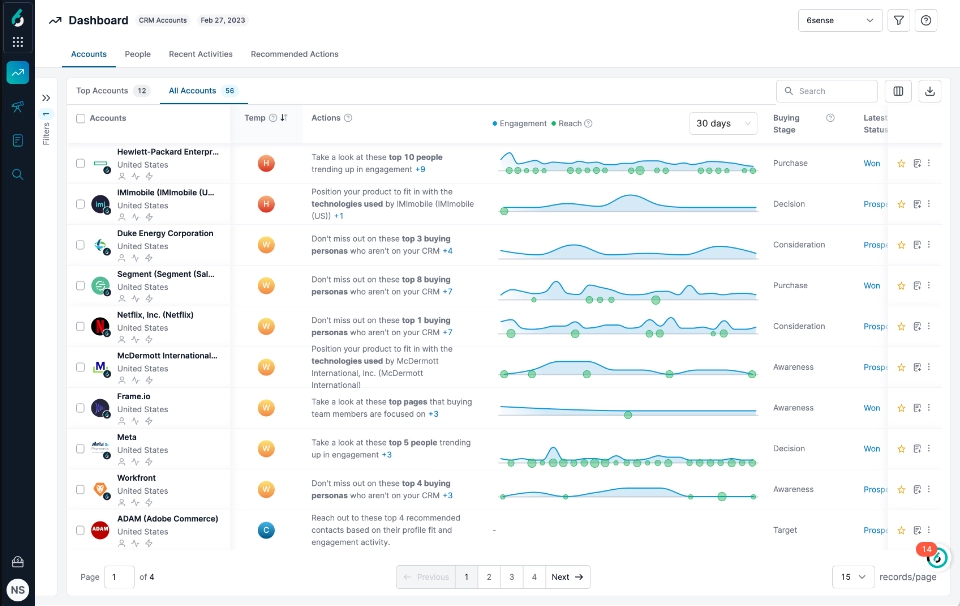
The platform classifies accounts into stages like Target, Awareness, Consideration, and Decision. This helps you tailor your outreach based on how close they are to making a purchase, enabling more relevant and timely engagement strategies.
Profile Fit Score
This score measures how similar an account is to your Ideal Customer Profile. It uses company data, technology usage, and behavioral patterns to determine the likelihood of a successful sale.
- AI Audience Builder: This uses generative AI to let you build very specific audience segments with plain English queries. For instance, you could ask, “Show me all manufacturing companies in the Midwest with over 500 employees researching logistics software,” and the system will dynamically create that segment.
Sales and Marketing Orchestration Features
These features allow your team to act on the insights you have gathered through coordinated, multi-channel approaches.
- Account-Based Advertising: This gives you the ability to run targeted display ad campaigns shown directly to the companies that the platform has identified as being in-market, reducing wasted advertising spend significantly.
- Multi-Channel Engagement: 6sense can trigger actions in other platforms you use. For example, it can add a prospect to an email sequence in Marketo or create a task for a sales rep in Salesforce when an account's buying stage changes, enabling seamless workflow automation.
Sales Enablement and Insights Features
These features are built directly into the sales team's daily workflow to maximize efficiency and effectiveness.
- Sales Intelligence Dashboard: This gives sales reps a clear view of their top accounts, showing recent intent spikes, key people who are engaged, and recommended actions based on the account's current buying stage.
- Generative Account Summaries: This feature uses AI to create short, narrative briefings for sales reps. It provides key information they need before a call or email, including recent activity, key stakeholders, and suggested talking points.
- Buying Team Mapping: This helps identify the key contacts and decision-makers within a target account's buying committee, providing insights into the complete stakeholder landscape for complex B2B sales.
Competitive Landscape: 6sense vs. Demandbase and ZoomInfo
While 6sense is sometimes compared to tools like LinkedIn Sales Navigator, its true competitors operate in the Account-Based Marketing (ABM) and Sales Intelligence platform space. Understanding its positioning requires a professional analysis against key players like Demandbase and ZoomInfo.
| Platform | Core Strength & GTM Focus | Primary Data Methodology | Best For |
|---|---|---|---|
| 6sense | Predictive Analytics & Anomaly Detection. Focuses on using AI to uncover net-new in-market accounts from anonymous intent signals across the web. | Aggregates first-party data with third-party intent from bidstream data and publisher networks, unified by its proprietary identity graph. | Teams prioritizing the discovery of unknown prospects early in their buying journey and orchestrating GTM plays based on AI-driven timing. |
| Demandbase | Unified ABM Platform & Advertising. Offers a comprehensive suite of tools for advertising, personalization, and sales intelligence within a single “ABX” platform. | Similar to 6sense, uses an account-based identity graph and intent data but with a strong historical focus on integrated display advertising capabilities. | Organizations seeking an all-in-one platform to manage and execute tightly integrated, multi-channel ABM campaigns, particularly those with a heavy advertising component. |
| ZoomInfo | Contact & Company Data Foundation. Primarily a B2B data provider that has expanded into intent signals and sales engagement. Its strength is the depth of its contact database. | Primarily relies on its extensive, human-verified contact and company database, which it enriches with intent signals acquired through its ecosystem. | Sales teams that require best-in-class contact data accuracy as their primary need and view intent data as an essential enrichment layer to prioritize outreach. |
Professional Takeaway: The choice is not about which platform is “best,” but which aligns with your GTM strategy. 6sense is built for a predictive-first approach, Demandbase for a campaign-centric ABM approach, and ZoomInfo for a data-first sales prospecting approach.
For organizations comparing these platforms, reviewing our detailed 6sense Top Alternatives and Competitors analysis provides comprehensive evaluation criteria and use case recommendations.
Objective Use Cases and Applications
Based on our testing and official documentation, 6sense is applied to solve specific B2B challenges, helping teams move from a manual, reactive approach to a data-driven, proactive strategy.
- Sales Prospecting Prioritization: This focuses sales development and account executive time on accounts showing active buying signals, instead of making cold calls or pursuing unqualified leads.
- Account-Based Marketing (ABM) Execution: It allows marketing teams to run efficient ad campaigns targeted only at high-value, in-market accounts, significantly reducing wasted advertising spend while improving conversion rates.
- Dynamic Audience Segmentation: Marketing audiences are updated automatically based on real-time intent data, ensuring campaigns stay relevant and targeted as buyer behavior evolves.
- Sales and Marketing Alignment: The platform creates a single, unified view of target accounts and their engagement levels, acting as a single source of truth for both sales and marketing teams and eliminating common friction between departments.
Teams seeking practical implementation guidance should explore our comprehensive 6sense Tutorials and Usecase resource, which covers real-world deployment scenarios and optimization strategies.
Integration Ecosystem and API Capabilities
A platform like 6sense is only as powerful as its ability to connect with your core tech stack. Strong integration is not just an add-on; it's a requirement for the platform to function effectively within your existing revenue operations.
Native CRM and Marketing Automation Integrations
The deepest integrations are with the tools where sales and marketing teams spend most of their time, ensuring seamless data flow and workflow automation.
| Platform | Integration Details | Key Capabilities |
|---|---|---|
| Salesforce | Native, bi-directional sync via an AppExchange package with enhanced Salesforce Data Cloud compatibility. | Embeds 6sense data in Salesforce records; triggers sales tasks automatically; provides Lightning Web Component for embedded insights. |
| HubSpot | API-based integration using custom properties and workflow triggers. | Creates dynamic lists based on buying stage; triggers HubSpot workflows for nurture campaigns. |
| Marketo | REST API and webhook integration with Smart Campaign triggers. | Enriches person records with intent data; triggers Marketo Smart Campaigns based on buying stage changes. |
Our analysis confirms that 2025 updates include deeper support for Salesforce Data Cloud, allowing 6sense signals to be used as a direct enrichment source within Salesforce's customer data platform architecture.
API and Webhook Specifications
For teams needing custom connections, 6sense offers robust API access for enterprise-level integrations.
- RESTful API: This provides programmatic access to account, segment, and intent data with OAuth 2.0 authentication, enabling custom dashboard creation and data analysis workflows.
- Webhook API: This streams real-time events, like an account changing its buying stage, to external systems. This capability is particularly useful for building custom, real-time workflows. For example, you could configure a webhook to send an immediate Slack alert to an account owner the moment a tier-1 account enters the ‘Decision' buying stage, enabling rapid, context-aware follow-up.
Security, Compliance, and Data Governance
For any AI Sales Software that handles customer data and business intelligence, security represents a non-negotiable foundation. Our review of 6sense's documentation and certifications shows a comprehensive approach to enterprise-grade security and data governance.
| Certification | Description |
|---|---|
| SOC 2 Type II | Independently audited for Security, Availability, and Confidentiality principles. |
| ISO/IEC 27001 | Certified for its Information Security Management System (ISMS). |
- Data Governance Framework: 6sense operates as a data processor on behalf of its customers. The relationship is governed by a comprehensive Data Processing Addendum (DPA) that outlines data handling procedures, the roles of sub-processors, and breach notification protocols. For global organizations, it is critical to discuss data residency requirements with their legal and compliance teams to ensure alignment with corporate policy and international data transfer regulations.
- Regulatory Compliance & Professional Verification: The platform is designed to support compliance with major data privacy regulations, including GDPR and CCPA/CPRA, and 6sense provides customers with a Data Processing Addendum (DPA).
Recommendation: While the platform provides the necessary compliance tools, the responsibility for compliant usage lies with your organization. We strongly advise consulting with qualified legal counsel to ensure your specific implementation and data handling processes fully adhere to all applicable regulations in your jurisdiction.
- Data Sourcing and Refresh Cadence: Intent signal data is updated in near real-time (typically within 24 hours). Core firmographic and technographic data is typically refreshed on a continuous, rolling basis—weekly to monthly cycles rather than quarterly—ensuring data accuracy and timeliness for dynamic campaign management and sales outreach.
6sense Pricing Structure Explained
6sense operates on a custom quote model rather than publishing standard pricing tiers, which is typical for enterprise-level AI Sales Software platforms. The investment represents a significant commitment, so ROI calculations should focus on closing high-value deals rather than simple per-user software costs.
Several factors influence the final pricing structure:
- The size of your total addressable market or customer database
- The scope of platform usage, including the number of users and which features are activated
- The specific product modules your business requires
- Custom integration and implementation requirements
Free trials are not offered publicly. The evaluation process begins with scheduling a sales demonstration with their team to discuss your specific needs and potentially arrange a proof-of-concept engagement.
Beyond the Quote: Understanding Total Cost of Ownership (TCO) and ROI
Evaluating 6sense requires looking beyond the subscription fee to its Total Cost of Ownership (TCO). Prospective buyers must factor in:
- Internal Resource Allocation: A successful implementation requires a dedicated project lead, typically from a RevOps or Marketing Ops team, for several weeks. Ongoing management and optimization require continued attention and expertise.
- Data Hygiene Prerequisites: The accuracy of the 6AI™ predictive model is highly dependent on the quality of your historical CRM data. A pre-implementation data cleansing project may be a necessary associated cost.
Conversely, the Return on Investment (ROI) framework should be centered on key pipeline acceleration metrics:
- Increased Sales Velocity: By focusing SDR and AE time on accounts with verified intent, the time from initial contact to closed-won can be significantly reduced.
- Improved Deal Size: Insights from 6sense can uncover cross-sell or up-sell opportunities, leading to larger initial contract values.
- Reduced Wasted Ad Spend: By targeting only accounts demonstrating purchase intent, marketing teams can achieve substantially lower customer acquisition costs (CAC).
A professional consultation or Proof of Concept (POC) should aim to establish baseline metrics for these areas to accurately forecast the potential ROI.
For detailed cost-benefit analysis and ROI calculations, consult our comprehensive 6sense Review which includes real-world implementation case studies and financial modeling examples.
Technical Specifications and Requirements
The technical requirements for using 6sense are straightforward since it operates as a cloud-based service with enterprise-grade infrastructure.
- Platform Type: Cloud-based Software-as-a-Service (SaaS) with global data centers
- Hardware Requirements: None beyond a standard computer capable of running modern web applications
- Browser Requirements: Current versions of major browsers including Chrome, Firefox, and Edge are fully supported
- Network Requirements: A stable, high-speed internet connection is required for optimal dashboard performance and real-time data processing
Getting Started with 6sense
Implementing 6sense follows a structured, managed process rather than self-service setup. Successful implementation typically requires a dedicated project lead from your Sales or Marketing Operations team to coordinate the technical and strategic components.
- Sales Engagement & Scoping: The journey begins with a demo and scoping call with the 6sense sales team to understand your specific requirements and use cases.
- Contracting & Onboarding: After contracting, the 6sense team provisions your account and assigns a dedicated customer success manager for the implementation process.
- Technical Setup & Integration: This critical phase requires administrative access to your systems and involves:
- Authorizing the integration with your CRM and Marketing Automation Platform
- Deploying the 6sense JavaScript tag on your website(s)
- Configuring relevant competitors and intent keywords for initial targeting
- Model Training: This critical step involves 6sense ingesting your historical CRM data to train the initial predictive models for Profile Fit and Buying Stage accuracy.
The ‘Model Training' phase is essential for success. The process can take several weeks, as the 6AI™ engine requires sufficient historical data to build an accurate predictive model. Organizations should prepare clean, comprehensive CRM data covering at least 12-18 months of deal history for optimal results.
Frequently Asked Questions (FAQ)
What is 6sense Signalverse™?
Signalverse™ is 6sense's proprietary data network that collects billions of B2B intent signals from sources like publisher networks and bidstream data. It uses a patented identity graph to match these anonymous signals to specific company accounts, forming the data foundation for its predictive AI capabilities.
How does 6sense identify anonymous website visitors?
6sense uses a multi-layered approach combining its tracking tag deployed on your website with its comprehensive identity graph. It captures visitor signals like IP addresses and browser behavior, then matches this data against its vast company database to resolve anonymous traffic to specific business accounts with high confidence levels.
What is the difference between 6sense and LinkedIn Sales Navigator?
6sense focuses on identifying account-level anonymous intent signals across the entire web to predict when a company is in-market. LinkedIn Sales Navigator is primarily a tool for researching and engaging with individual professionals on the LinkedIn platform based on their stated profiles and activities.
Does 6sense provide contact data?
6sense does not operate its own native B2B contact database. Instead, it provides contact information by integrating with and sourcing data from leading third-party contact data providers. This functionality allows users to find and activate contacts within prioritized accounts directly from the 6sense platform, but the contact data itself is sourced from established data partners.
How does 6sense integrate with Salesforce?
6sense offers a native, bi-directional integration through a managed package on the Salesforce AppExchange. It synchronizes predictive data like Buying Stage and intent keywords to custom fields on Salesforce records and provides an embedded dashboard for reps to view insights directly within the CRM interface.
Is 6sense a CRM?
No, 6sense is not a CRM system. It is a sales and marketing intelligence platform designed to integrate deeply with and enrich existing CRMs like Salesforce or HubSpot. 6sense provides the predictive intelligence layer, while the CRM remains the system of record for customer relationships and deal management.
What is a “Buying Stage” in 6sense?
A “Buying Stage” is a key predictive output from 6sense's AI that classifies an account into a specific phase of the buyer's journey, such as Target, Awareness, Consideration, or Decision. This classification is based on intent signals and behavioral patterns, allowing teams to tailor their engagement strategy according to where the account is in their purchasing process.
How long does it take to implement 6sense?
A typical implementation includes technical setup (CRM integration, tracking tag deployment) and a critical model training period where the AI analyzes historical deal data. While the technical configuration can be completed relatively quickly, the entire onboarding and model training process typically takes several weeks to ensure the predictive models achieve optimal accuracy for your specific market and sales patterns.
For comprehensive answers to implementation questions and common challenges, explore our detailed 6sense FAQs resource compiled from real-world user experiences and expert analysis.
Expert Verdict and Strategic Recommendation
After a thorough technical assessment, 6sense proves to be a powerful, enterprise-grade platform built for a specific purpose: identifying and activating in-market accounts at scale. Its core strength lies in the synergy between the vast Signalverse™ data asset and the predictive power of the 6AI™ engine.
This platform is best suited for: Mature B2B organizations with long sales cycles, a clearly defined Ideal Customer Profile (ICP), and a clean, historical CRM database (preferably Salesforce). Teams committed to an account-based marketing (ABM) strategy and with dedicated Revenue Operations resources will realize the most significant ROI.
This platform may be overkill for: Early-stage startups, businesses with short, transactional sales cycles, or companies that lack the marketing and sales operations resources to manage a sophisticated, multi-channel orchestration strategy. The significant investment requires a clear activation plan and dedicated resources to be justifiable.
For teams evaluating whether 6sense aligns with their current GTM strategy and technical requirements, our comprehensive analysis of Best 10 AI Sales Prospecting & Intelligence platforms provides comparative insights and decision frameworks.
Professional Consultation Recommendation: For AI Sales Software applications with significant professional, financial, or compliance implications, we recommend consulting with qualified RevOps professionals and legal counsel who can assess your specific requirements, data quality, and risk tolerance. This overview provides comprehensive understanding but should not replace professional evaluation of your unique business context.Technology Evolution Notice: The information about 6sense Overview and Features and AI Sales Software tools presented in this article reflects our thorough analysis as of 2025. Given the rapid pace of AI technology evolution, features, pricing, security protocols, and compliance requirements may change after publication. While we strive for accuracy through rigorous testing, we recommend visiting official websites and conducting current vendor consultations for the most up-to-date information.


Leave a Reply