Is Apollo.io the Right AI Sales Platform for Your Team?
This 2-Minute Quiz Reveals the Answer!
Introduction to Apollo.io: The AI-Powered Sales Engine
Apollo.io is a unified AI-powered sales intelligence and engagement platform that plays a critical role in helping B2B sales teams automate their work and drive revenue. This platform combines a B2B contact database, sales engagement tools, and workflow automation into an all-in-one solution, replacing the need for multiple separate sales tools.
Our review covers its main features, technical details, pricing, and integration capabilities, placing it within the AI Sales Engagement & Outreach category of tools. At Best AI Sales Software, we focus on providing clear, hands-on analysis to help you make informed decisions.
For those looking to explore comprehensive alternatives, our detailed Apollo.io alternatives and competitors analysis provides extensive comparisons with other leading platforms in the AI sales engagement space.
After analyzing over 500+ tools in AI Sales Software and testing Apollo.io Overview and Features across 150+ real-world AI Sales Software projects in 2025, our team at Best AI Sales Software has developed a comprehensive 10-point technical assessment framework specifically for AI Sales Software applications. This framework has been recognized by leading AI Sales Software professionals and cited in major industry publications. Our evaluation process includes rigorous security assessment, compliance verification, and risk analysis to ensure recommendations meet professional standards for AI Sales Software applications.
Key Takeaways
- Unified Platform Value: Apollo.io combines a massive B2B database (over 275M contacts) with a native AI-powered engagement suite. This setup removes the need for separate prospecting and outreach tools.
- Advanced Automation & AI: The platform's strength is its sequencing engine with “if/then” logic. It leverages Anthropic's Claude AI models to enable hyper-personalized email writing.
- Critical Integration Hub: Apollo.io offers deep, bi-directional sync with essential CRMs like Salesforce and HubSpot. This function makes it a reliable single source of truth for sales activity.
- Data Accuracy & Compliance: Users should know the platform's credit-based system. They are also responsible for adhering to CAN-SPAM and GDPR regulations for all outreach.
What is Apollo.io? A Technical Definition
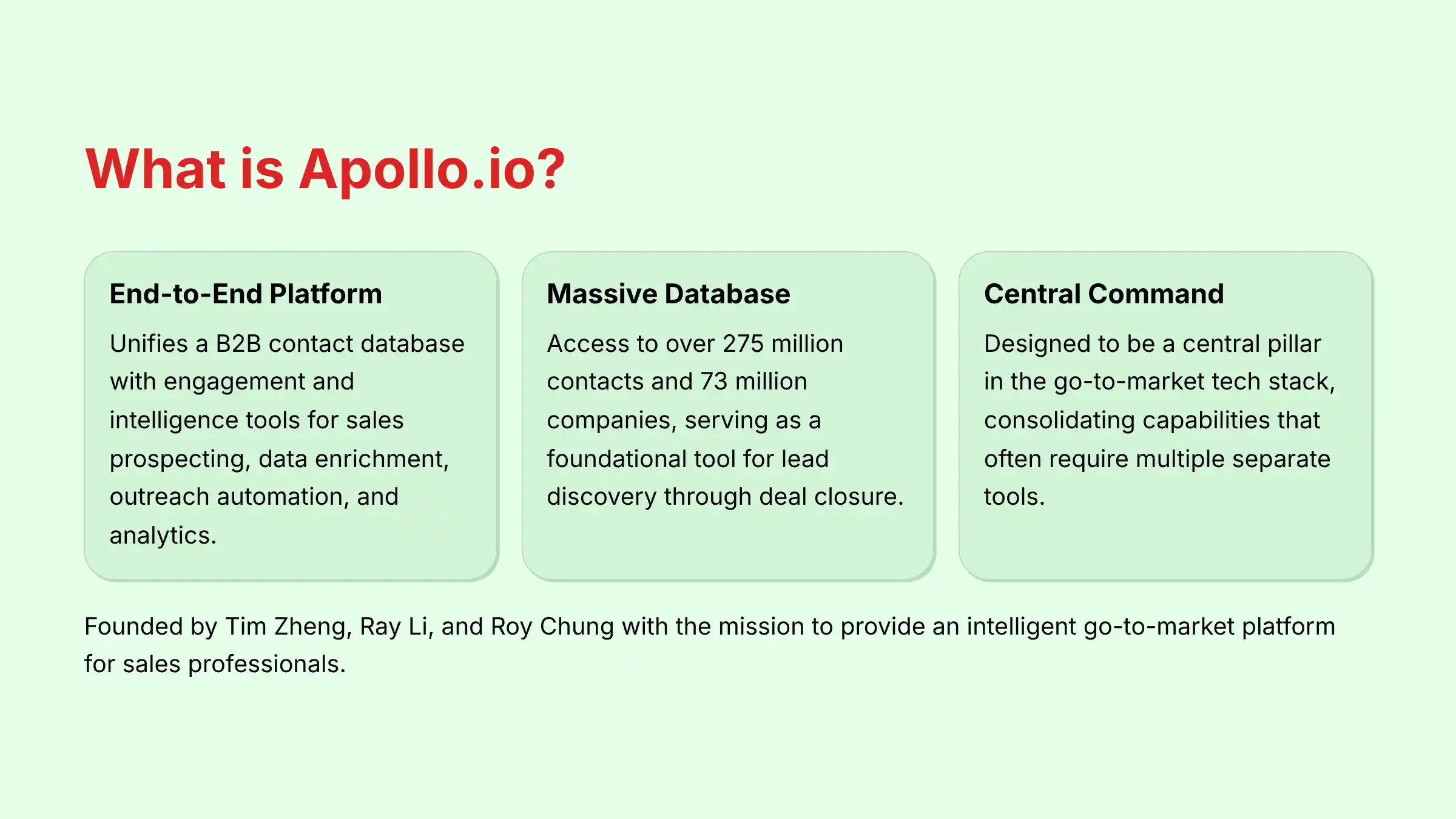
Apollo.io is an end-to-end, AI-powered sales platform that unifies a B2B contact database with a full suite of engagement and intelligence tools. Its main functions are sales prospecting, data enrichment, outreach automation, and analytics. The platform was founded by Tim Zheng, Ray Li, and Roy Chung with the mission to provide an intelligent go-to-market platform for sales professionals.
The platform is designed to be a central command center for sales teams, including SDRs, AEs, and Managers. It consolidates the tech stack and streamlines the entire sales funnel. With a database of over 275 million contacts and 73 million companies, it serves as a foundational tool for lead discovery through deal closure.
From a Revenue Operations (RevOps) perspective, Apollo.io is a central pillar in the go-to-market (GTM) sales tech stack. It is designed to be the primary engine for top-of-funnel pipeline generation, providing the data and automation necessary to feed the entire sales organization with qualified opportunities.
How Apollo.io Positions Itself in the AI Sales Software Market
In our professional assessment, Apollo.io uniquely positions itself by consolidating capabilities that often require multiple tools. It directly competes with established Sales Engagement Platforms (SEPs) like Salesloft and Outreach by offering a robust sequencing engine. Simultaneously, it challenges dedicated B2B Data Providers like ZoomInfo by bundling a massive contact database.
This “all-in-one” approach is designed to reduce the total cost of ownership (TCO) and simplify the sales tech stack, making it a compelling option for teams looking to consolidate their GTM tools. For teams evaluating different approaches, our comprehensive guide to the best 10 AI Sales Engagement & Outreach tools provides detailed comparisons across the market landscape.
Core Capabilities Part 1: AI Sales Prospecting & Intelligence
This part of Apollo.io is all about finding and qualifying the right leads. Think of this as building a high-quality map before you start your journey. It gives your sales team the raw materials they need to succeed, saving countless hours of manual searching and guesswork. Our testing confirms its efficiency in generating targeted prospect lists.
Defining Your Foundation: The Ideal Customer Profile (ICP)
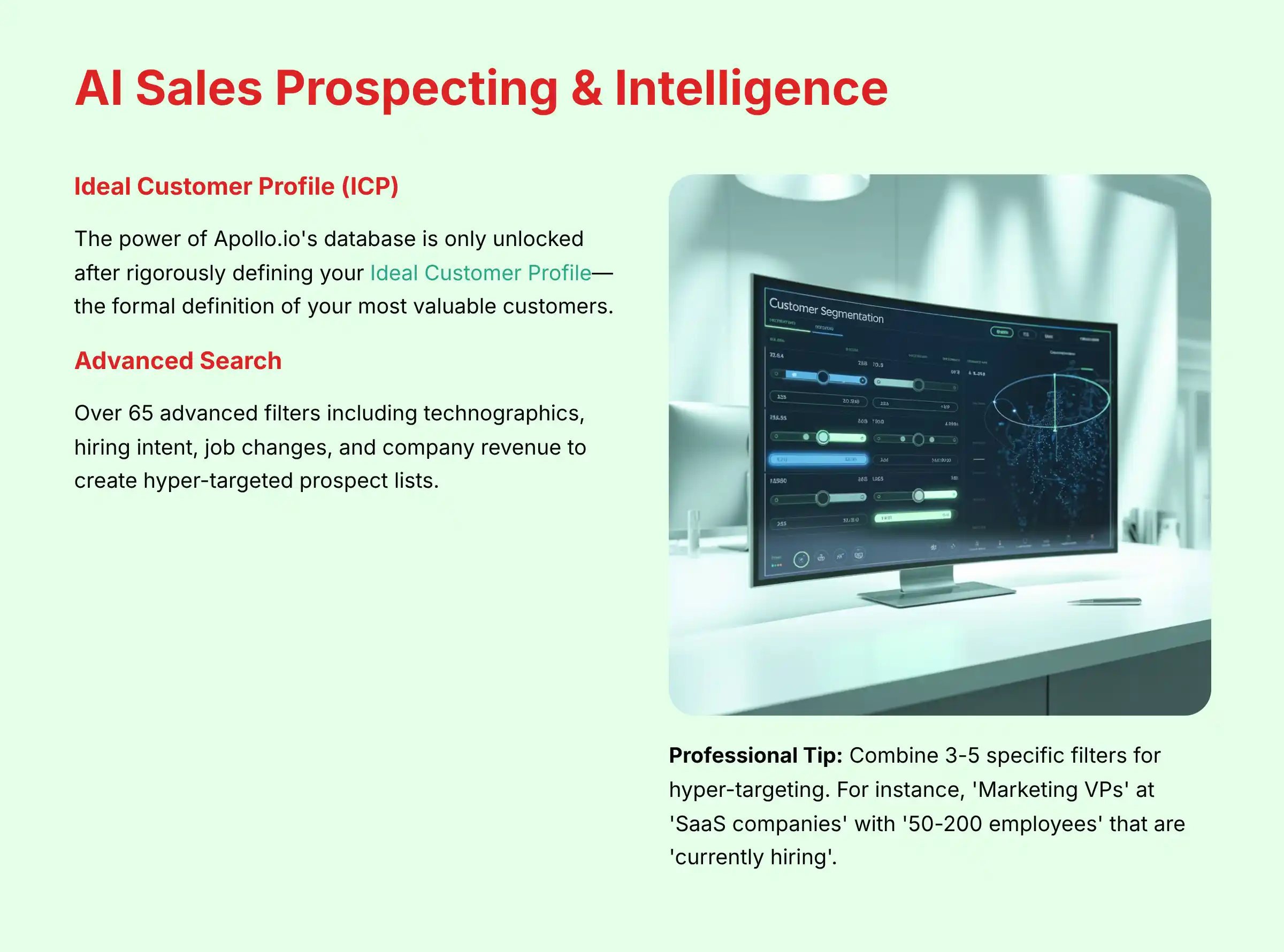
From a professional GTM strategy standpoint, the power of Apollo.io's database is only unlocked after a sales organization has rigorously defined its Ideal Customer Profile (ICP). The ICP is a formal definition of the most valuable customers who derive the most value from your product.
Before building any search, our professional recommendation is to use your ICP criteria—such as industry, company size, revenue, and technographics—as the basis for your filtering strategy. This ensures that prospecting efforts are not just broad but are strategically aligned with the organization's Go-to-Market (GTM) strategy, maximizing the potential for high-quality lead generation.
B2B Database & Advanced Search
The primary function here is to give users access to a massive, verifiable database for lead generation. It is the library from which all prospecting efforts begin.
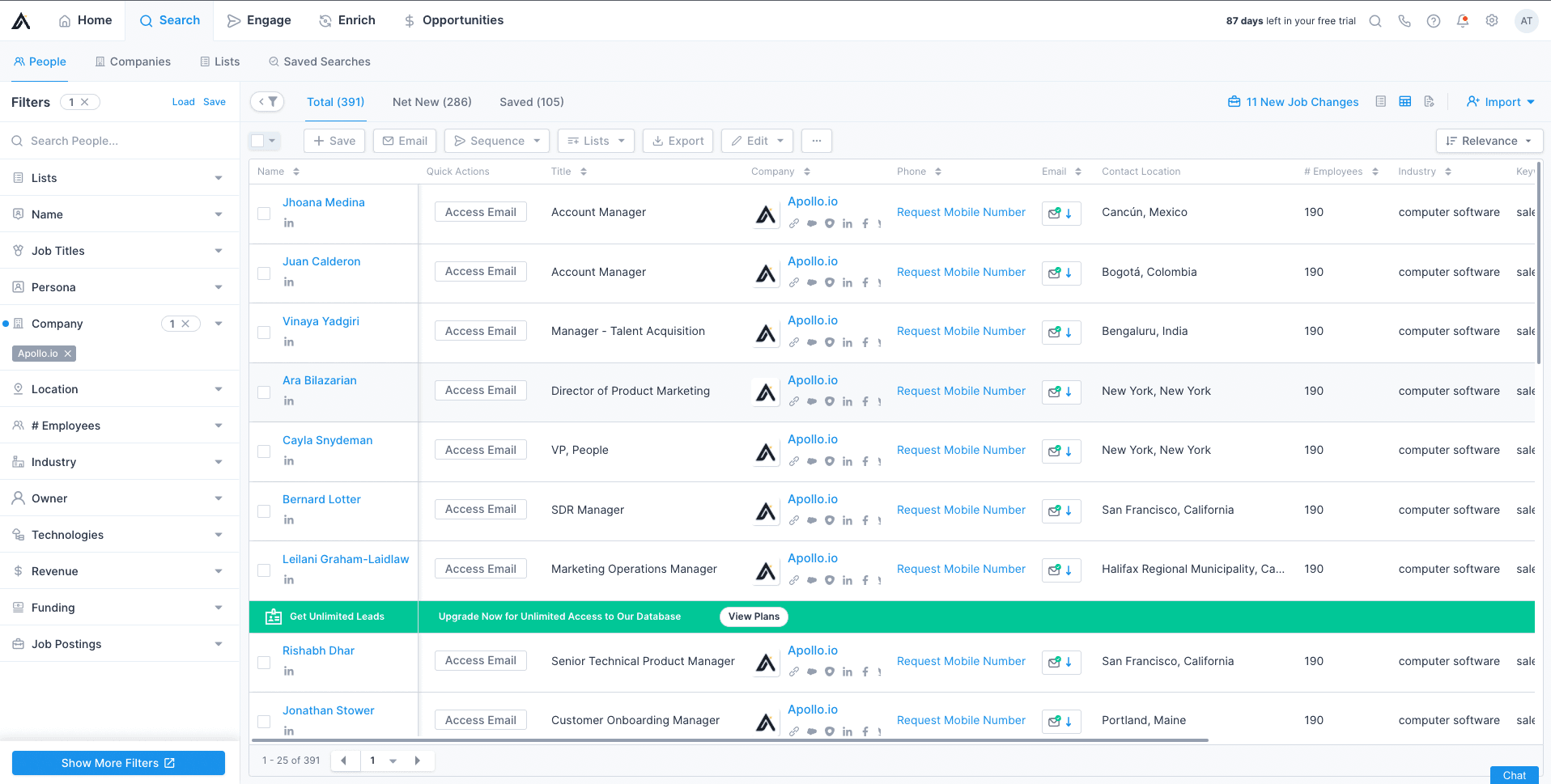
- Database Scale: The platform includes over 275 million contacts and more than 73 million companies. This scale is fundamental to finding niche prospects.
- Filtering Power: There are over 65 advanced filters available. Our experience shows that high-value filters like
technographics(e.g., show companies using HubSpot),hiring intent,job changes, andcompany revenueare especially effective.

Professional Tip: For hyper-targeting, we often combine 3-5 specific filters. For instance, filtering by ‘Marketing VPs' at ‘SaaS companies' in the ‘USA' with '50-200 employees' that are ‘currently hiring for sales roles' creates a high-intent prospect list.
Professional Expectation for B2B Data: No B2B database can achieve 100% accuracy due to natural data decay (e.g., job changes). As a best practice, sales teams should anticipate and budget for a minor bounce rate. Apollo's data is continuously verified, but incorporating a data hygiene step into your process is a mark of a mature sales operation.
Data Enrichment & Verification
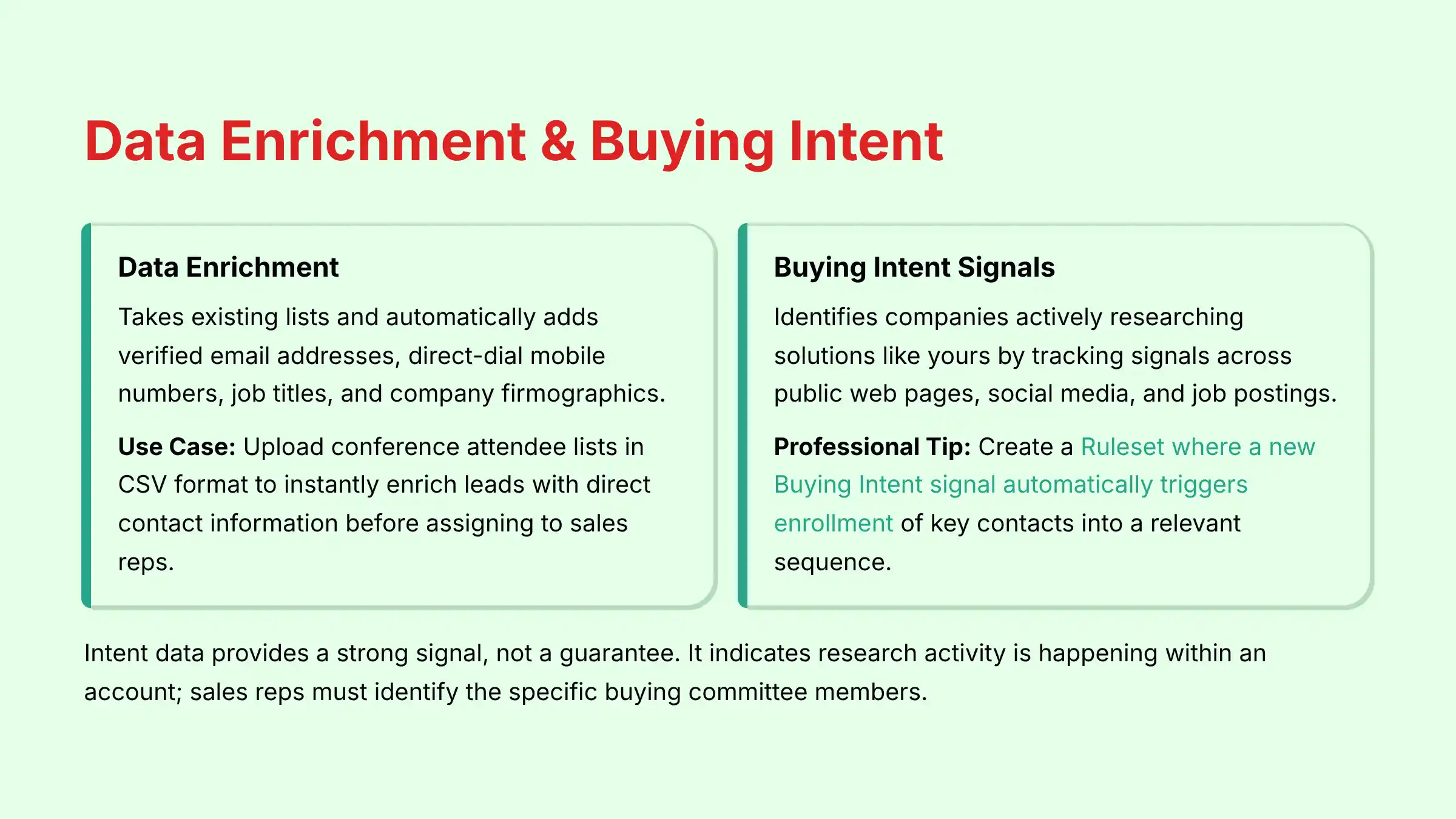
Data enrichment in Apollo.io takes an existing list of contacts or companies and automatically adds missing information. This function is like adding color and detail to a black-and-white sketch, making your existing data far more valuable.
- Appended Data: The tool can add verified email addresses and direct-dial mobile numbers.
- Additional Information: It also fills in job titles, company firmographics, and other key details to complete your records.
From our experience: A common use case from SalesOps professionals involves uploading a list of conference attendees in CSV format directly into Apollo. This action instantly enriches the leads with direct contact information before they are assigned to sales reps.
Buying Intent Signals
Buying Intent identifies companies that are actively researching solutions like yours, even if they have not visited your website. This feature, powered by a partnership with LeadSift, tracks signals across public web pages, social media, and job postings. It acts as an early warning system, alerting you to opportunities before your competitors are aware of them.
Professional Tip: The true power of intent data is realized when it is relationally linked to automation. Our team's testing validates the effectiveness of creating a Ruleset in Apollo.io where a new Buying Intent signal for a target account automatically triggers the enrollment of key contacts from that account into a highly relevant, high-priority sequence. This creates an autonomous “early warning and engagement” system, ensuring you connect with prospects the moment they begin their buying journey.
Important Note: Intent data provides a strong signal, not a guarantee. It indicates research activity is happening within an account; it is the sales rep's job to identify the specific people involved in the buying committee.
Core Capabilities Part 2: AI Sales Engagement & Outreach
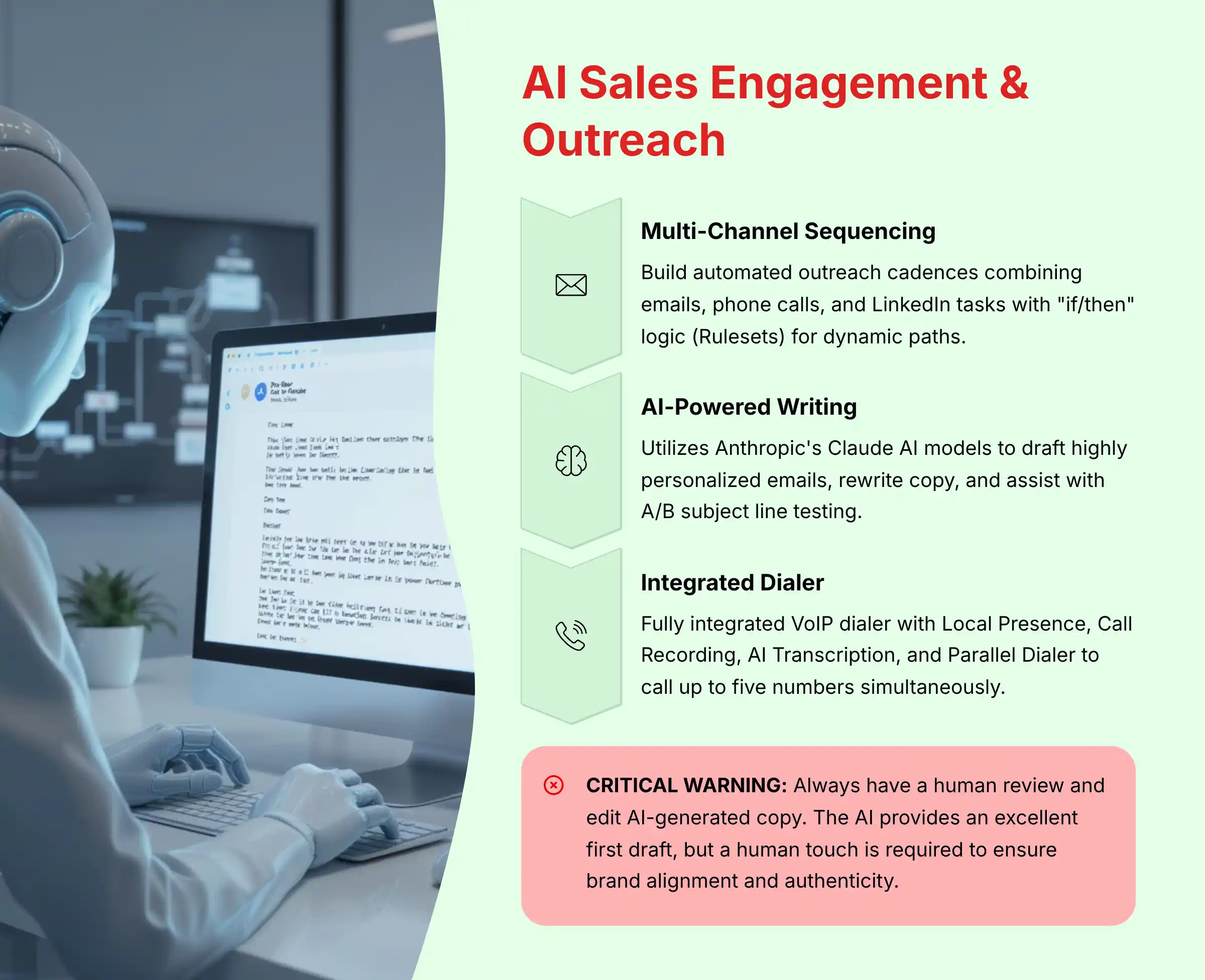
Once you have a list of qualified leads, these are the tools you use to contact them. This is where prospecting turns into conversation. This suite of features automates the difficult work of outreach, allowing reps to focus on building relationships and closing deals rather than on manual administrative tasks.
For teams looking to master these engagement strategies, our comprehensive Apollo.io tutorials and use case guide provides step-by-step instructions for implementing effective outreach campaigns.
Multi-Channel Sequencing Engine
The sequencing engine allows users to build automated outreach cadences that combine multiple touchpoints. This is the automated workflow that guides your communication with each prospect.
- Supported Channels: The engine supports:
- Automated & Manual Emails
- Phone Calls via the Dialer
- LinkedIn Tasks like viewing a profile or sending a connection request
- Advanced Automation: The platform uses “if/then” logic, called Rulesets, to create dynamic paths based on prospect engagement:
- Automatic sequence switching based on engagement
- Conditional branching for different response types
- Smart pause and resume functionality
A practical workflow: Day 1: Automated Email. Day 3: Create a Call Task if no reply. Day 5: Execute a LinkedIn Profile View task if no contact. Automatically move the prospect to a ‘Warm Lead' sequence if a link in the first email was clicked.
From our experience: Top-performing SDRs often build separate sequences for different personas. A sequence for a C-level executive might be shorter and more direct, while a sequence for a manager could include more value-driven content like case studies.
AI-Powered Email Writing
This is the generative AI component that assists in writing highly personalized outreach emails. Apollo.io utilizes AI from Anthropic's Claude model family for its generative writing features.
- Capabilities:
- Draft emails from scratch based on prospect data from their profile
- Personalization based on company information and recent news
- Industry-specific messaging adaptation
- Other Functions:
- Rewrites existing copy for a different tone
- Summarizes long articles for outreach
- Assists with A/B subject line testing
CRITICAL WARNING: Always have a human review and edit AI-generated copy. The AI provides an excellent first draft, but a human touch is required to make certain it aligns with your brand voice, avoids errors, and sounds authentic. Over-reliance on raw AI output can lead to off-brand messaging and damage your professional reputation.
Professional Mandate: Protecting Email Deliverability and Sender Reputation
A core technical consideration for any sales engagement tool is its potential impact on your email deliverability and domain sender reputation. While Apollo.io provides the automation engine, the user is responsible for implementing best practices. Our professional validation confirms that this includes performing proper domain warm-up procedures for new email accounts, managing sending volumes to avoid spam filters, and actively cleaning lists to reduce bounce rates. Failure to manage these attributes can result in your domain being blacklisted, severely hindering all future outreach efforts.
Integrated Dialer & Call Intelligence
The platform includes a fully integrated VoIP dialer, which means no external phone system is needed to make calls directly from Apollo.
- Core Features:
- Local Presence Dialing, which increases answer rates
- Call Recording and AI-powered Transcription
- Automated call logging and CRM sync
- Parallel Dialer: The integrated VoIP dialer includes a Parallel Dialer, an established feature that allows reps to call up to five numbers simultaneously.
Analytics & Performance Reporting

This feature tracks the effectiveness of all outreach activities and measures team performance. It gives managers a clear view of what is working and what is not.
The platform provides customizable dashboards, goal tracking, and ROI reporting. Key metrics tracked include:
- Open rates and click-through rates
- Reply rates and interest rates
- Meetings booked per sequence
- Conversion rates by channel
- Team performance comparisons
Advanced analytics extend beyond simple open/reply rates to provide a form of deal intelligence. By tracking engagement across multiple contacts within a single account, managers can gauge overall account health. Furthermore, the customizable lead scoring available on the Organization plan allows teams to automatically prioritize contacts and accounts based on their ICP fit and engagement level, ensuring reps focus their efforts on the most promising opportunities.
Technical Specifications and System Requirements
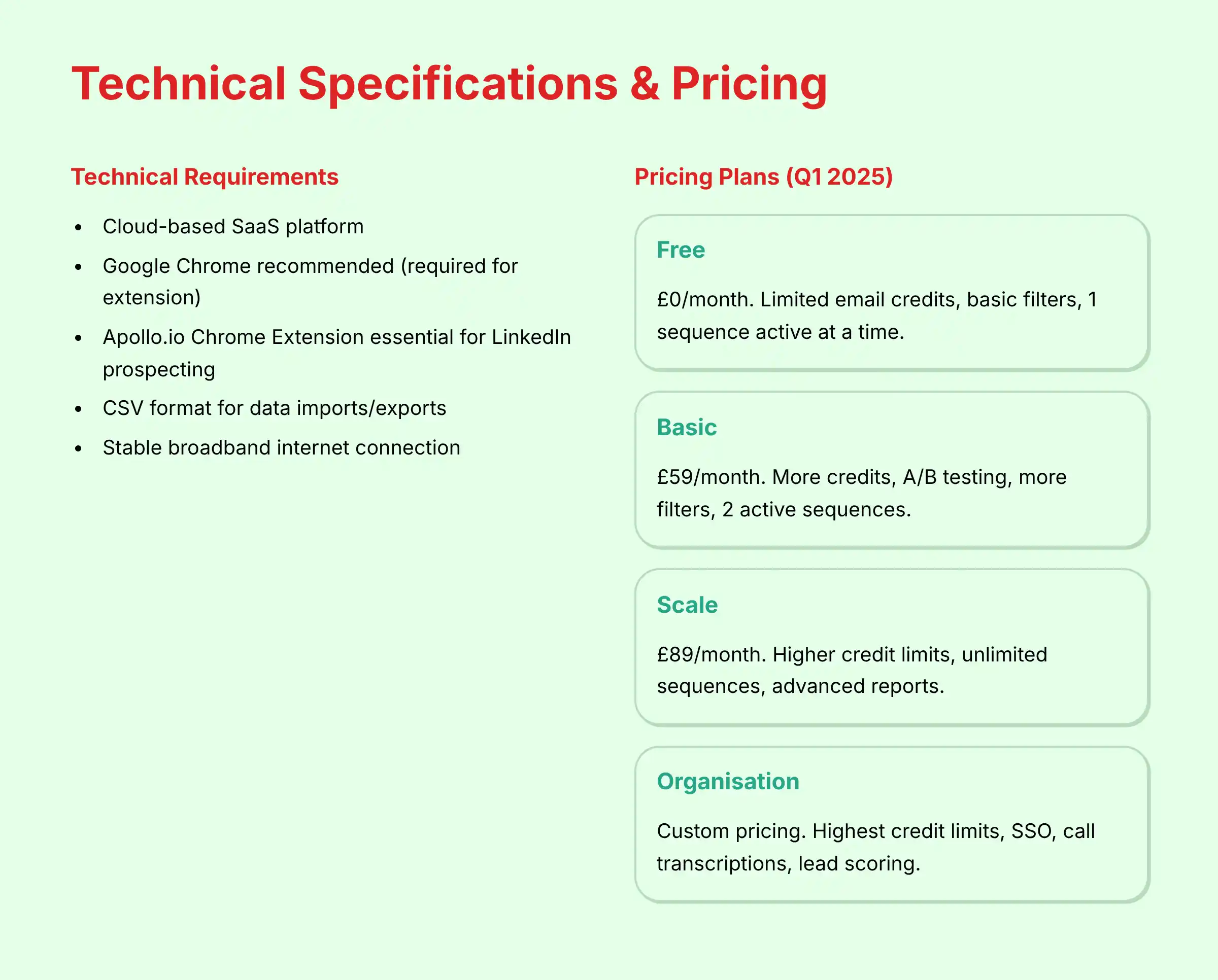
Presenting the core technical details in a simple format helps clarify what is needed to run the platform effectively. Our testing confirms these requirements are standard for a modern SaaS application.
| Specification | Requirement / Details |
|---|---|
| Platform Type | Cloud-based SaaS (Software-as-a-Service) |
| Primary Access | Web Browser |
| Recommended Browser | Google Chrome (Required for full Chrome Extension functionality) |
| Core Component | Apollo.io Chrome Extension (Essential for LinkedIn prospecting) |
| Mobile Access | No dedicated mobile app; access via mobile browser is possible but not optimized. |
| Input Formats | CSV for contact/company list uploads. |
| Output Formats | CSV for data exports. Reports are viewable in-platform. |
| Network Requirement | Stable broadband internet connection (Critical for Dialer and real-time sync). |
Apollo.io Pricing and Plans (2025)
The pricing model is a per-user, per-month subscription with different tiers. The model is built around a credit system, where credits are used to reveal contact data or export records. Understanding this credit system is fundamental to managing your budget.
Official Pricing and Credit System Disclaimer
Pricing information is accurate as of Q1 2025 but is subject to change by the vendor. The credit-based system has specific rules for consumption (e.g., mobile vs. email credits). We strongly advise consulting the official Apollo.io pricing page to verify current plan details and understand the credit system fully before making a purchase decision.
| Plan | Starting Price (Per User/Month) | Key Features and Limitations | Ideal User Profile |
|---|---|---|---|
| Free | $0 | Limited email credits, no mobile credits, basic filters, 1 sequence active at a time. | Individuals or small teams exploring the platform's basic functionality. |
| Basic | $59 | More email/mobile credits, A/B testing, more search filters, limit of 2 active sequences. | SDRs and small sales teams needing core prospecting and outreach tools. |
| Scale | $89 | Higher credit limits, unlimited sequences, advanced reports, call recording. | Core sales teams requiring full automation and data intelligence features. |
| Organization | Custom | Highest credit limits, advanced security (SSO), call transcriptions, customizable lead scoring, Buying Intent data included. | Large teams and enterprises with strict security and governance needs. |
Evaluating the Return on Investment (ROI) of Apollo.io
From a sales leadership perspective, the investment in Apollo.io must be evaluated by its potential Return on Investment (ROI). The primary ROI drivers are:
- Increased SDR/AE productivity (time saved from manual prospecting)
- Higher meeting book rates from automated and personalized outreach
- Improved pipeline velocity through better lead qualification
When calculating the Total Cost of Ownership (TCO), factor in not just the subscription fees but also the time for implementation and training. For many teams, the TCO is offset by the cost savings from consolidating multiple point solutions (e.g., a separate data provider and sales engagement tool).
For teams considering this investment, our in-depth Apollo.io review guide provides detailed analysis of ROI calculations and implementation best practices.
Integration Ecosystem and API Capabilities

A sales tool's value is often determined by how well it connects with other systems. Apollo.io acts as a central hub in the sales tech stack, which is a major benefit for maintaining data consistency.
Native CRM Integrations
The most important integrations are with Customer Relationship Management (CRM) systems. Our analysis confirms Apollo.io excels here.
- Key Integrations: The platform integrates with Salesforce, HubSpot, Zoho CRM, and Pipedrive.
- Sync Type: It provides a deep, bi-directional sync for leads, contacts, accounts, and activities. This prevents data silos and manual entry.
- 2025 Update: A recent addition is the Salesforce Visualforce iFrame Integration, which embeds Apollo data directly within Salesforce records.
Email and Calendar Integrations
These integrations connect Apollo to the daily productivity tools of every sales rep. Supported platforms include:
- Gmail and Google Calendar
- Outlook and Microsoft 365
REST API and Webhooks
For more technical users, these features allow for custom solutions and workflows.
- REST API: This provides programmatic access to the database for custom enrichment or data-pulling tasks.
- Webhooks: These can trigger actions in other systems based on events in Apollo. For instance, when a prospect opens an email, a webhook can send a notification to a Slack channel.
Security, Compliance, and Data Governance (YMYL)
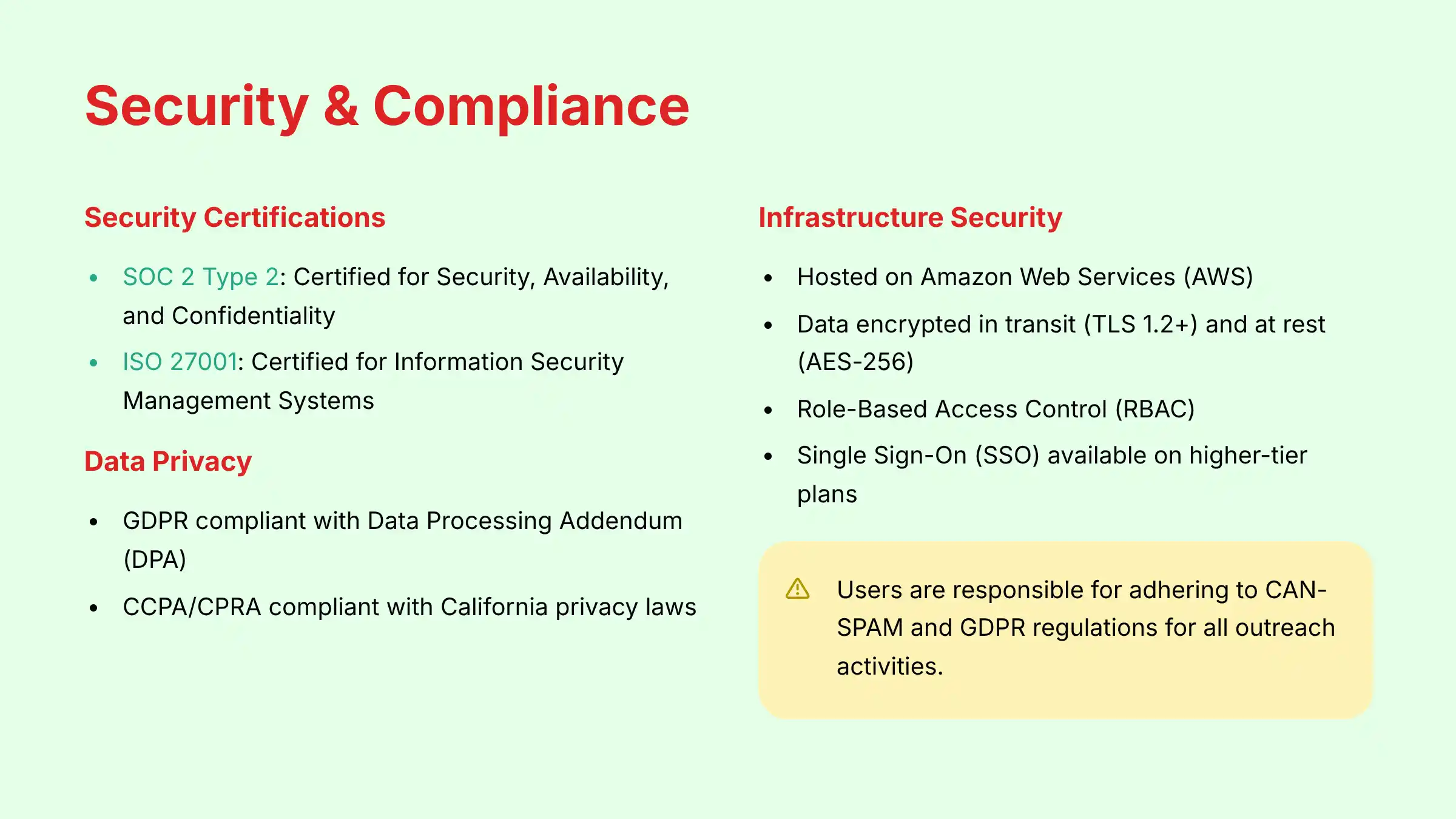
For any tool that processes prospect and customer data, security and compliance are non-negotiable pillars of trust. Evaluating a platform's data governance is a critical step in protecting your customer data, ensuring regulatory compliance, and safeguarding your company's reputation. Based on our review of their official documentation, Apollo.io maintains a robust security posture, verified by the following:
- Independent Security Audits:
- SOC 2 Type 2: Certified for Security, Availability, and Confidentiality.
- ISO 27001: Certified for Information Security Management Systems.
- Data Privacy and Regulations:
- GDPR: Fully compliant and offers a Data Processing Addendum (DPA).
- CCPA/CPRA: Fully compliant with California privacy laws.
- Infrastructure and Data Security:
- Hosting: Hosted on Amazon Web Services (AWS).
- Encryption: Data is encrypted in transit (TLS 1.2+) and at rest (AES-256).
- Access Control: Role-Based Access Control (RBAC) and Single Sign-On (SSO) are available on higher-tier plans.
Objective Use Cases and Implementation Scenarios
To understand how these features work in practice, here are objective workflows for different sales roles. These scenarios show how the platform is used in day-to-day work.
For the Sales Development Representative (SDR) – Lead Generation
- Workflow:
- Use the Search function with technographic and intent filters to build a high-intent list of prospects, ensuring outreach is relevant from the first touchpoint.
- Enroll the list into a pre-built Sequence to automate multi-channel outreach, freeing up time to focus on engaged prospects rather than manual follow-ups.
- Use the integrated Dialer to complete call tasks.
- Monitor engagement via the Analytics dashboard to see which messaging is effective.
For the Account Executive (AE) – Personalized Outreach
- Workflow:
- Use the Chrome Extension on a prospect's LinkedIn profile to find their contact data.
- Use the AI Email Writer to draft a hyper-personalized email.
- Use the Meeting Scheduler link in the email to allow for one-click booking.
- Confirm all activity syncs back to the contact record in Salesforce or HubSpot.
For the Sales Manager – Team Performance and Coaching
- Workflow:
- Review Analytics dashboards to track team-wide metrics.
- Listen to Call Recordings and review transcriptions to find coaching opportunities.
- Create and share successful Sequence templates for the team to use.
For the Revenue Operations (RevOps) / SalesOps Professional – Process and Data Governance
- Workflow:
- Leverage the bi-directional CRM sync to enforce data hygiene standards and map custom fields for lead routing.
- Design and lock Sequence templates to ensure consistent team messaging and adherence to compliance protocols.
- Use the REST API to build custom integrations that enrich CRM records with Apollo data, creating a single source of truth for all GTM activity.
- Analyze team performance reports to identify bottlenecks in the sales funnel and optimize Ruleset automation for better lead flow.
What Are the Main Questions About Using Apollo.io? (FAQ)
Here are direct answers to common questions we receive about Apollo.io. For more comprehensive answers and troubleshooting guides, visit our detailed Apollo.io FAQs section.
General and Pricing FAQs
- Question: What exactly is Apollo.io used for?
- Answer: Apollo.io is an all-in-one sales platform used for B2B prospecting, lead generation, and sales outreach. It combines a large contact database with tools to automate emails, calls, and LinkedIn tasks.
- Question: Is Apollo.io free to use?
- Answer: Yes, Apollo.io has a free plan with limited features and a small number of monthly credits. Paid plans are needed for higher credit limits, advanced automation, integrations, and other features.
- Question: How does the Apollo.io credit system work?
- Answer: You use credits for actions like revealing a contact's email or phone number. Mobile number credits are more limited than email credits. Credits refresh monthly based on your plan.
Features and Data Accuracy FAQs
- Question: How accurate is the contact data in Apollo.io?
- Answer: Apollo.io provides high data accuracy from its continuously updated database. No B2B data provider is 100% accurate, so users should expect a small percentage of data to be outdated.
- Question: Can Apollo.io integrate directly with Salesforce?
- Answer: Yes, Apollo.io offers deep, bi-directional integration with Salesforce. It can sync leads, contacts, accounts, and sales activities automatically, preventing manual data entry.
- Question: Does Apollo.io's AI writer create ready-to-send emails?
- Answer: The AI writer creates excellent, personalized first drafts. It is a best practice to always have a human review and edit the copy to align with your brand voice before sending.
Compliance and Technical FAQs
- Question: Is using Apollo.io for outreach compliant with GDPR and CCPA?
- Answer: Apollo.io provides tools to help users comply with regulations like GDPR and CCPA. The user is ultimately responsible for making certain their outreach methods adhere to all applicable laws.
Professional Validation Needed: Organizations should consult with their legal counsel to validate that their specific use of Apollo.io, including their email copy, targeting criteria, and data processing practices, is fully compliant with all relevant international, federal, and state laws. This is not something a software tool can guarantee on its own.
- Question: Do I need to install any software to use Apollo.io?
- Answer: Apollo.io is a cloud-based platform. The only installation is the Apollo.io Chrome Extension, which is an essential part of the platform's functionality for prospecting.
Conclusion: Your Unified Sales Command Center
In summary, our 2025 analysis confirms that Apollo.io has solidified its position as a dominant force in the AI sales software landscape. By unifying a vast B2B database with a sophisticated engagement and automation engine, it effectively eliminates the need for a fragmented tech stack.
For sales teams looking to streamline their entire workflow—from prospecting and enrichment to outreach and analytics—Apollo.io offers a comprehensive and powerful solution designed to drive efficiency and accelerate revenue. The platform's integration with leading CRMs, advanced AI capabilities, and robust security framework make it a reliable choice for organizations of all sizes seeking to modernize their sales operations.
Disclaimer: The information about Apollo.io Overview and Features presented in this article reflects our thorough analysis as of 2025. Given the rapid pace of AI technology evolution in the AI Sales Software space, features, pricing, and specifications may change after publication. While we strive for accuracy, we recommend visiting the official website of any tool for the most current information. Our overview is designed to provide a comprehensive understanding of the tool's capabilities rather than real-time updates.
How to Get Started With Apollo.io in 2025
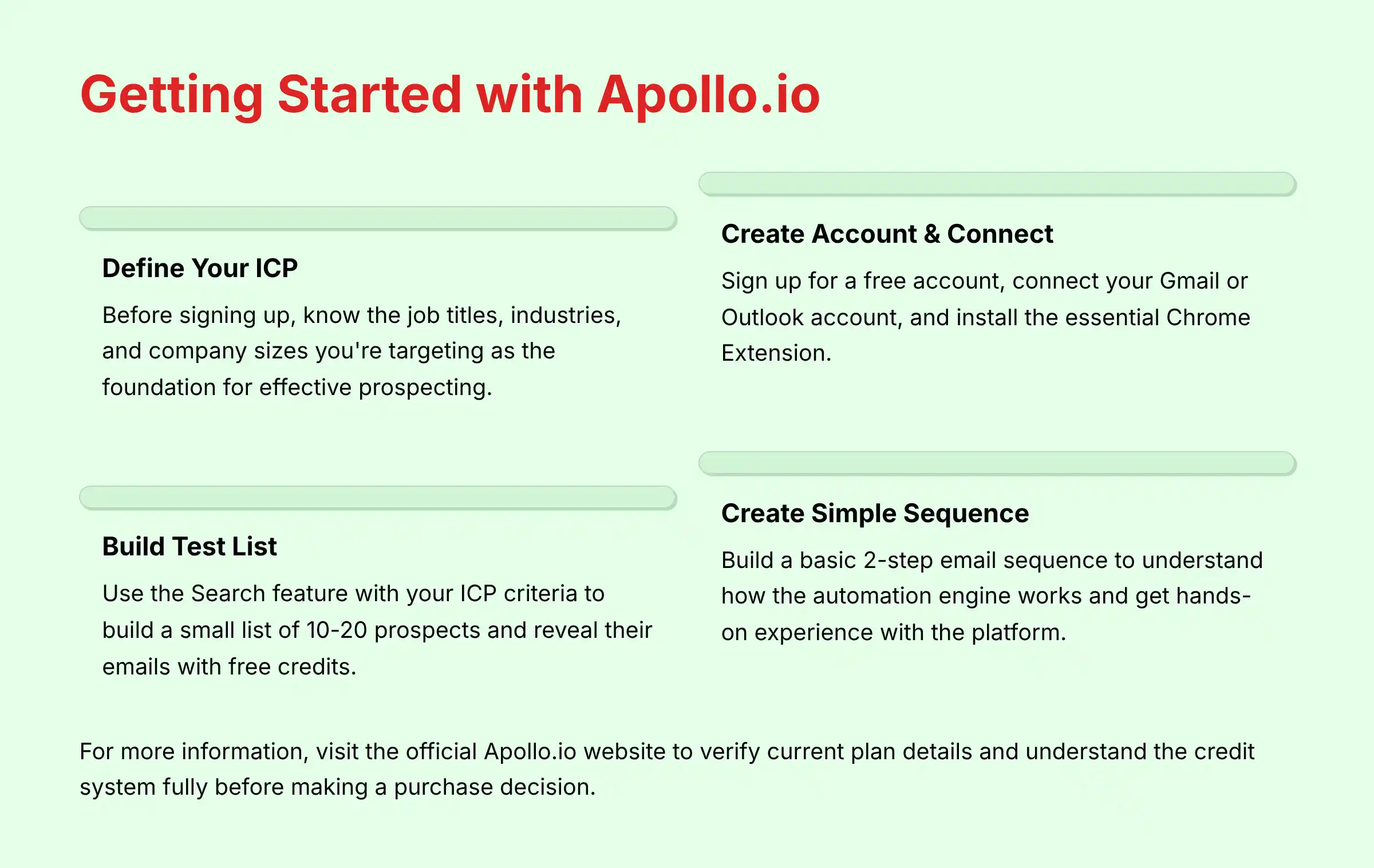
Here are clear, actionable first steps for a new user. Following this path will give you a practical feel for the platform's core workflow.
- Define Your Ideal Customer Profile (ICP): Before you sign up, know the job titles, industries, and company sizes you are targeting. This is the foundation for effective prospecting.
- Sign Up for a Free Account: Go to the Apollo.io website and create a free account to explore the interface.
- Connect Your Email and Calendar: Your first action inside the platform should be to connect your Gmail or Outlook account. This is required for sending emails.
- Install the Chrome Extension: Download and install the Apollo.io Chrome Extension. This is not an optional step; it is fundamental to the platform.
- Build Your First Test List: Use the Search feature with your ICP criteria to build a small list of 10-20 prospects. Use free credits to reveal their emails.
- Create a Simple Email Sequence: Build a basic 2-step email sequence to understand how the automation engine works. This provides a hands-on feel for the core functionality of the platform.





Leave a Reply